Key Takeaways
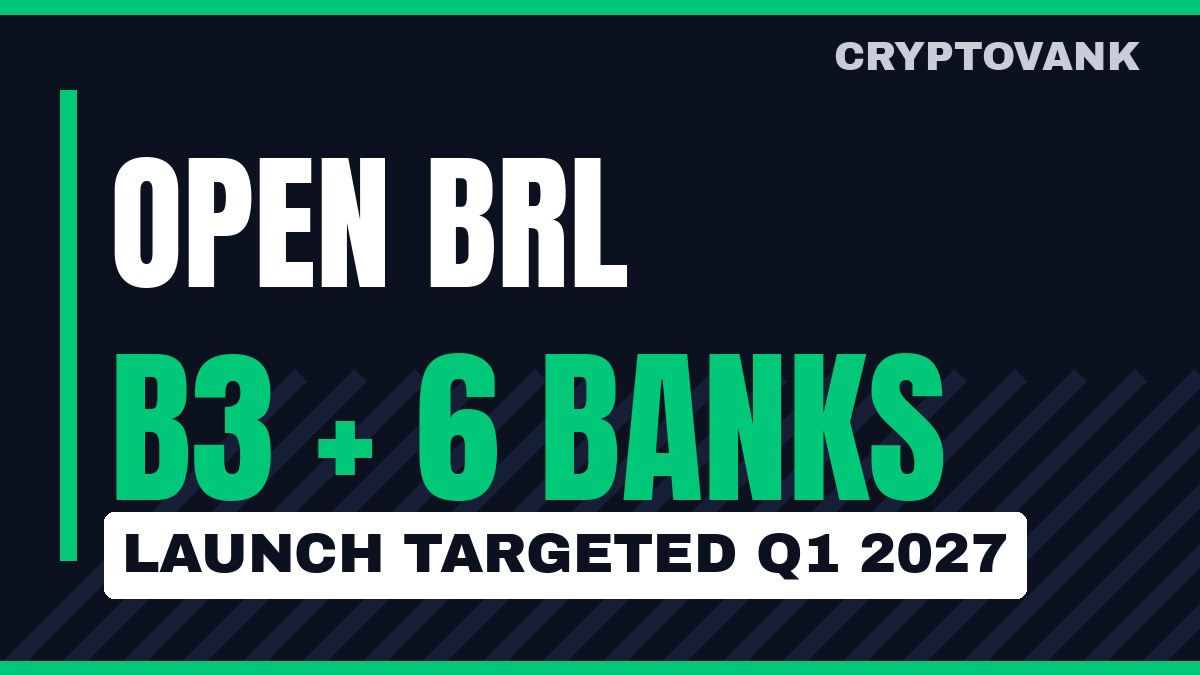
- B3 and six banks (Bradesco, BTG Pactual, Itau Unibanco, Safra, Santander, XP) plan to launch Open BRL, a real-pegged stablecoin, in the first quarter of 2027 (CoinDesk, citing Valor Economico).
- Banco B3 will issue the token one-to-one against reais; other institutions can join from day one, and B3 plans to use it to settle tokenized stock trades.
- Real-pegged stablecoins are tiny: about $71 million in verified onchain supply across five tracked coins (DIA), versus USDT driving nearly 90% of Brazil’s stablecoin volume.
Brazil’s biggest banks are building a shared stablecoin instead of competing with one another. B3, the country’s stock exchange operator, has teamed up with six major financial firms on Open BRL, a real-pegged token for payments and digital-asset settlement, CoinDesk reported on Nov. 27, citing local outlet Valor Econômico.
The plan matters beyond Brazil. It is a template for how incumbent banks may handle stablecoins: a neutral, jointly governed token rather than one bank’s coin that rivals refuse to accept.
What is Open BRL?
Open BRL is a stablecoin backed one-to-one by Brazilian reais. Users deposit 1 real and receive one token on a blockchain, and Banco B3 will issue it and hold the reserves so holders can redeem in reais at any time, per CoinDesk.
The partners expect to go live in the first quarter of next year, according to B3 vice president of products Luiz Masagão. The group did not disclose how much it is investing.
| Item | Detail |
|---|---|
| Issuer | Banco B3, backed 1:1 by reais |
| Partners | Bradesco, BTG Pactual, Itaú Unibanco, Safra, Santander, XP |
| Target launch | Q1 2027 |
| Platform operator | B3 at launch; steering committee sets rules; possible spin-off later |
| Use case | Payments, interbank transfers, tokenized stock settlement |
| Access | Open to other institutions from day one |
Why are banks building a shared stablecoin?
CoinDesk says talks began about three months ago, after B3 and the banks concluded that standalone stablecoins could meet pushback from rival firms. Banks will still keep their own tokens for internal use, while Open BRL lets them move funds among themselves through B3.
The same logic drives bank-led projects elsewhere. We covered Hong Kong’s version in our report on HKMA Project Ensemble and a bank-and-fintech pilot in our note on the Uber tokenized deposits trial.
How big is Brazil’s stablecoin market?
Large in volume, small in local currency. Brazilians declared 404.8 billion reais in stablecoin trades in 2025, about 80% of all reported crypto activity, according to tax authority Receita Federal, and Tether’s USDT drove nearly 90% of that, per CoinDesk.
Real-pegged supply is far smaller. Consultancy Fintrender put it above $140 million across more than 10 retail and institutional tokens in May, while DIA shows about $71 million of verified onchain supply across five tracked coins, led by Avenia’s BRLA and Transfero’s BRZ. The BRL1 token from Mercado Bitcoin, Bitso and Foxbit has a $3.4 million market cap on DeFiLlama.
What do regulators say?
Masagão said the group is building within existing rules and has briefed Brazil’s central bank, and that the securities regulator, the CVM, backs the effort because it ties into tokenization. The central bank’s crypto rules, in force since February, require platforms to hold a license and treat stablecoin trades as foreign exchange operations.
Regulators have not set separate licensing rules for local stablecoin issuers, a gap that could shape how Open BRL launches.
Our take: does a bank stablecoin help consumers?
Not at first. Open BRL targets institutions and settlement, so Brazilian consumers are unlikely to see it before a wallet or card integrates it. The consumer product that does exist is the stablecoin card, as we compared in our OKX vs Deel cashback guide.
The real test is adoption. A neutral bank token only works if the six founders actually route flows through it, and if retail platforms accept it. Dollar stablecoins already hold network effects that a first-quarter launch will not erase.
What to Watch Next
- Q1 2027: Target go-live for Open BRL.
- Before launch: Whether Brazil’s central bank issues issuer-specific stablecoin licensing rules.
- Disclosure: The size of the banks’ investment, not yet stated.
- Adoption: Whether B3’s tokenized stock platform settles trades in Open BRL.
Based on CoinDesk’s report of Nov. 27, 2026, which cites Valor Econômico. For information only; not investment advice.