
Quick answer: On Nov. 2, 2026, SEC staff added three answers to the SEC decentralization FAQ. They say token holders in a broad, rules-based governance system generally are not a ‘central party’ unless they coordinate outside that system. The guidance is non-binding.
The SEC decentralization FAQ got its biggest update yet on Monday, Nov. 2, 2026. Staff now say that token holders voting in a broad, rules-based governance system generally do not form a “central party” that controls a network.
That matters for DAOs, because a network with no central party is easier to fit into the “digital commodity” bucket. Still, the answers are staff views only and have no legal force.
What the SEC decentralization FAQ now says
The Division of Corporation Finance first published the FAQ on Sept. 25, 2026. It explains the Commission’s March 17, 2026, interpretive release on how securities law applies to crypto assets. The updated page on SEC.gov adds three new answers, numbered 1.4 to 1.6.
Question 1.4: are voters a “group”? The interpretive release defines a central party as a person, entity or group with operational, economic or voting control. Staff say governance participants generally are not such a group if they are unaffiliated. They also must have no agreement, formal or informal, to act together outside the governance system. Even if they were a group, they would still need real control to count.
Question 1.5: what is “overseeing participation”? A central party oversees a network when it has unilateral power to:
- grant or limit access to the system;
- set or change how upgrades, protocol changes or token distributions are voted on;
- decide who can validate transactions; or
- modify the code, reverse transactions or revoke access.
On the other hand, there is no oversight when the system runs on rules-based code. The same holds when discretion is used only through broad governance.
Question 1.6: is functional the same as decentralized? No. Staff say these are separate ideas. A network is functional when its token works as designed. It is decentralized when no person or group has control. So a working network is not automatically a decentralized one.
The fine print DAOs should read
The FAQ also defines a “broad-based governance system.” It must be transparent, so proposals, votes and results are public. It must be rules-based, so no single stakeholder can change the process. Finally, it must be wide and diverse, with power not concentrated in one stakeholder or a coordinated group.
Two details stand out. First, the words “including through delegation” appear twice. In other words, a delegate bloc that votes on behalf of many holders could weaken the case. Second, a footnote warns that a foundation can itself be a central party if it sets operating rules for apps on a network.
Staff also limit the view to Section III of the release. It has no bearing on other legal terms, including the definition of an “exchange,” as The Crypto Times noted.
Why it matters for DeFi
For years, token voting was seen as a legal risk. Critics argued that large holders voting together looked like a board running a company. This answer pushes the other way, but only for open systems with no side deals.
As a result, the real test moves to who holds the keys. Many DeFi protocols still use admin multisigs, emergency pause powers or upgrade councils. Under Question 1.5, a small team that can change code or freeze users on its own looks like central oversight. Our DeFi risks guide explains why these powers exist and what they mean for users.
The update also fits a wider pattern. In August, the SEC proposed Regulation Crypto Assets, which we covered in our report on Ripple’s letter backing the rule. The FAQ cites that release for the view that maintaining a functional network is not an “essential managerial effort.” Meanwhile, an older answer, revised Sept. 28, says buybacks on a functional network with no central party are not such efforts either. That point matters for tokens like PYTH, whose DAO sends all product revenue to buybacks.
Data and market context
Prices did not react to the guidance. At 20:50 UTC on Nov. 2, 2026, bitcoin traded at $76,872, down 1.2% in 24 hours, per CoinGecko. Ether stood at $2,248.23.
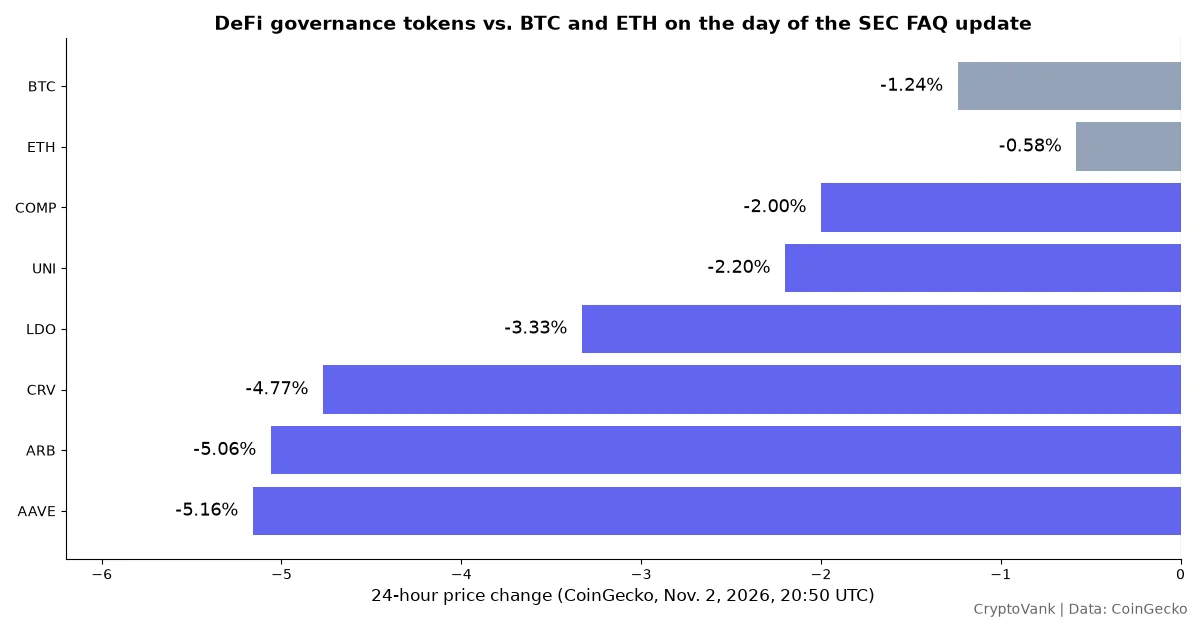
Governance tokens fell harder than the majors. AAVE dropped 5.2% to $127.13, ARB fell 5.1% and UNI slipped 2.2% to $7.01. Since the wider market was weak all day, these moves say little about the FAQ itself. Guidance like this tends to shape legal advice and token design over months, not prices in hours.
What to watch next
- DAO changes: Watch for proposals that shrink admin keys, cap delegate power or retire foundation control to meet the new test.
- More FAQs: Staff have now updated this page twice in six weeks. Further answers on staking or wrapped tokens are possible.
- Formal rules: The FAQ is not law. A final Regulation Crypto Assets rule, or a Commission vote, would carry far more weight.
- Court use: Lawyers may cite these answers in disputes, but courts are not bound by staff views.
FAQ about the SEC decentralization FAQ
Is the SEC decentralization FAQ legally binding?
No. The page says the answers reflect staff views only. They are not a rule or a Commission statement, and they create no new legal duties.
Does DAO voting make a token a security under this guidance?
Not by itself. Staff say broad, unaffiliated token-holder voting generally does not form a central party. However, side agreements, coordinated delegation or unilateral admin powers could change that answer.
When was the SEC crypto FAQ updated?
The Division of Corporation Finance first issued the FAQ on Sept. 25, 2026. It revised one answer on Sept. 28 and added Questions 1.4, 1.5 and 1.6 on Nov. 2, 2026.
Sources
- SEC: Frequently Asked Questions on Crypto Assets (updated Nov. 2, 2026)
- SEC: Crypto@SEC statements list
- The Crypto Times: SEC staff updates crypto guidance on governance and decentralization
- Phemex News: SEC clarifies broad governance participants are generally not centralized entities
- CoinGecko price data
This article is for information only and is not financial or legal advice. Do your own research before making any investment decision.