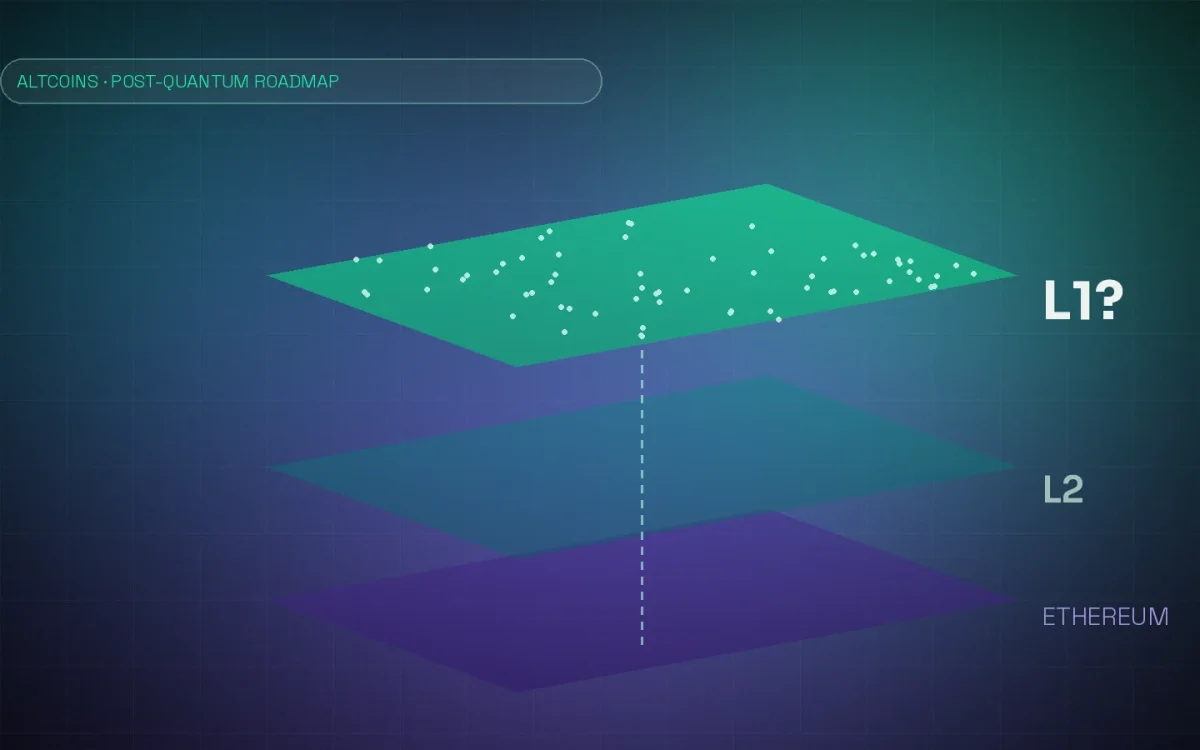
Starknet says it is “actively considering” leaving its role as an Ethereum layer-2 network and becoming a standalone layer-1 blockchain. Its stated goal is to become “the first fully quantum-resistant network” by 2027. The idea has sent the STRK token sharply higher, but there is no formal proposal, governance vote or migration plan yet.
What happened
Early on Thursday, Oct. 8, StarkWare CEO Eli Ben-Sasson asked his followers on X whether “Starknet becoming an L1 for post-quantum agility” was a good or a bad idea. Minutes later, the official Starknet account said the move was under active consideration, with full quantum resistance targeted for 2027, Bankless reported.
Ben-Sasson borrowed the phrase “bunker mode” from Ethereum researcher Justin Drake, who a day earlier had warned that AI-driven advances in mathematics could weaken the cryptography protecting Bitcoin and Ethereum wallets sooner than expected. His argument is simple. As a layer 2, Starknet depends on Ethereum’s security and has to wait for Ethereum’s own upgrade, which targets quantum resistance by the end of 2029. As a layer 1, it could set its own timeline.
STRK price reaction
At 13:40 UTC on Oct. 9, CoinGecko showed STRK at $0.0716, up 23% in 24 hours and 69% over seven days, with a market value of about $531 million. Trading volume over 24 hours was about $447 million, close to the token’s entire market cap. That points to a lot of short-term, momentum-driven trading.
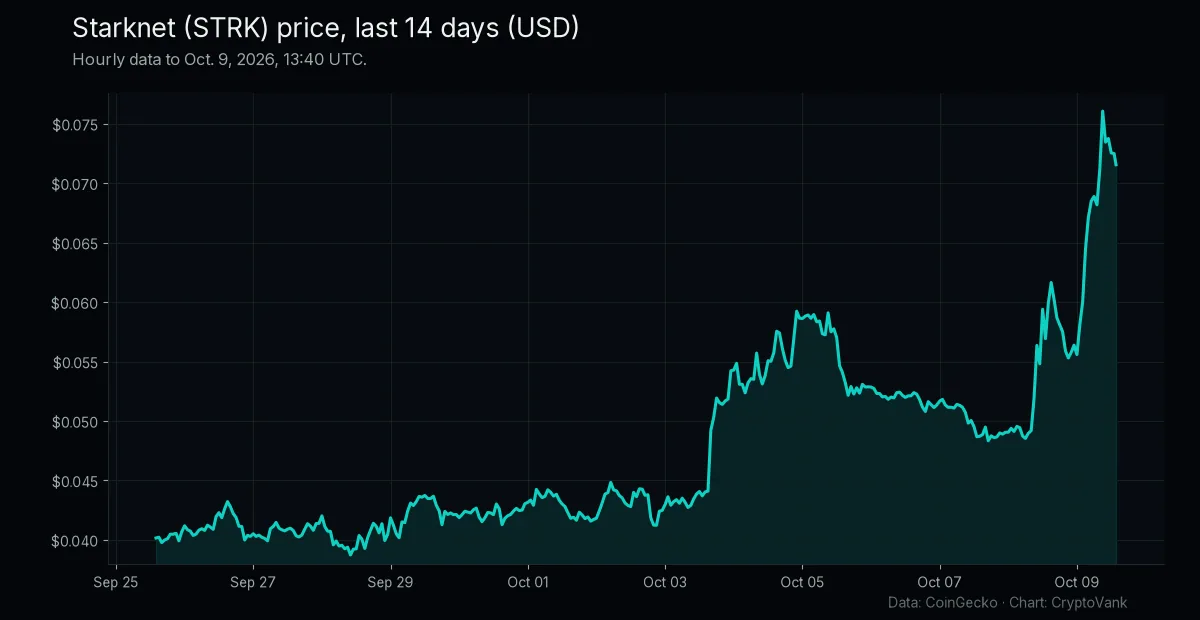
The chart shows the rally did not start with the L1 news. STRK had already climbed from around $0.043 to nearly $0.060 between Oct. 3 and Oct. 5, then gave back part of that before Thursday’s jump. The token remains more than 98% below its record high of $4.41 from February 2024.
There is also a supply event coming up. Starknet’s official token documentation shows up to 127 million STRK unlocking for investors and early contributors on the 15th of each month through March 2027, including Oct. 15. Unlocks don’t automatically mean selling, but at current prices that is roughly $9 million of new supply each month, arriving into a thin, fast market.
Why Starknet thinks it is ahead on quantum safety
Most blockchains face a hard migration because wallets rely on elliptic-curve signatures. A large enough quantum computer, or a mathematical breakthrough, could in theory break those signatures. Starknet’s pitch rests on two design choices:
- STARK proofs rely on hash functions, not elliptic curves. The proof system that secures the network’s state was never vulnerable to known quantum attacks in the way signatures are, according to StarkWare.
- Every account is a smart contract (native account abstraction). Wallets can switch to a post-quantum signature scheme one at a time, keeping the same address and funds, without a network-wide hard fork.
StarkWare’s published roadmap has three phases. The first replaces the remaining elliptic-curve-based hashing in areas like state commitments and address derivation. The second brings existing contracts onto quantum-safe storage. The third is the catch: the bridge to Ethereum and the data-availability layer still depend on Ethereum’s elliptic-curve cryptography, so Starknet would move “in step with Ethereum” on those. Becoming an L1 is essentially a way to remove that last dependency.
The trade-offs
This is not a free upgrade. A layer 2 gets its final security from Ethereum. A standalone layer 1 has to provide its own: its own validators or sequencer setup, its own economic security, and its own data availability. That would also change what STRK is for, since the token would likely play a bigger role in securing the network. None of these details have been published.
The move would also land at an awkward time for Ethereum’s rollup-centric roadmap. Blast announced its shutdown on Oct. 2, and Pudgy Penguins’ Abstract followed on Oct. 6, citing costs higher than revenue. A large, established L2 seriously considering leaving, even for a security reason, adds to the debate about whether rollups are getting enough out of their link to Ethereum.
To be fair to the other side, the quantum threat is still a scenario rather than a demonstrated attack. Ethereum’s researchers are working on the same problem, and Vitalik Buterin warned this week that rushing migrations can cause losses of its own.
What to watch next
- A formal governance proposal. Until there is a written plan with a timeline and token changes, this is an intention, not a roadmap.
- The Oct. 15 unlock and how STRK trades around it.
- Bridge and data-availability design. How assets bridged from Ethereum would be handled is the most important practical question for users.
- Ethereum’s response. Any acceleration of Ethereum’s own post-quantum timeline would weaken the case for leaving.
FAQ
Is Starknet leaving Ethereum?
Not yet. Starknet says it is actively considering becoming a layer 1, but no proposal, vote or launch plan has been announced. It remains an Ethereum layer 2 today.
Why is STRK going up?
The token rallied after Starknet said on Oct. 8 that it is weighing a move to a quantum-resistant layer 1. It had also risen earlier in October, and trading volume is very high relative to its market cap.
Do Starknet users need to do anything?
No action has been announced. Be wary of any message asking you to “migrate” or “upgrade” your wallet, which is a common phishing trick. Only follow announcements from Starknet’s official channels.
Sources
- Bankless via Yahoo: >Starknet weighs becoming an L1 to chase quantum resistance
- CoinDesk: >Bitcoin steadies near $82,500 (STRK section)
- Starknet: >Starknet’s upgrade to quantum resistance
- StarkWare: >Starknet’s post-quantum roadmap
- Starknet docs: >STRK token and unlock schedule
- CoinDesk: >Pudgy Penguins’ Abstract becomes second Ethereum layer 2 to shut in a week
- Price data: >CoinGecko
This article is for information only and is not financial advice. Small-cap tokens are highly volatile; do your own research.