Quick answer: In its first Bank of Korea crypto survey, the central bank has asked 18 banks and 13 brokerages, starting Oct. 23, 2026, how a hack at South Korea’s top crypto exchange, a long price slump or a rival’s crypto losses would hit them, The Herald Business and Yonhap reported on Nov. 2.
The Bank of Korea crypto survey is the central bank’s first look at how deep the country’s banks and brokers have gone into digital assets. Since Oct. 23, 2026, it has asked 31 firms what would happen to them if the top local exchange went down after a hack.
The Herald Business and Yonhap first reported the review on Monday, Nov. 2, citing financial industry sources. Moreover, the timing is hard to miss. Only days after the survey went out, Binance suffered a $6.3 billion hack that US authorities have tied to North Korea.
What is in the Bank of Korea crypto survey?
In total, the questionnaire went to 18 banks and 13 brokerages. According to The Herald Business, the bank list includes the five big lenders: KB Kookmin, Shinhan, Hana, Woori and NH NongHyup. Likewise, Korean crypto outlet TokenPost reported the same list.
Specifically, each firm must describe four things:
- its crypto teams and budget
- how far it has entered the market, and its plans
- how it rates the risks of crypto work
- what risk controls it already runs
The survey also asks how much each firm has put into crypto companies at home and abroad, Cointelegraph reported.
Three stress scenarios for the Bank of Korea crypto review
The most telling part is a set of “what if” questions. First, firms must say how they would be hurt if the country’s largest crypto exchange by market share stopped trading for a while after a big hack. TokenPost stressed that this is a test case, not a real incident.
Second, the survey asks about a sharp drop in prices for assets such as bitcoin, followed by a long trading slump. Finally, it asks what would happen if another financial firm took heavy losses in a crypto incident.
Put simply, the central bank wants to know how a shock could spread. A hack at one exchange or one lender should not turn into a problem for the whole banking system.
Why does the Bank of Korea care now?
Above all, Korean lenders are moving closer to crypto, while the rules are still not finished. “Financial institutions are making their own preparations even as virtual asset legislation is moving more slowly than the market expected,” a BOK official told The Herald Business. The aim, the official added, is to “take stock of the current situation and get an early read on what lies ahead.”
Meanwhile, a second official said banks and brokers already report to the Financial Supervisory Service. However, the official said that coverage of their crypto work “is still lacking.” Yonhap also said the answers will serve as internal reference data.
In addition, the bank has flagged this link before. Its June Financial Stability Report found that crypto and stock markets have moved more closely together since US spot bitcoin ETFs launched in 2024, The Herald Business noted.
Market data and context
The survey started before the Binance breach. Even so, the hack shows exactly the kind of shock the questions describe. You can read how investigators tied the attack to North Korea and how much money left Binance once withdrawals reopened.
At the same time, prices were also under strain. CoinGecko data shows bitcoin fell 10.7%, from about $86,490 on Oct. 5 to about $77,223 on Oct. 31. That was part of bitcoin’s worst October since 2014.
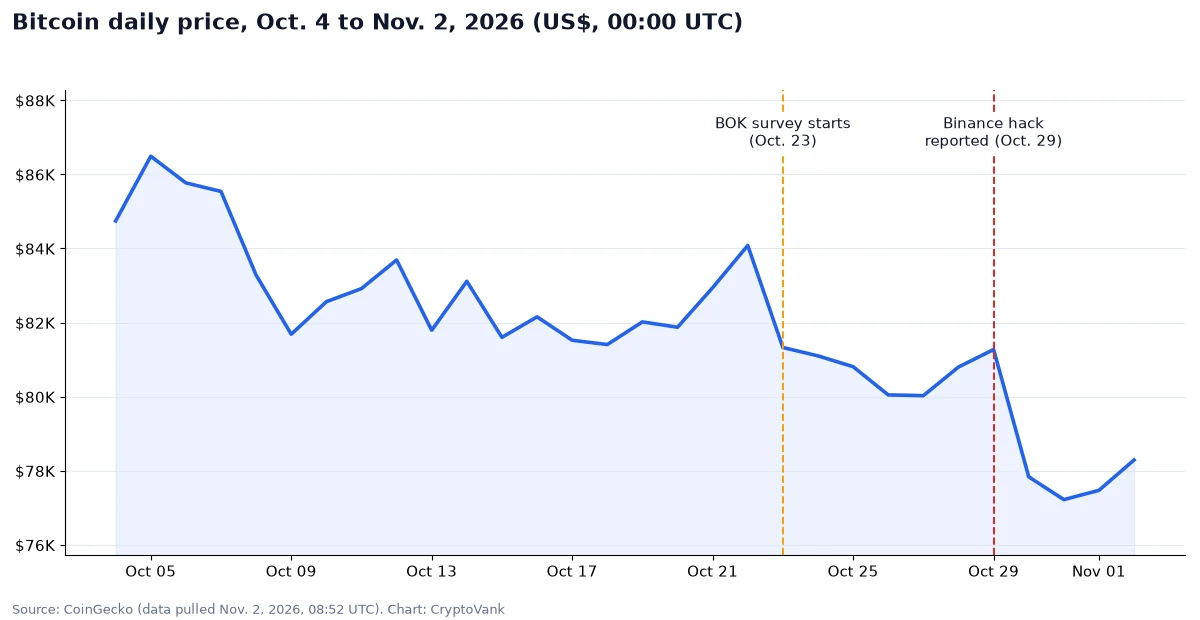
At 08:52 UTC on Nov. 2, bitcoin traded at $78,275, up 0.1% in 24 hours, per CoinGecko. In other words, that equals about ₩105.0 million. Ether stood at $2,300, up 1.2%.
What it means for crypto users and banks
In our view, this is a fact-finding exercise, not a crackdown. No new rule comes out of it directly. Still, central banks tend to ask these questions before they push for capital, liquidity or disclosure rules.
For banks, therefore, the hack scenario is the key one. For instance, a long outage at a big local exchange could freeze customer cash and stall payments linked to it. As a result, it could hit any lender that has bet on crypto services.
Of course, other regions face the same question. For example, Europe answered it with one rulebook, as our MiCA regulation explainer shows. You can follow more rule changes in our regulation coverage.
What to watch next
- Whether the Bank of Korea publishes any findings, perhaps in its next Financial Stability Report.
- Progress on South Korea’s pending crypto legislation, which the BOK official said is moving slowly.
- New bank crypto launches, and whether lenders slow them after the Binance hack.
Bank of Korea crypto survey FAQ
When did the Bank of Korea start its crypto survey?
It began on Oct. 23, 2026, according to The Herald Business and Yonhap. It is the first time the central bank has run this kind of survey of banks and brokerages.
Which firms does the survey cover?
It covers 18 banks and 13 brokerages, 31 firms in total. The banks include KB Kookmin, Shinhan, Hana, Woori and NH NongHyup, per The Herald Business and TokenPost.
Does the survey mean new crypto rules in South Korea?
Not directly. Instead, the Bank of Korea says it wants internal reference data on how firms are entering the market. Even so, the answers could shape future rules on bank crypto activity.
Sources
- The Herald Business: Bank of Korea conducts first-ever review of financial firms’ virtual asset risks
- Yonhap: BOK surveys banks and brokerages on crypto business (Korean)
- TokenPost: BOK surveys 18 banks and 13 brokerages on crypto risk (Korean)
- Cointelegraph: Bank of Korea probes financial firms’ exposure to crypto risks
- CoinGecko: Bitcoin price data
This article is for information only and is not financial advice.