
Quick answer: Crypto PAC spending reached about $170 million before the Nov. 3, 2026 U.S. midterms, CoinDesk reported on Nov. 1. Fairshake and its affiliates spent $154 million and kept $56 million in reserve. The largest sums went to Republican Senate candidates or against Democrats, led by almost $56 million against Sherrod Brown in Ohio.
Crypto PAC spending has reached about $170 million ahead of the Nov. 3, 2026 U.S. midterm elections, and most of the biggest checks went to Republicans or against Democrats. That puts the industry on the opposite side of the polls and betting markets, which favor Democrats.
What happened in the final weeks
CoinDesk tallied the totals on Nov. 1. Fairshake and its affiliates have devoted $154 million to favored candidates this cycle, a spokesman told the outlet. The group also kept a $56 million reserve for the next cycle.
In addition, two smaller super PACs add to the total. The Digital Freedom Fund, backed mainly by Tyler and Cameron Winklevoss, committed more than $8 million in October. Its goal was to keep Democratic challengers out of Senate seats in Ohio, Texas and Iowa. The Fellowship Fund, funded by Cantor Fitzgerald and tied to Tether, gave $3.8 million to Republicans. Later, it added $600,000 for three Democratic incumbents.
Similarly, Reuters reached a close figure a week earlier. On Oct. 27, it counted roughly $176 million across more than 100 races. Through Oct. 20, Fairshake and its affiliates had spent about $150.8 million, and other crypto groups about $25 million.
Where the crypto PAC spending went
By far, the single largest target is Ohio. Fairshake has spent almost $56 million to stop former Senator Sherrod Brown from winning back a Senate seat. That is more than a third of its total. The Winklevoss fund added $7.2 million to the same race.
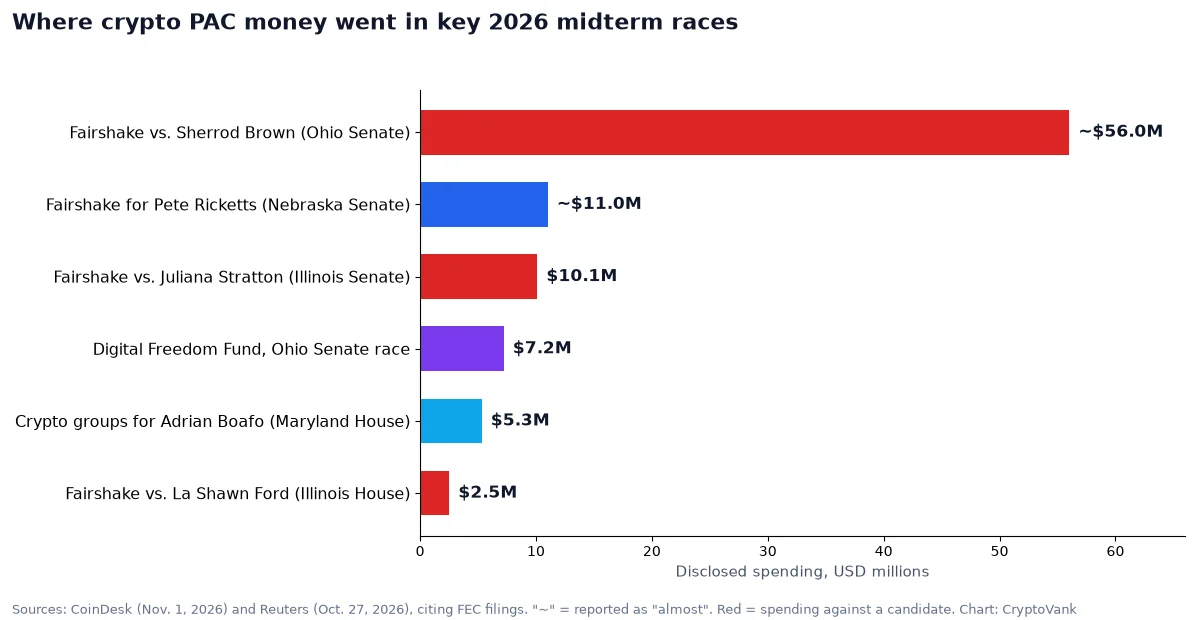
In Nebraska, Fairshake committed almost $11 million to back Republican Senator Pete Ricketts. In Illinois, it spent over $10.1 million attacking Lieutenant Governor Juliana Stratton, who is running for the Senate. However, Reuters reports that she is still expected to win.
Fairshake’s spokesman, Geoff Vetter, said the group backs “pro-crypto candidates who support American innovation in both parties.” Indeed, it has funded House candidates from both parties. In Senate races, though, it chose to back only Republicans after Senate Democrats blocked the Clarity Act, Reuters reported.
Why crypto PAC spending matters for policy
Our view is simple: the money buys access, not votes on bills. Even a clean Republican sweep would not get a market structure law through the Senate alone. Any major crypto bill still needs 60 votes, so it needs Democrats.
That is the risk in this strategy. Bettors on Kalshi give Democrats a 70% chance of winning both chambers, CoinDesk noted. If that happens, the party the industry spent against will set the agenda. We covered the prediction market itself in our report on Kalshi’s $40 billion valuation.
Moreover, the stakes are concrete. The Clarity Act would move most crypto oversight to the CFTC. It stalled this session. Without it, JPMorgan analysts told Reuters, rules made by agencies under President Trump could be reversed by a later administration. For a recent example of that agency-led approach, see our story on the CFTC’s offshore exchange registration plan.
Data and context
The 2026 figure is below the 2024 cycle, when Fairshake spent $196 million, according to Reuters. Still, the industry leads every other sector in campaign spending by a wide margin, CoinDesk said, citing OpenSecrets data. Public Citizen called crypto the single biggest corporate spender in 2026 federal races.
Meanwhile, the ads rarely mention crypto. Instead, they run under affiliate names such as “Defend American Jobs” and “Protect Progress” and focus on taxes or immigration. So most voters see the money without seeing the cause behind it.
For now, markets are calm going into the vote. At 20:59 UTC on Nov. 1, Bitcoin traded at $77,853 and Ether at $2,261.66, both up about 0.5% in 24 hours, per CoinGecko.
What to watch next
- Ohio on Nov. 3. Brown led narrowly in polls, per Reuters. The industry has spent more than $68 million on that race, per AdImpact data cited by Reuters, so a Brown win would be the clearest test of the strategy.
- Control of each chamber. Split control would likely slow any new crypto bill, including a revived Clarity Act or crypto tax rules.
- The reserve. Fairshake’s $56 million cushion means 2028 spending starts early, as it did after 2024.
- Stablecoin and Tether scrutiny. Democratic oversight could revive probes like the one in our report on the Senate questions to Tether.
Crypto PAC spending FAQ
How much did crypto PACs spend on the 2026 midterms?
About $170 million from the three largest crypto super PACs, CoinDesk reported on Nov. 1, 2026. Fairshake and its affiliates account for $154 million of that. Reuters counted roughly $176 million across all crypto groups through Oct. 20.
Who funds Fairshake?
Fairshake is largely backed by Coinbase, Andreessen Horowitz (a16z) and Ripple Labs, according to CoinDesk and Reuters. It spent $196 million in the 2024 cycle and holds about $56 million for future races.
Why does the election matter for crypto investors?
Congress controls the Clarity Act, which would give the CFTC most crypto oversight. That bill stalled in 2026, and major crypto laws need 60 Senate votes. A Democratic majority could slow or reshape it, while rules made by agencies alone can be reversed later.
Sources
- CoinDesk: Crypto PACs spent $170 million, with most going to Republicans
- Reuters via Investing.com: Crypto blitzes midterms with $176 million
- FEC: Fairshake pre-general report, Oct. 1 to Oct. 14, 2026
- CoinGecko: Bitcoin price
This article is for information only and is not financial advice.