
Quick answer: In USDT vs USDC, USDC is the safer stablecoin on reserves and regulation: S&P Global rates it 2 (strong) against 5 (weak) for USDT, and the EU’s EBA named it the first significant MiCA stablecoin on Oct. 14, 2026. USDT is larger and more liquid, at $183.9 billion vs $72.6 billion, per CoinGecko.
USDT vs USDC is the first choice most people face when they move money onto crypto rails. Both tokens aim to be worth exactly $1, both are backed by reserves held by a company, and both run on dozens of blockchains. Yet they are not equally safe, and the gap has grown in 2026.
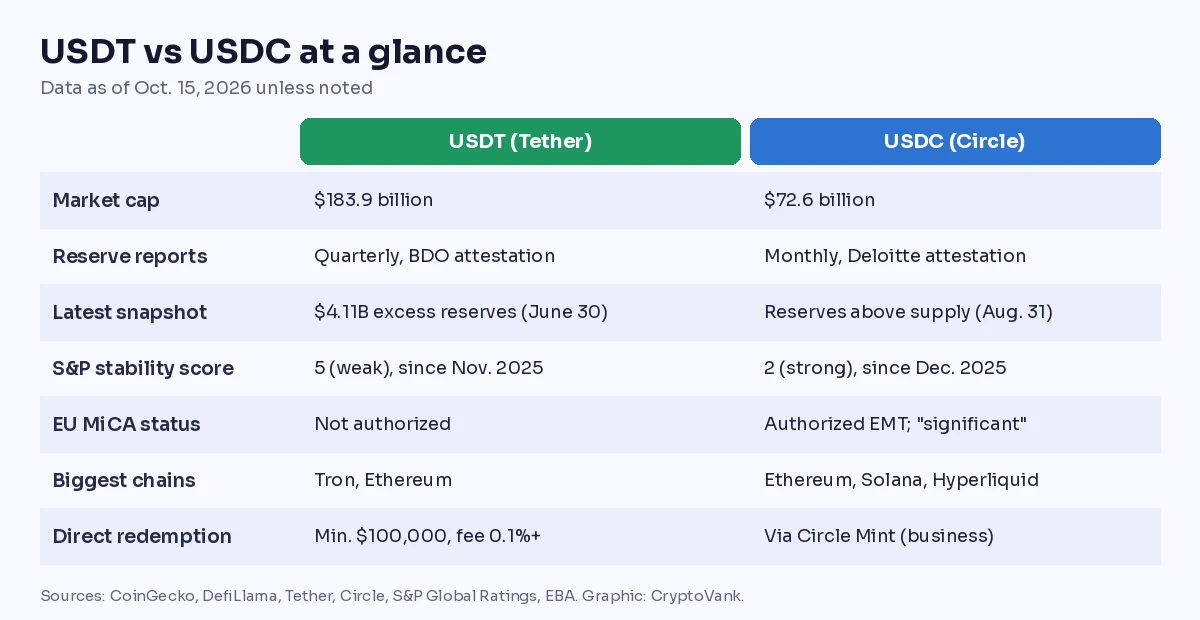
Tether’s USDT is still the giant. It had a market value of about $183.9 billion on Oct. 15, 2026, against roughly $72.6 billion for Circle’s USDC, according to CoinGecko. Together they make up about 84% of a stablecoin market worth around $306 billion, per DefiLlama. This guide compares them on the points that decide safety: reserves, reporting, ratings, regulation, peg history and redemption. If you are new to the topic, start with our stablecoins hub and the basics in Stablecoins Explained.
What is the difference between USDT and USDC?
Both are fiat-backed dollar stablecoins. You hand the issuer a dollar, it mints one token and holds assets worth at least that dollar. The difference lies in who the issuer is and what it holds.
- USDT is issued by Tether International, S.A. de C.V. It is the most traded token in crypto and dominates on the Tron network, where about $93 billion of USDT sits, with another $73 billion on Ethereum, per DefiLlama.
- USDC is issued by Circle Internet Financial, LLC in the US and Circle Internet Financial Europe SAS in the EU. Its largest home is Ethereum (about $44.7 billion), followed by Hyperliquid and Solana (about $7 billion each), per DefiLlama.
What backs USDT and USDC?
Tether’s reserves
Tether’s latest report covers June 30, 2026. It showed $187.75 billion in assets against $183.64 billion in liabilities, a buffer of $4.11 billion, according to the BDO-attested Q2 report. Cash and cash equivalents made up about $140.64 billion, including $114.96 billion in US Treasury bills.
The rest is where critics focus. Tether also held about 146.2 tons of gold worth $18.84 billion and 98,933 bitcoin worth $5.80 billion at the report date, CoinDesk reported. Falling gold and bitcoin prices helped cut the buffer roughly in half from $8.23 billion three months earlier. Those assets can earn Tether a profit, but they can also lose value fast in a crash.
Circle’s reserves
Circle says USDC is backed 100% by cash and cash-equivalent assets. Most of the reserve sits in the Circle Reserve Fund (USDXX), an SEC-registered government money market fund managed by BlackRock and held at BNY, according to Circle’s transparency page. The fund holds short-dated Treasuries, overnight Treasury repos and cash, and BlackRock publishes its holdings daily on its fund page.
In Deloitte’s August 2026 examination, reserves were $73.399 billion against $73.321 billion of USDC in circulation on Aug. 31, 2026. In other words, there is no gold or bitcoin in the mix.
How often do Tether and Circle prove their reserves?
Frequency matters because a report is only a snapshot. Circle publishes reserve holdings weekly and a monthly attestation by Deloitte, a Big Four firm. Tether publishes a quarterly attestation by BDO, plus daily supply figures on its transparency page.
Note that neither attestation is a full financial audit. Both confirm that reserves met or exceeded tokens in circulation on specific dates. Still, monthly checks leave less room for surprises than quarterly ones.
How do ratings agencies score USDT vs USDC?
S&P Global Ratings scores stablecoins from 1 (very strong) to 5 (weak) on their ability to hold the peg. In its Aug. 4, 2026 summary, USDC sat at 2 (strong) and USDT at 5 (weak).
S&P cut USDT from 4 to 5 on Nov. 26, 2025, citing more higher-risk assets in the reserves and “persistent gaps in disclosure,” Reuters reported. Tether said it strongly disagreed. This score is not a credit rating, but it is the clearest outside view of the two tokens.
Which stablecoin is regulated?
In the European Union
USDC is authorized under MiCA, the EU’s crypto rulebook, through Circle’s French e-money license. On Oct. 14, 2026, the European Banking Authority made it the first “significant” e-money token, which brings direct EBA supervision from Nov. 12, as we covered in EBA Labels USDC First Significant EU Stablecoin.
USDT has no MiCA authorization. EU markets regulator ESMA told national supervisors on Oct. 8, 2026 that licensed platforms should stop serving non-MiCA stablecoins and clear leftover balances by Jan. 8, 2027, as explained in our ESMA deadline report.
In the United States
The GENIUS Act, signed in July 2025, set federal rules for payment stablecoins. Circle says it views USDC as a “covered stablecoin” under the law, per its USDC page. Tether took a different route. Rather than change USDT, it launched a separate token, USAT, on Jan. 27, 2026. Anchorage Digital Bank, N.A. issues USAT under federal oversight, per Tether’s announcement. USAT is still small, at about $183 million on Oct. 15, 2026, per CoinMarketCap.
Have USDT or USDC ever lost their $1 peg?
Yes, both have, briefly. On May 12, 2022, during the TerraUSD collapse, USDT slipped to about 95 cents before it recovered, Reuters reported.
USDC had the deeper scare. On March 11, 2023, it fell to around 87 cents after Circle disclosed that $3.3 billion of its roughly $40 billion reserve was stuck at the failed Silicon Valley Bank, per Reuters and The Guardian. It returned to $1 within two days, after US authorities guaranteed SVB deposits. Circle now holds most of its reserve in the BlackRock-managed fund rather than in bank deposits. The lesson is that even well-backed coins depend on banks and on fast redemptions.
Can you redeem USDT and USDC for dollars?
In practice, most people never redeem directly. Instead, they sell on an exchange, where traders buy below $1 and redeem with the issuer, which keeps prices close to the peg.
However, direct access differs. Tether requires a verified account, a $150 verification fee and a minimum of $100,000 per redemption, with a fee of the greater of $1,000 or 0.1%, per its fees page. Circle offers 1:1 redemption to businesses through its Circle Mint service.
Both issuers can also freeze tokens. Their terms let them block addresses tied to crime or legal orders, per the Tether terms and USDC terms.
USDT vs USDC: which should you use?
There is no single winner. It depends on what you need.
- Choose USDC if reserve quality, frequent reporting and regulation matter most, or if you live in the EU and use licensed platforms.
- USDT still leads on trading pairs and on Tron, where fees are low and many peer-to-peer and exchange transfers happen.
- Split your balance if you hold large sums. Spreading money across issuers limits the damage if one token depegs.
Whichever you use, the chain matters as much as the token. Always send on a network the receiver supports, and consider a wallet you control, following our self-custody wallet setup guide. If you plan to spend stablecoins, see what a crypto card is and the stablecoin card news from Stripe and Plasma. Swaps between stablecoins can be taxable in some countries, so check our crypto taxes basics.
USDT vs USDC FAQ
Is USDC safer than USDT?
On the public evidence, yes. S&P Global rates USDC 2 (strong) and USDT 5 (weak). Circle publishes monthly Deloitte attestations and holds cash and Treasuries only, while Tether reports quarterly and also holds gold and bitcoin. USDT, however, has never failed to redeem, and it is the most liquid stablecoin.
Why is USDT bigger than USDC?
USDT launched years earlier and became the default trading pair on many exchanges, especially outside the US. It also dominates on Tron, with about $93 billion in supply there, per DefiLlama. On Oct. 15, 2026, USDT was worth about $183.9 billion and USDC about $72.6 billion, per CoinGecko.
Can I still use USDT in the EU?
USDT is not authorized under MiCA. ESMA says licensed EU platforms should stop offering services for non-MiCA stablecoins, with leftover client balances cleared by Jan. 8, 2027. Until then, users can usually only sell, convert, withdraw or transfer existing USDT on those platforms.
Do USDT or USDC pay interest?
No. Holding either token pays you nothing by itself. Tether and Circle keep the interest earned on reserves. Yield on stablecoins comes from lending, DeFi or exchange products, which add platform and smart-contract risk.
Are USDT and USDC insured?
No. Neither token is a bank deposit, so government deposit insurance does not cover them. Your protection depends on the issuer’s reserves, its banks and custodians, and the law where it is supervised.
This guide is for information only and is not financial advice. Stablecoins carry issuer, banking, regulatory and technical risks. Always do your own research (DYOR).
Sources
- CoinGecko: stablecoins by market cap
- DefiLlama: stablecoin supply by chain
- Tether: Q2 2026 attestation release
- CoinDesk: Tether Q2 2026 profit and reserve buffer
- Circle: transparency and reserves
- Deloitte: USDC examination report, August 2026
- S&P Global Ratings: Stablecoin Stability Assessments, Aug. 4, 2026
- Reuters: S&P cuts Tether to “weak”
- Tether: USAT launch
- Reuters: USDC and Silicon Valley Bank, March 2023
- Reuters: Tether slides below peg, May 2022
- Tether: fees



1 comment