Quick answer: Nine U.S.-listed companies, including Broadcom, Verizon, CoreWeave and UnitedHealth, have objected to OKXICE trading tokenized versions of their shares, per the venue’s Oct. 15, 2026 public notice. Under the SEC’s opt-out rule, each objection bars OKXICE, but not other venues, from offering that stock token.
Nine U.S.-listed companies, including Broadcom, Verizon, CoreWeave and UnitedHealth, have filed objections that stop OKXICE from offering tokenized versions of their shares. The list, in a public notice dated Oct. 15, 2026, more than doubled in a week and is the first hard data on how listed companies view third-party stock tokens.
What happened at OKXICE?
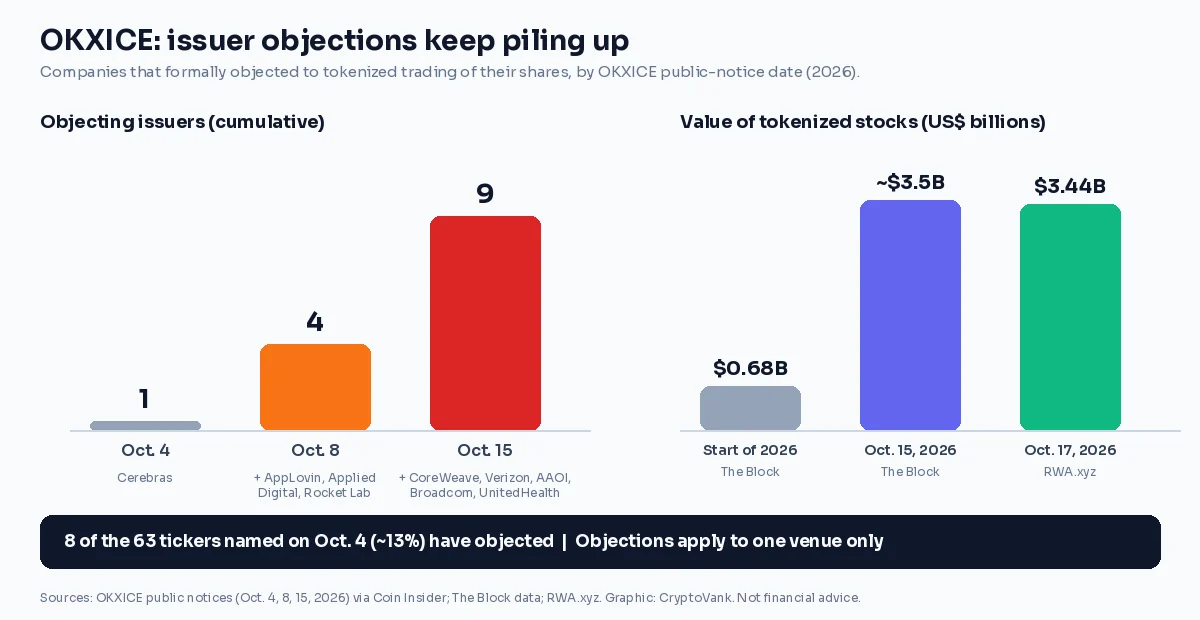
OKXICE is the 50-50 joint venture of crypto exchange OKX and NYSE owner Intercontinental Exchange (ICE). Its updated public notice names nine issuers that sent a formal objection: Cerebras Systems, AppLovin, Applied Digital, Rocket Lab, CoreWeave, Verizon, Applied Optoelectronics, Broadcom and UnitedHealth Group.
The list grew in three steps, according to Coin Insider’s comparison of the filings. Cerebras stood alone on Oct. 4. AppLovin, Applied Digital and Rocket Lab joined on Oct. 8. Finally, five more names followed on Oct. 15.
Eight of the nine were among the 63 tickers OKXICE planned to offer in its Oct. 4 filing, The Block reported on Oct. 17. As a result, roughly 13% of the original lineup has now said no.
The notice itself gives no reasons. However, Applied Optoelectronics told The Wall Street Journal it was unsure how tokenization would affect its stock price, liquidity and volatility. It also worried investors might think it backed an offering it did not sponsor.
How the SEC opt-out works
OKXICE plans to run under the SEC’s “Innovation Exemption,” a five-year order issued Sept. 17, 2026. It lets tokenized securities venues trade tokenized U.S. stocks without registering as exchanges.
When an unaffiliated third party tokenizes a stock, the venue must notify the company in writing and wait at least 30 calendar days. A timely written objection bars that venue from offering the token, law firm O’Melveny explains. Silence, by contrast, lets the listing go ahead.
Every objection is venue-specific. Nasdaq’s issuer FAQ stresses there is no blanket opt-out, so each new venue starts its own 30-day clock. Moreover, Nasdaq says it intends to opt its own shares out of these venues.
Why it matters for tokenized stocks
Our read: the objectors are not random. Five of them sit in the AI hardware and data-center trade, and several are momentum names that retail traders follow closely. In other words, those are exactly the stocks a round-the-clock venue would want most.
Meanwhile, Verizon and UnitedHealth show that caution is not limited to volatile mid-caps. Blue chips are also unwilling to let an outside tokenizer set up a market in their shares.
Visibility is also part of the worry. Trades on these venues do not appear on the consolidated tape, as Latham & Watkins notes. For example, a company could see real trading in its stock that never shows up in normal volume data.
Still, the sector keeps growing. Tokenized stocks were worth about $3.5 billion on Oct. 15, up from about $680 million in January, per The Block’s data. RWA.xyz showed a similar $3.44 billion on Oct. 17. For more context, see our look at IMF warnings on tokenized stock liquidity and daily tokenized stock volume on Base.
What OKXICE plans to offer
According to the notice, OKXICE will run permissioned Uniswap v4 pools on X Layer, OKX’s layer-2 network. In addition, each stock token pairs with USDC, USDG or USDT. Traders must pass KYC and sanctions checks and hold a non-transferable “soulbound” token to trade.
A broker-dealer must hold the shares one-for-one, and holders must get dividends and voting rights. The notice gives no launch date. OKXICE told the Journal it still plans dozens of names, including Nvidia, Apple, Microsoft and Tesla.
For market context, OKB, the gas token on X Layer, traded at $116.74 at 19:56 UTC on Oct. 17, up 0.3% in 24 hours, per CoinGecko. Bitcoin was at $81,554, flat on the day.
What to watch next
- New notices. Venues must publish objections within five business days, so the next OKXICE update will show whether megacaps join the list.
- Other venues. Each venue restarts the clock. Watch Morgan Stanley’s tokenized equity plans for Q1 2027 and the DTCC tokenization service.
- SEC feedback. The order asks for public comment. Therefore, issuer pushback could shape the SEC’s permanent rules.
OKXICE FAQ
What is OKXICE?
OKXICE is a 50-50 joint venture between crypto exchange OKX and Intercontinental Exchange, owner of the NYSE. It plans to trade tokenized U.S. stocks in permissioned stablecoin pools on X Layer under the SEC’s Sept. 17, 2026 Innovation Exemption.
Which companies objected to OKXICE tokenized stocks?
OKXICE’s Oct. 15, 2026 notice lists Cerebras Systems, AppLovin, Applied Digital, Rocket Lab, CoreWeave, Verizon, Applied Optoelectronics, Broadcom and UnitedHealth Group. Their objections bar OKXICE from offering third-party tokens of those shares.
Can a company block all tokenized versions of its stock?
No. Under the SEC order, an objection only applies to the venue that sent the notice. Nasdaq’s issuer FAQ says there is no blanket opt-out, so companies must object to each new venue within 30 days.
Sources
- OKXICE public notice, Oct. 15, 2026 (PDF)
- The Block: Nine companies object to tokenized trading on OKXICE
- Coin Insider: Nine issuers object to OKXICE listings
- TokenPost: Nine issuers object on OKXICE
- SEC: Innovation Exemption press release
- Nasdaq: Innovation Exemption FAQ for issuers
- O’Melveny: What public companies should know
- Latham & Watkins: Tokenized trading in company stock
- CoinGecko: OKB price
This article is for information only and is not financial advice. Do your own research before trading any asset.