

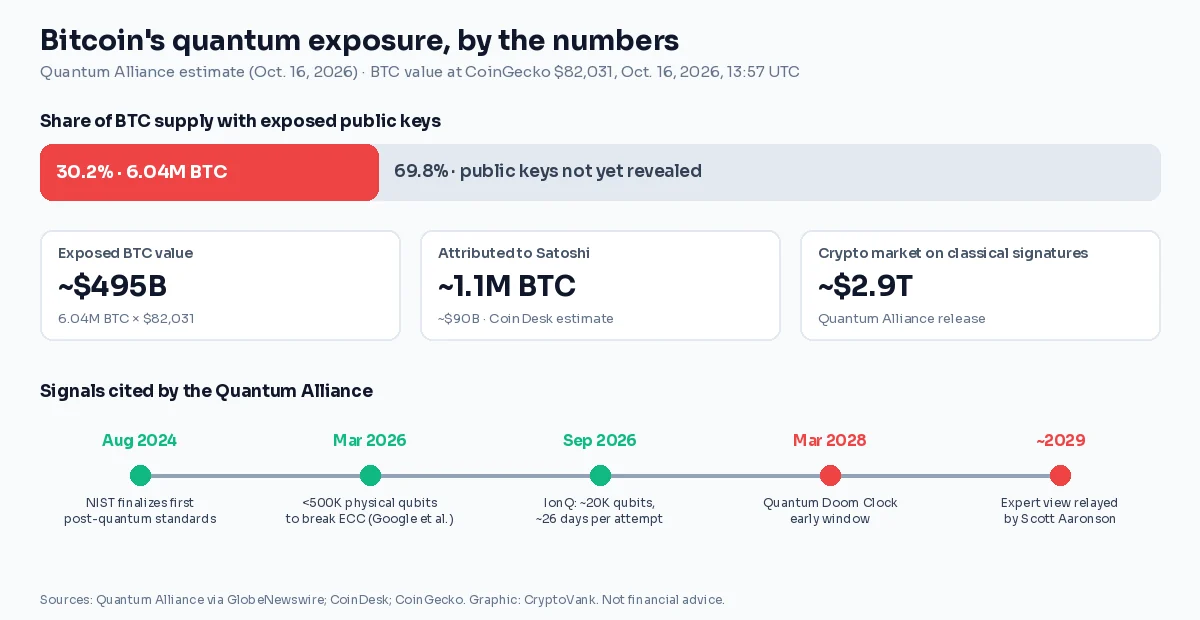
Quick answer: Nine blockchain firms launched the Quantum Alliance on Oct. 15–16, 2026 to define and test post-quantum readiness. The group says 6.04 million BTC, 30.2% of supply, have exposed public keys. No current quantum computer can steal them, per its GlobeNewswire release and CoinDesk.
Nine blockchain organizations have launched the Quantum Alliance, an open standards body that will define what “quantum-ready” means for crypto networks. The group says 6.04 million BTC, or 30.2% of supply, already have public keys exposed on the ledger.
The launch was first reported on Thursday, Oct. 15, 2026, by CryptoBriefing. A formal GlobeNewswire release followed on Oct. 16 at 11:54 UTC. No existing quantum computer can break Bitcoin’s signatures today, the members stress.
What the Quantum Alliance announced
The Quantum Alliance brings together executives from Quantus, American Fortress, Intmax, Keystone, Midnight Foundation, Postquant Labs, Abelian, The Vault and Hacken. Together they cover base layers, privacy networks, rollups, hardware signers and security audits.
First, its main job is a public definition of quantum readiness. That covers transaction signatures, key management, consensus, zero-knowledge proofs and peer-to-peer links. In addition, the group will publish open test criteria, so any team can check its own claims.
Work starts in four groups:
- Migration: how live chains move funds and keys, including exposed and lost coins.
- Zero-knowledge systems: how to benchmark post-quantum proof designs.
- Wallet security: key generation, storage, signing and recovery.
- Cross-chain compatibility: shared rules for wallets, bridges and signers.
Notably, the process copies the Internet Engineering Task Force. Proposals advance on public evidence and rough consensus. Corporate size and token holdings carry no voting weight, the release says.
Why the Quantum Alliance matters for Bitcoin
Most blockchains sign transactions with elliptic-curve keys. However, once a wallet signs, its public key sits on the ledger forever. A large enough quantum computer running Shor’s algorithm could, in theory, work back from that key to the private key.
That is why the exposed-supply figure matters. At the CoinGecko price of $82,031 (Oct. 16, 2026, 13:57 UTC), 6.04 million BTC are worth roughly $495 billion. CoinDesk also notes that about 1.1 million BTC are attributed to Satoshi Nakamoto, though it rounds the exposed total to 6.4 million.
Even so, members do not agree on timing. Postquant Labs CTO Richard Carback told CoinDesk he sees 2028 as a realistic date for a machine that can break today’s cryptography. On the other hand, The Vault’s Bryn Bennett said nobody knows the date. In his view, custodians should ask whether they can migrate in time, whether the threat lands in 2028 or 2035.
The data behind the warnings
For example, the release lists several recent signals. Since early 2025, the “Quantum Doom Clock” model built by two members has pointed to March 2028 as an early window. In March 2026, Google Quantum AI, Ethereum Foundation and Stanford researchers estimated that breaking Bitcoin-style curves could take fewer than 500,000 physical qubits. That is about a twentieth of earlier estimates.
In September, IonQ estimated that a fault-tolerant trapped-ion machine with about 20,000 physical qubits could solve Bitcoin’s secp256k1 problem in roughly 26 days per attempt. Meanwhile, NIST finalized its first post-quantum standards in August 2024. Still, no one can force a live blockchain to adopt them.
Scorecards also clash. The migration.fail assessment, which counts only live cryptography, gives Ethereum an F. A separate qLABS index ranked Ethereum second among prepared networks. As a result, the alliance wants one shared yardstick.
The freeze debate
Beyond timing, the harder question is political. Should Bitcoin freeze coins that may never move? Binance founder Changpeng Zhao has floated freezing Satoshi’s coins, and developer Jameson Lopp has proposed limits on vulnerable outputs, CoinDesk reports.
Bennett pushed back. “Freezing coins is a governance decision for the Bitcoin network, not for the industry,” he told CoinDesk. Carback, by contrast, prefers moving those coins, or placing them in a trust that owners could claim with proof.
Moreover, any fix means new signatures. Because these are larger, so blocks could fit fewer transactions and fees could rise. In short, the cryptography is the easy part; coordination is the hard part.
What to watch next from the Quantum Alliance
First, look for the alliance’s draft readiness definition and test suite. Second, watch whether Bitcoin developers converge on a migration proposal. Third, track how other chains respond. Starknet, for example, is already weighing a quantum-safe layer-1 path.
Meanwhile, for holders, the practical step is simple. Avoid reusing addresses, and keep keys in a well-set-up wallet; our self-custody wallet setup guide covers the basics. For broader context, read our explainer on AI, quantum risk and crypto bunker mode, and track BTC on our Bitcoin price page.
Quantum Alliance FAQ
What is the Quantum Alliance?
The Quantum Alliance is an open standards body launched by nine blockchain organizations, announced Oct. 15–16, 2026. It will publish a definition of post-quantum readiness, open test criteria and migration designs for networks, wallets and bridges.
How much Bitcoin is exposed to quantum attacks?
The alliance’s Oct. 16, 2026 release counts 6.04 million BTC, 30.2% of supply, as quantum-exposed at rest because their public keys are already visible. That equals roughly $495 billion at $82,031 per BTC (CoinGecko, 13:57 UTC).
Can a quantum computer steal Bitcoin today?
No. The alliance and CoinDesk both say no existing quantum computer can break Bitcoin’s cryptography. Forecasts cited in the release point to about 2028–2029 as the earliest window, while others argue it could be 2035 or later.
Sources
- GlobeNewswire: Quantum Alliance forms to define and verify post-quantum readiness
- CoinDesk: Quantum Alliance forms to defend 6.4 million vulnerable bitcoin
- CryptoBriefing: Nine blockchain groups unite to set open standards for post-quantum readiness
- CoinGecko: Bitcoin price
Not financial advice. Quantum-risk timelines are uncertain and disputed. Do your own research (DYOR).
1 comment