
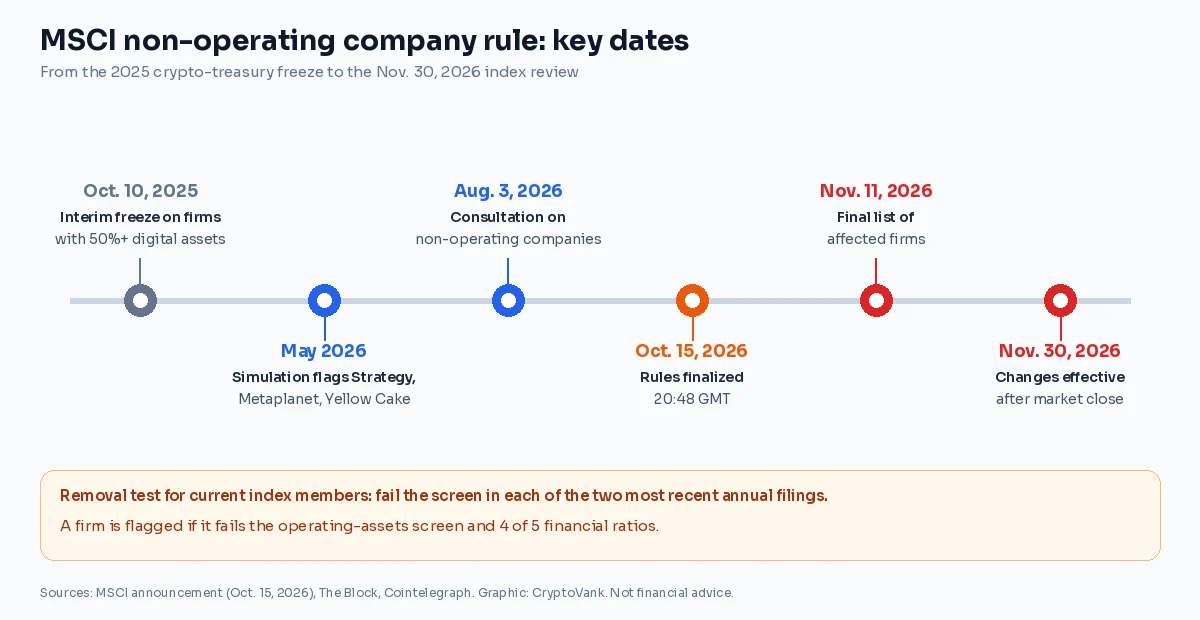
Quick answer: On Oct. 15, 2026, MSCI finalized rules that make non-operating companies ineligible for its Global Investable Market Indexes, effective after the Nov. 30, 2026 close. Strategy, which holds 848,250 BTC, was flagged for deletion in an earlier MSCI simulation. The final list of affected firms comes Nov. 11, per MSCI.
MSCI has made its call. The index giant will treat companies that mostly hold assets instead of running a business as “non-operating,” and that puts Strategy, the largest corporate bitcoin holder, on a path out of its global benchmarks.
Nothing changes today. However, the MSCI Strategy decision sets two dates every bitcoin treasury investor should mark: Nov. 11 and Nov. 30, 2026.
What did MSCI decide on Oct. 15, 2026?
In an announcement posted Oct. 15, 2026, at 20:48 GMT, MSCI said it will classify non-operating companies as ineligible for the MSCI Global Investable Market Indexes. It adopts, with minor changes, a proposal first put out for consultation on Aug. 3, 2026.
MSCI already kept out funds, business development companies and other passive vehicles. Now the rules also cover corporate issuers that look like them, using two screens:
- a core screen that checks whether a company has substantial operating assets;
- for firms that fail it, five financial ratios. Being flagged on four or more makes a stock ineligible.
The change is part of the November 2026 Index Review, effective at the close of Nov. 30, 2026. MSCI will publish the final list of affected companies on Nov. 11.
Is Strategy being removed from MSCI indexes?
Not yet, and not automatically. MSCI will remove a current constituent only if it fails the screen in each of its two most recent annual filing periods. In addition, MSCI may use the latest interim filing.
Still, the risk is real. MSCI’s May 2026 simulation flagged Strategy, Metaplanet and uranium holder Yellow Cake, The Block reports. Cointelegraph adds that MSCI also marked Upexi for deletion, while SharpLink, Ton Strategy, Solana Company and DeFi Development sit on a watchlist.
Strategy holds 848,250 BTC after its latest 250 BTC purchase. By comparison, its software business is small, and that gap is exactly what the operating-assets test measures. For more on what the company paid, see our Strategy cost-basis analysis.
How much selling could an exclusion cause?
JPMorgan analysts estimated that Strategy’s removal could trigger roughly $2.8 billion of selling. However, Cointelegraph notes that the estimate covered MSCI’s earlier digital-asset proposal, not the final rules.
For its part, Strategy has played the impact down. In August it said funds tracking these indexes hold about 13 million shares, or 3.1% of its basic shares outstanding — less than one day’s trading volume. In a September letter it called the plan “discriminatory” and said adoption “would profoundly harm MSCI’s reputation as a reliable and neutral index provider,” per The Block.
Because index funds must follow their benchmark, a deletion means selling regardless of price. If you are new to how passive products work, our guide on how crypto ETFs work explains the same mechanics.
What changes for other bitcoin treasury companies?
Meanwhile, there is a twist that helps some firms. MSCI will drop the interim measures it set on Oct. 10, 2025, for companies whose digital assets made up 50% or more of total assets. For example, those rules froze share-count increases and delayed additions.
From November, MSCI will judge those firms by the same operating-assets test as everyone else. As a result, a company with a real business plus a large crypto treasury could pass. In contrast, one that is mostly a holding vehicle likely will not, whether it holds bitcoin, ether, or uranium.
Market implications
For bitcoin itself, the direct effect is small: an index exit forces sales of shares, not coins. Bitcoin traded near $81,970 on Oct. 16, 2026, at 04:51 UTC, up about 0.5% in 24 hours, per CoinGecko; follow it on our Bitcoin price page.
Instead, the bigger question is funding. Treasury firms buy bitcoin by issuing stock and preferred shares. So losing passive demand can make that capital costlier, which could slow purchases. In short, watch the Nov. 11 list, Strategy’s response, and any similar moves by other index providers.
MSCI Strategy FAQ
When will MSCI publish the final list?
MSCI will publish the final list of affected companies on Nov. 11, 2026, as part of its November Index Review announcement. Changes take effect after the market close on Nov. 30, 2026.
Why could Strategy be removed from MSCI indexes?
Under rules finalized Oct. 15, 2026, MSCI excludes non-operating companies. Strategy’s assets are mostly bitcoin, 848,250 BTC, rather than operating assets. Also, an MSCI simulation in May 2026 flagged it for deletion, per The Block.
Which other companies could be affected?
Earlier MSCI work flagged Metaplanet, Yellow Cake and Upexi, per The Block and Cointelegraph. In addition, SharpLink, Ton Strategy, Solana Company and DeFi Development sit on a watchlist.
Does MSCI removal mean Strategy sells bitcoin?
No. Instead, index funds would sell Strategy shares, not bitcoin. JPMorgan once estimated about $2.8 billion of such selling, based on an earlier MSCI proposal. Strategy says index funds own about 3.1% of its basic shares.
Sources
- MSCI: Results of the consultation on non-operating companies (Oct. 15, 2026)
- The Block: MSCI finalizes index rules that put Strategy at risk
- Cointelegraph: MSCI adopts index exclusion rules that could oust Strategy
- Bloomberg: MSCI decision moves Strategy toward index exit
- CoinGecko: Bitcoin price
Not financial advice. Index changes and stock prices can move quickly. Do your own research (DYOR).