
Quick answer: Bitcoin ETF flows show how much money entered or left U.S. spot Bitcoin ETFs in a day, measured by shares created or redeemed. Inflows mean net new money; outflows mean redemptions. Through Oct. 9, 2026, the funds had a cumulative net inflow of $57.18 billion since January 2024, per Farside Investors.
Bitcoin ETF flows are one of the most quoted numbers in crypto news. A headline says “$485 million left Bitcoin ETFs” and traders treat it as a verdict on the market. This guide gives you bitcoin ETF flows explained step by step: what the number measures, where it comes from, and what it cannot tell you.
The short version: a flow is money moving into or out of the funds through new shares, not a price change. Through Oct. 9, 2026, U.S. spot Bitcoin ETFs had collected a cumulative net inflow of $57.18 billion since launch, according to daily data from Farside Investors.
What are Bitcoin ETF flows?
A spot Bitcoin ETF holds actual bitcoin and issues shares that trade on a stock exchange. The U.S. Securities and Exchange Commission approved the first group on Jan. 10, 2024, and they began trading the next day. If you are new to these products, start with our guide to how crypto ETFs work.
Most of the time, investors simply trade existing shares with each other. That trading does not change the size of the fund. Flows appear only when large brokers called authorized participants ask the issuer to create new shares or redeem old ones.
- Inflow (creation): new shares are issued, and the fund takes in more bitcoin, or cash to buy it.
- Outflow (redemption): shares are cancelled, and bitcoin or cash leaves the fund.
- Net flow: creations minus redemptions for the day, usually shown in U.S. dollars.
So a “$100 million inflow” means the fund grew by about $100 million worth of new shares that day, on top of any price change.
How are Bitcoin ETF flows calculated?
Each fund reports its shares outstanding and its net asset value. The daily flow is roughly the change in shares outstanding multiplied by the value per share. Trackers such as Farside then add up every fund to get one total.
Creations used to happen in cash only. On July 29, 2025, the SEC approved in-kind creations and redemptions for Bitcoin and Ether products. As SEC Commissioner Mark Uyeda explained, the cash-only model forced issuers to buy or sell bitcoin on the open market themselves. With in-kind transfers, authorized participants can deliver or receive bitcoin directly.
That detail matters for you as a reader. An inflow does not always mean the fund bought bitcoin on an exchange that morning. The coins may have come from a broker’s existing inventory.
How to read the daily Bitcoin ETF flows table
Open our Bitcoin ETF flows tracker or the Farside table and you will see one row per trading day and one column per fund. Positive numbers are inflows. Numbers in brackets or with a minus sign are outflows. The last column is the daily total.
Here is what the last few weeks looked like:
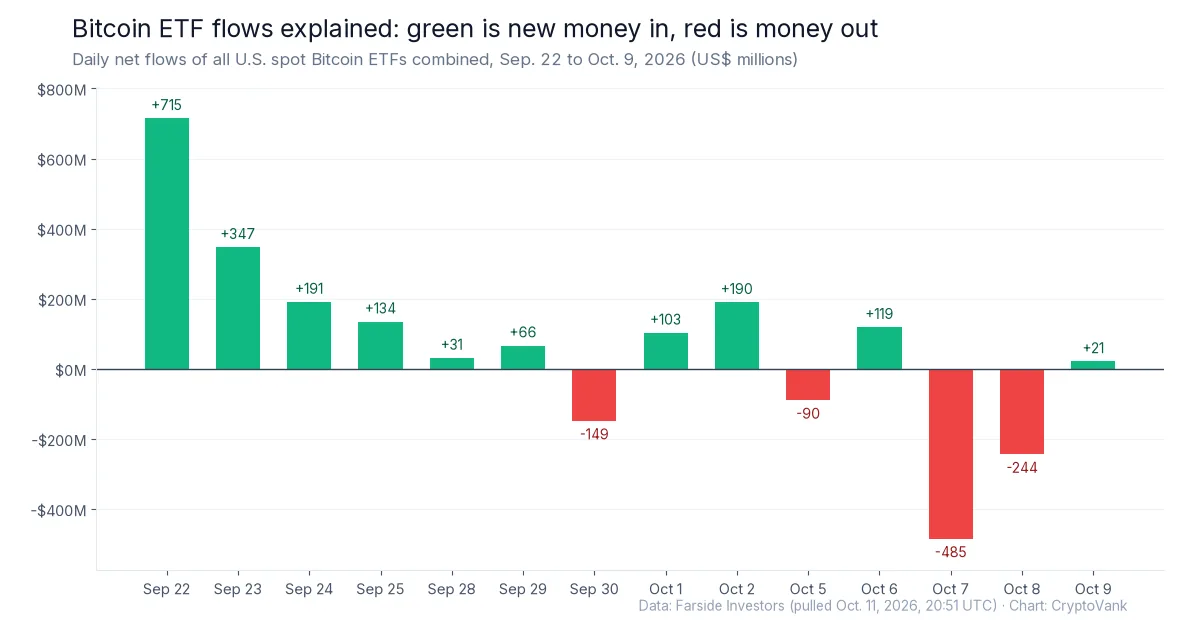
Over these 14 trading days, the funds took in a net $949 million. Yet the path was bumpy. Sept. 22 brought $714.7 million in. Oct. 7 saw $484.9 million leave, and Oct. 8 another $244.1 million. As a result, October was down a net $386.3 million through Oct. 9, as we covered in our report on crypto ETF outflows this month.
When you read the table, ask three questions:
- Is it one fund or many? On Oct. 8, Fidelity’s FBTC alone lost $197.1 million of the $244.1 million total. A broad exit across every issuer is a stronger signal than one large holder rebalancing.
- Is it a streak? Three or more days in the same direction tell you more than any single print.
- How big is it versus normal? Since launch, the average day has been a net inflow of $83 million, per Farside. The record day was $1.37 billion in, and the worst was $1.11 billion out.
What Bitcoin ETF flows don’t tell you
Flows are useful, but they are often over-read. Keep these limits in mind.
Flows are not the bitcoin price
ETFs are one buyer among many. In October 2026, the funds had net outflows, yet bitcoin was still about 0.3% above its Oct. 1 level on Oct. 11, per CoinGecko. Spot buyers on exchanges, companies and long-term holders can easily offset ETF selling. Check the live Bitcoin price page next to the flow data rather than reading flows alone.
The data arrives late
U.S. funds trade during New York market hours, and some issuers publish their figures only after the close or the next morning. That is why trackers often show a zero or a blank for a fund until it reports. Our tracker updates once a day after the U.S. close for that reason.
Flows only cover U.S. spot funds
The usual totals leave out ETPs listed in Europe, Canada, Hong Kong and elsewhere. They also leave out futures-based funds and direct buying on exchanges. A “record outflow” from U.S. funds is a U.S. story, not the whole global market.
Old money moving is not new selling
The Grayscale Bitcoin Trust (GBTC) converted from a trust into an ETF when the products launched. It has lost a net $27.94 billion since then, per Farside, while charging a 1.50% annual fee versus 0.25% at BlackRock’s IBIT. Much of that money moved from one fund to cheaper ones rather than leaving bitcoin. IBIT, by contrast, has taken in $65.73 billion.
Why Bitcoin ETF flows still matter for the market
Used carefully, flows are one of the cleanest windows into institutional demand. They are public, daily and measured in dollars. Large, steady inflows usually mean financial advisers, funds and wealth platforms are adding exposure. Persistent outflows often line up with risk-off moods driven by macro news, such as rising bond yields.
Flows also feed market sentiment. A run of red days can push readings like the Crypto Fear and Greed Index lower, which in turn shapes how traders behave. For new products, such as the 3x leveraged Bitcoin and Ether ETFs recently cleared for listing, early flows show whether demand is real.
A simple routine works well:
- Look at the weekly net figure, not one day.
- Check which funds drove it.
- Compare it with the bitcoin price and the broader market mood.
- Note any fund-specific events, such as fee cuts, share splits or conversions.
If you would rather hold the coin yourself instead of an ETF share, our self-custody wallet setup guide covers the basics.
Bitcoin ETF flows FAQ
What does a Bitcoin ETF inflow mean?
An inflow means authorized participants created new ETF shares that day, so the fund took in more bitcoin or cash. Through Oct. 9, 2026, U.S. spot Bitcoin ETFs had a cumulative net inflow of $57.18 billion since launch, per Farside Investors.
Do Bitcoin ETF outflows mean the price will drop?
Not necessarily. U.S. spot Bitcoin ETFs had $386.3 million in net outflows in October 2026 through Oct. 9, yet bitcoin was about 0.3% above its Oct. 1 level on Oct. 11, per CoinGecko. Flows are one demand signal, not a price forecast.
Where can I see Bitcoin ETF flows every day?
Farside Investors publishes a free daily table for each U.S. spot fund. CryptoVank’s Bitcoin ETF flows tracker updates once a day after the U.S. market close using Farside’s data, with the latest total and the biggest movers.
Why has GBTC had so many outflows?
GBTC converted from an existing trust into an ETF in January 2024 and charges a 1.50% fee, versus 0.25% for IBIT, per Farside. It has lost a net $27.94 billion since launch, much of it moving to cheaper funds.
What is the largest daily Bitcoin ETF flow on record?
Per Farside’s data through Oct. 9, 2026, the largest single-day net inflow was $1.37 billion and the largest net outflow was $1.11 billion across all U.S. spot Bitcoin ETFs combined.
Sources
- Farside Investors: Bitcoin ETF flow (US$m)
- SEC: Statement on the approval of spot bitcoin exchange-traded products (Jan. 10, 2024)
- SEC: SEC permits in-kind creations and redemptions for crypto ETPs (July 29, 2025)
- SEC: Commissioner Uyeda statement on in-kind creations and redemptions
- CoinGecko: Bitcoin price
This guide is for information only and is not financial advice. Do your own research (DYOR) before you invest.