Quick answer: The IMF found that tokenized stocks are about 1.5 times more volatile than the shares they track and much less liquid, especially on decentralized exchanges. Still, more than half of their trading happens outside U.S. market hours and about 80% of trades are for less than one share, which shows real demand for 24/7 and fractional access.
Tokenized stocks are drawing real demand, but they move about 1.5 times more than the shares they track, the International Monetary Fund (IMF) says. In its new report, the fund finds that most of this trading happens when Wall Street is closed, and in very small sizes.
The findings come from Chapter 3 of the IMF’s October 2026 Global Financial Stability Report, titled “Scaling Tokenization: New Efficiencies, New Vulnerabilities.” CoinDesk, Decrypt and crypto.news all reported the same core numbers.
What the IMF found about tokenized stocks
The IMF studied the five most actively traded tokenized U.S. equity products. They track names such as Tesla, Nvidia and Alphabet, plus S&P 500 and Nasdaq exposure. The sample covered 11 trading venues over 365 days.
Three results stand out:
- Off-hours demand. More than half of all trading took place outside regular U.S. market hours.
- Tiny trade sizes. About 80% of trades were for less than one share.
- Useful price signals. When U.S. markets reopened, regular shares reflected 87% to 99% of the overnight moves their tokens had already made.
That last point matters. It suggests weekend and overnight token prices are not just noise. They often hint at where the real stock will open.
Why tokenized stocks swing harder
However, the drawbacks are just as clear. Tokenized stocks were about 1.5 times as volatile as the underlying shares, and they were much less liquid. Decentralized exchanges had the thinnest liquidity and the biggest gaps from traditional prices. Venues with more volume tracked the real stock more closely.
Here is our reading of why. A token that trades at 3 a.m. on a Sunday has no deep stock market behind it at that moment. Fewer buyers and sellers are around, so one order can move the price more. In other words, the same feature that attracts users, 24/7 access, is also what makes prices jumpier.
For traders, the practical lesson is simple. A weekend token price is a guess about Monday, not a guaranteed price. On a thin DEX pool, the gap can also be wider than on a busy centralized venue.
Data: how big is the tokenized stocks market?
The market is still small. The IMF puts tokenized real-world assets at about $65 billion as of July 31, 2026. Tokenized equities made up roughly $2.3 billion of that. By comparison, global stock markets were worth just under $160 trillion in 2025, according to SIFMA figures cited in the report.
We checked live data, too. At 19:54 UTC on Oct. 11, CoinGecko valued its tokenized stocks category at $2.44 billion. That is only slightly above the IMF’s July estimate. So the sector has not exploded since the summer, despite many new product launches.
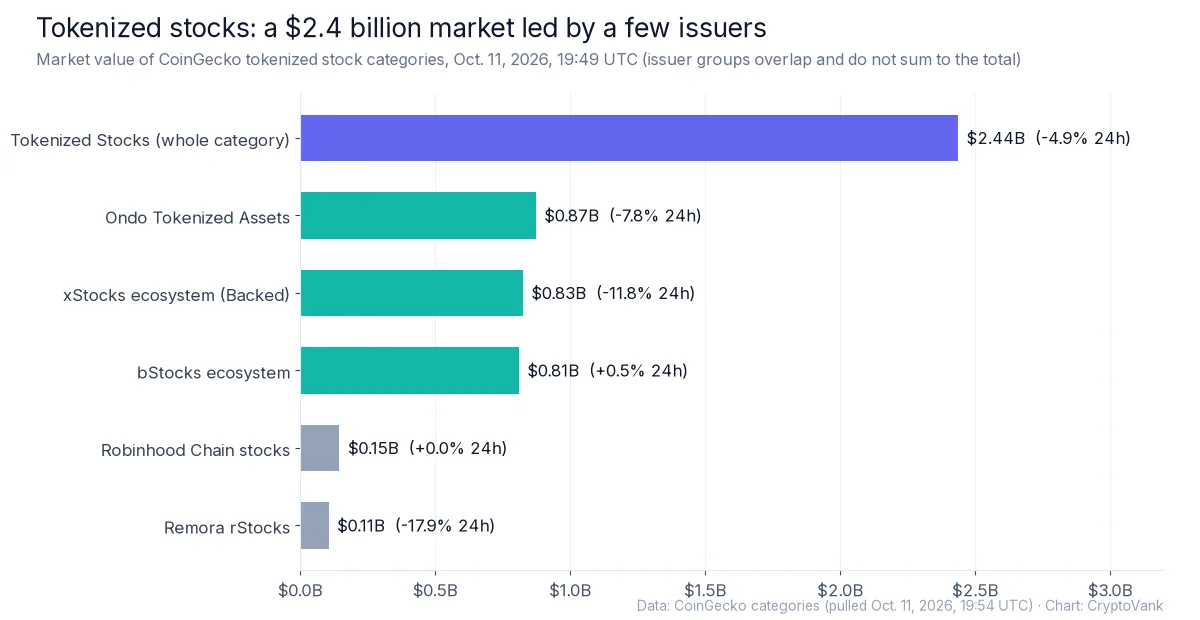
The IMF also says the market is concentrated. Ondo Finance and Backed Finance’s xStocks hold more than 70% of it. Both issue tokens that give price exposure without direct share ownership. CoinGecko’s data points the same way. Ondo’s group sat at $873 million and xStocks at $826 million. A third family that CoinGecko labels bStocks was close behind at $811 million. Note that CoinGecko’s issuer groups overlap, so they do not add up to the total.
The category also fell 4.9% in 24 hours on a Sunday, when the underlying shares were not trading. Category values can shift with token supply as well as price, so we would not read too much into one day. Even so, it is a neat real-time example of the weekend price swings the IMF describes. Meanwhile, the ONDO token traded at $0.508, up 1.9% in 24 hours, per CoinGecko.
Why it matters for crypto and Wall Street
First, the report gives the sector a mixed but useful verdict. Demand for round-the-clock and fractional trading is real, and it comes mostly from retail users. That fits what we saw when tokenized stocks on Base passed $100 million in daily volume.
Second, big players are moving in. CoinDesk and Decrypt both note that Intercontinental Exchange (ICE), owner of the New York Stock Exchange, is working with OKX on 24/7 trading of tokenized U.S. shares. Coinbase, Kraken, Binance and Robinhood already offer tokenized stocks in some form.
Third, the risks scale with size. The IMF says systemic risk is limited for now because the market is small. But it warns that automated margin calls, collateral moving between platforms and nonstop trading could make a future shock harder to contain. Crypto has seen that pattern before, as our look back at the October 10 crash one year later shows.
What to watch next
- Liquidity on new venues. If ICE and OKX launch their venue, watch whether deeper order books shrink the 1.5x volatility gap.
- Issuer concentration. A market led by two or three issuers carries extra counterparty risk. New entrants could spread it out.
- Rules for 24/7 trading. The IMF wants stronger rules on ownership, liquidity and settlement before the market grows much larger. Europe’s tougher stance on non-MiCA stablecoins shows how quickly regulators can reshape a crypto product.
Tokenized stocks FAQ
What are tokenized stocks?
Tokenized stocks are blockchain tokens that track the price of a listed share, such as Tesla or Nvidia. Many popular ones give price exposure only, without direct ownership of the share.
Are tokenized stocks riskier than regular shares?
According to the IMF, yes in some ways. They were about 1.5 times more volatile than the shares they track and much less liquid, especially on decentralized exchanges.
How big is the tokenized stocks market?
About $2.3 billion as of July 2026, per the IMF, and $2.44 billion on CoinGecko at 19:54 UTC on Oct. 11, 2026. Global stocks were worth just under $160 trillion in 2025.
Sources
- IMF: Global Financial Stability Report, October 2026, Chapter 3 (PDF)
- CoinDesk: IMF finds demand for tokenized stocks, says the market is still volatile, illiquid
- Decrypt: Tokenized stocks show real demand but remain volatile and illiquid, IMF finds
- crypto.news: IMF warns tokenized stocks are 1.5 times more volatile
- CoinGecko: Tokenized stocks category
This article is for information only and is not financial advice. Do your own research before you invest.