
Quick answer: One year after the October 10 crash, which liquidated more than $19 billion of leveraged crypto bets on Oct. 10, 2025, bitcoin trades at $82,976, about 34% below its $126,080 record, per CoinGecko (Oct. 10, 2026, 16:54 UTC). Leverage is lower, but analysts say the risks behind the crash remain.
The October 10 crash is one year old today, and bitcoin still has not won back its pre-crash price. Leverage has cooled since then, yet the forces that caused the selloff have not gone away.
What happened in the October 10 crash
On Oct. 10, 2025, at 20:50 UTC, President Donald Trump threatened 100% tariffs on China in a Truth Social post. Over the next 24 hours, more than $19 billion of leveraged crypto positions were liquidated, according to Galaxy Research. That was nearly double the previous record of about $10 billion, set on April 17, 2021.
Bitcoin dropped from about $122,000 to roughly $105,000 on most venues, CoinDesk and CryptoPotato report. Just four days earlier, on Oct. 6, it had set its record high of $126,080, per CoinGecko.
Altcoins fared far worse. Tokens outside bitcoin and ether fell about 33% within 25 minutes, Galaxy says. On Binance, ATOM and ENJ briefly traded near zero. About 1.62 million accounts were liquidated, and roughly 87% of them were long bets on higher prices.
Why the October 10 crash still matters
The crash was a plumbing failure, not a verdict on bitcoin. Prices fell because forced sellers hit thin order books, not because holders lost faith overnight. That distinction matters for anyone trying to read the market today.
Several weak points showed up at once:
- Auto-deleveraging. Hyperliquid used auto-deleveraging (ADL) for the first time in more than two years. ADL force-closes winning trades, often shorts, to keep an exchange solvent.
- Collateral pricing. On Binance, the USDe stablecoin fell to about $0.65, even though it traded near $1 elsewhere. The wrapped tokens wBETH and BNSOL hit discounts of 80% to 90%, Galaxy says. Binance later paid about $300 million to affected users.
- Concentration. Hyperliquid and Bybit together handled 75% of the liquidations.
In contrast, DeFi held up. Aave liquidated about $180 million of loans without downtime, and Uniswap cleared a record of more than $10 billion in volume, according to Galaxy. Our DeFi risks explainer covers why smart-contract markets carry their own dangers, though.
Bitcoin price data: one year later
The crash marked the start of a long slide, not a one-day dip. CoinGecko’s daily data shows bitcoin falling to about $58,566 on July 1, 2026. CryptoPotato says it briefly dipped under $58,000 that day, more than 50% below the peak.
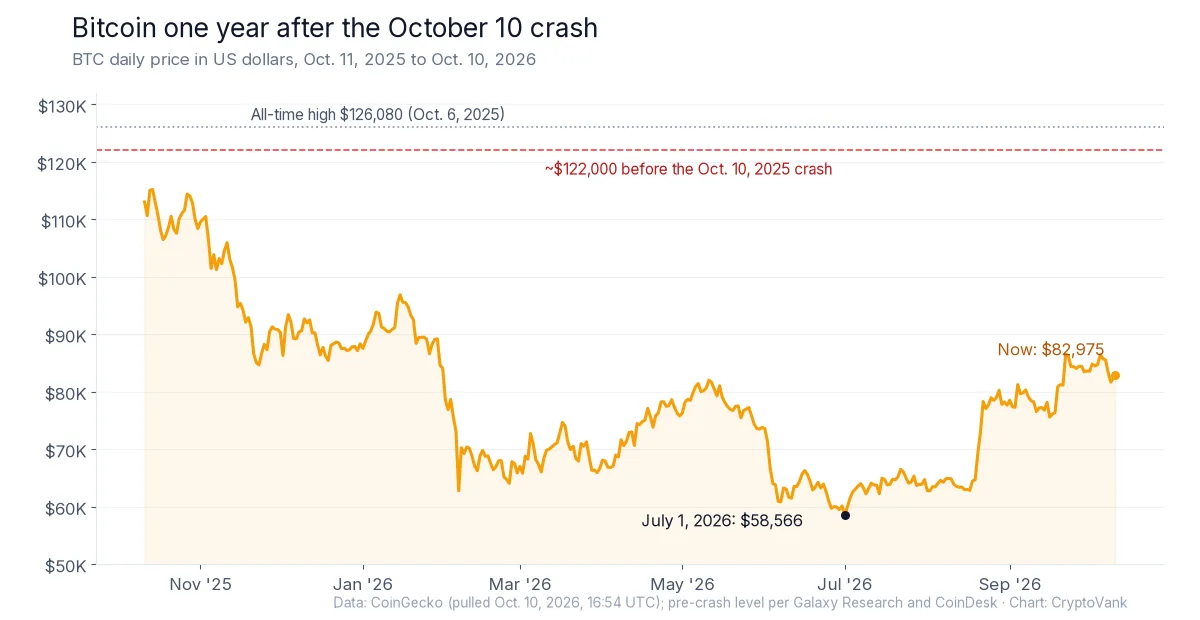
Since then, the price has recovered strongly. At 16:54 UTC on Oct. 10, 2026, bitcoin traded at $82,976, up 0.3% in 24 hours, per CoinGecko. That is about 42% above the July low. However, it is still about 32% below the $122,000 level from before the crash, and 34% below the record. Ether sat at $2,505, and the total crypto market was worth about $2.82 trillion.
The wider market has not caught up either. Monthly app fees and DEX volumes are still below October 2025 levels, Galaxy says. Only eight of the top 50 tokens, excluding stablecoins and wrapped assets, trade above their 10/10 prices.
Has crypto learned from the October 10 crash?
Partly. Galaxy says leverage now sits well below last October’s peak. CCN, citing CoinGlass data, reports that bitcoin’s leverage ratio fell for a fourth month in a row to its lowest level since August 2024. Some exchanges have also tightened margin rules and improved price oracles.
Still, the warning signs have not vanished. Bitcoin open interest rose 4% in the seven days to Oct. 7, to about 650,480 BTC, CCN says. Meanwhile, more than $1 billion of positions were wiped out in less than a day last week, per CryptoPotato. We covered that drop in our report on bitcoin holding $80,000.
“There’s still a chance that you can have an October 10th for sure,” Mark Connors of Risk Dimensions told CoinDesk. “The levered products have not gone away.”
Our take: a stress test, not a cycle top call
In our view, the most useful lesson is about timing. The crash came just days after a record high, when traders were most confident. Crowded long bets turned a political headline into a $19 billion wipeout within hours.
The good news is that the system bent but did not break. No major exchange failed, and onchain markets kept working. On the other hand, Galaxy notes that the event still lacks a full public account. So nobody can say for sure that the fixes are complete.
For long-term holders, the takeaway is simple. Leverage, not bitcoin itself, caused most of the damage. Holding coins in your own wallet removes the risk of a forced sale on an exchange. Our self-custody wallet guide explains how to start.
What to watch next
- Open interest and funding rates. Fast growth in both, while prices rise, is the clearest sign that leverage is building again.
- Exchange rule changes. Watch for public fixes to auto-deleveraging and collateral pricing on the largest futures venues.
- Macro shocks. A tariff post started 10/10. This month, oil and bond yields have done the same job, as our oil and Treasury yields analysis shows.
- Market mood. The Fear and Greed Index can flag when the crowd leans too far one way.
October 10 crash FAQ
What caused the October 10 crash?
A Truth Social post by President Trump at 20:50 UTC on Oct. 10, 2025, threatened 100% tariffs on China. Heavy leverage and thin order books then turned the selloff into more than $19 billion of forced liquidations in 24 hours.
How much did bitcoin fall on Oct. 10, 2025?
Bitcoin dropped from about $122,000 to roughly $105,000 on most exchanges, with brief lower prints on some venues. It had set a record of $126,080 on Oct. 6, 2025, per CoinGecko.
Has bitcoin recovered from the October 10 crash?
Not fully. Bitcoin traded at $82,976 on Oct. 10, 2026, at 16:54 UTC, per CoinGecko. That is about 34% below its record, though it is up roughly 42% from its July 1, 2026 low.
Sources
- Galaxy Research: One year after 10/10, the $19B liquidation event that didn’t break crypto
- CoinDesk: Bitcoin’s $19 billion wake-up call, one year later
- CryptoPotato: 1 year since crypto’s biggest liquidation event
- Crypto Briefing: Bitcoin’s $19 billion crash still shapes crypto risk a year later
- CCN: One year after crypto’s $19B 10/10 crash
- CoinGecko: Bitcoin price data
This article is for information only and is not financial advice. Do your own research before you buy or sell any crypto asset.