
Quick answer: ESMA’s Oct. 8, 2026 opinion says MiCA-licensed crypto firms should stop all services for non-MiCA stablecoins, including custody and transfers. Supervisors should require leftover client balances to be cleared no later than Jan. 8, 2027, with only sell, convert, withdraw or transfer options allowed in the meantime. USDT is the largest token affected.
EU crypto platforms now have until Jan. 8, 2027, at the latest to stop serving non-MiCA stablecoins such as Tether’s USDT, the bloc’s markets regulator says. The new guidance goes further than the 2025 trading ban, because it also covers custody, transfers and advice.
The European Securities and Markets Authority (ESMA) published the opinion on Oct. 8. It is addressed to national regulators, not to firms directly. Even so, it sets the line that licensed exchanges and wallets across the EU are expected to follow.
What happened: ESMA closes the custody gap
The opinion says crypto firms licensed under MiCA, the EU’s Markets in Crypto-Assets rules, “should not provide crypto-asset services” for stablecoins that fail MiCA’s issuer rules. The list of services is broad. It runs from trading platforms and order execution to transfers, custody, advice and portfolio management.
National regulators must also check that firms have real controls in place. In practice, clients should not be able to buy or add to these tokens. Simple risk warnings will not count, either, CoinDesk and NFTevening report.
Leftover balances get a short exit window. Supervisors should require them to be resolved “as soon as possible” and within three months of publication. That puts the outer limit at Jan. 8, 2027. Until then, platforms may only let clients sell, convert, withdraw, transfer or store what they already hold.
Why non-MiCA stablecoins matter here
The opinion names no token. However, USDT is the obvious target. Tether has no MiCA license for USDT, and the token is missing from ESMA’s register of approved e-money tokens, NFTevening reports. CoinDesk adds that PayPal’s PYUSD is not authorized either.
By contrast, Circle registered USDC and its euro token EURC under MiCA in 2024. As a result, EU platforms can keep listing both.
This is the second step, not the first. In January 2025, ESMA told firms to restrict trading in these tokens. After that, Kraken, Binance and others removed USDT pairs for European users. Still, several platforms kept holding the tokens for clients. The new text ends that workaround.
The data: a global giant with a local problem
At 13:54 UTC on Oct. 11, USDT traded at $0.9991 and USDC at $0.9997, according to CoinGecko. Both held their pegs. Bitcoin sat at $82,994, roughly flat on the day.
The supply numbers tell a bigger story. MiCA’s stablecoin rules took effect on June 30, 2024. Since then, USDT supply has grown from $112.6 billion to $184.1 billion, a 63% rise, per DefiLlama. That is about 59% of the $312.8 billion stablecoin market.
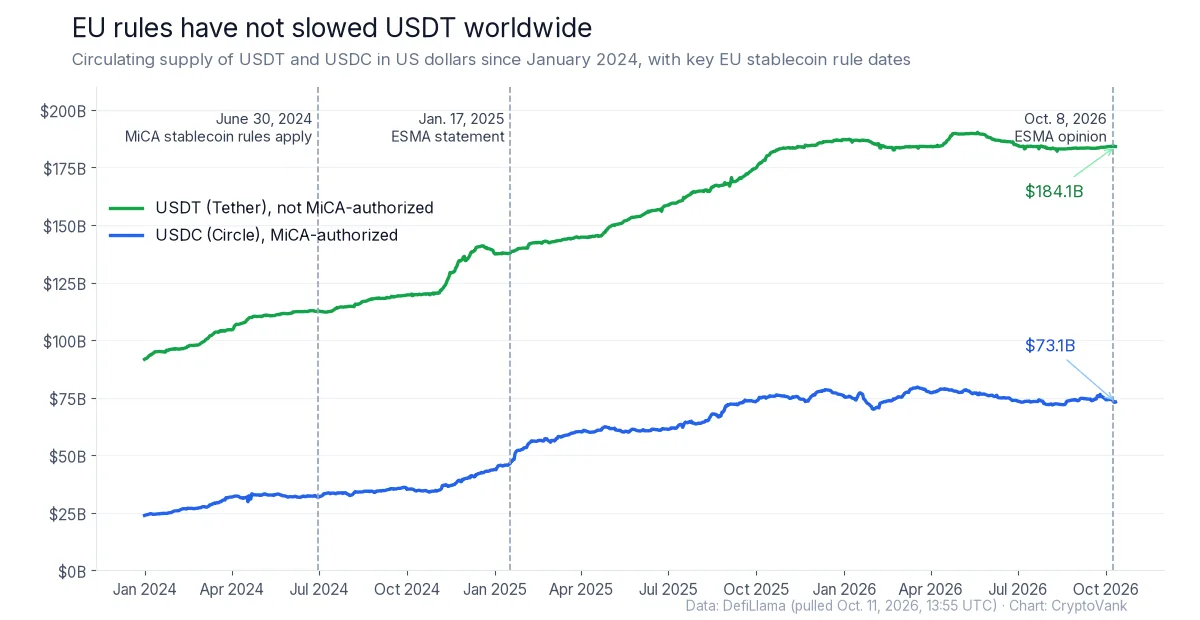
USDC grew faster in percentage terms. Its supply more than doubled, from $31.9 billion to $73.1 billion. Over the last 12 months, though, the picture has flattened. USDT added 2.6%, while USDC slipped 2.2%.
Our read is simple. Europe’s earlier trading limits did not stop USDT’s global growth, since its supply kept rising after they began. So the new rule is unlikely to shake the token’s price or its peg. Instead, the real impact falls on EU users and on the euro stablecoin market. Every euro of trading that leaves USDT needs a home, and licensed tokens like USDC and EURC are the main winners.
What it means for EU users
First, the opinion is not a ban on owning USDT. You can still hold it in a self-custody wallet, and you can still use it on platforms outside the EU. Our self-custody setup guide covers how to do that safely.
Second, your exchange decides the exact timeline. Some may cut deposits right away, while others may allow sell-only access until January. After the cutoff, you may not be able to send USDT back to an EU platform.
Third, check your crypto card. Many cards spend stablecoins in the background, so it helps to know which token yours uses. Our crypto card comparison lists the main options. For background, read our explainer on how stablecoins work. EU tax rules are also tightening, as our story on France’s stablecoin swap tax shows.
What to watch next
Watch the national regulators first. Each one now has to apply the opinion, and some may set dates well before Jan. 8. Next, watch the big exchanges. Platforms that still hold USDT for EU clients will need to publish wind-down plans and notify users.
Finally, watch Tether. The company has not commented on the opinion so far, according to Morning Tick. Earlier reporting by Crypto Briefing said it does not plan to seek an EU e-money license, so a quick reversal looks unlikely.
Non-MiCA stablecoins FAQ
Is USDT banned in the EU?
No. ESMA’s opinion targets services from licensed crypto firms, not ownership. EU residents can still hold USDT in their own wallets. However, licensed EU platforms should stop trading, storing and transferring it for clients by Jan. 8, 2027, at the latest.
What happens to USDT left on an EU exchange?
Each platform sets its own plan within the national regulator’s limits. During the wind-down, clients may only sell, convert, withdraw, transfer or store existing balances. Some may convert leftover balances automatically, as Kraken did in March 2025, so check your platform’s notices.
Which stablecoins are MiCA-compliant?
Circle’s USDC and EURC are registered under MiCA, so EU platforms can keep offering them. USDT is not authorized, and CoinDesk reports that PayPal’s PYUSD is not either. ESMA keeps the official list in its interim MiCA register.
This article is for information only. Not financial advice; DYOR.
Sources
- ESMA sets out supervisory expectations on services related to unauthorised stablecoins, ESMA
- Opinion on crypto-asset services for non-MiCA-compliant ARTs and EMTs (PDF), ESMA
- ESMA gives EU crypto platforms 3 months to drop non-MiCA stablecoins such as USDT, CoinDesk
- EU regulators target non-compliant stablecoins with a 90-day deadline, CryptoSlate
- EU orders crypto firms to drop non-MiCA stablecoins, NFTevening
- ESMA orders MiCA firms to halt services for non-compliant stablecoins, Crypto Briefing
- EU tells all its licensed crypto exchanges to cut Tether, Morning Tick
- Stablecoin supply data, DefiLlama
- Tether (USDT) price data, CoinGecko