

Quick answer: Stripe stablecoin cards now support more than the dollar. On Oct. 15, 2026, Stripe and Plasma said the card infrastructure will handle USD, EUR, BRL, MXN and COP plus OUSD and other eligible stablecoins, in 30+ countries today and 100+ in 2027, per the official release.
Stripe stablecoin cards are no longer a dollar-only product. On Oct. 15, 2026, Stripe and Plasma said they will launch multi-currency cards that let people spend euros, reais and pesos directly, without first converting through dollars.
What Stripe and Plasma announced
The news came in a joint press release at 09:20 ET (13:20 UTC). Plasma joins as a design partner. In other words, it will help shape how the product works for people whose money spans several countries.
Stripe, meanwhile, is widening the infrastructure behind the cards. The release lists these supported options:
- Fiat currencies: USD, EUR, BRL, MXN and COP.
- Stablecoins: OUSD and other eligible “GENIUS-ready” stablecoins.
- Markets: more than 30 countries today, with a plan for 100+ countries in 2027.
The example is simple. A cardholder who holds euros will be able to pay in euros, so no dollar conversion sits in the middle. Businesses can also issue cards in the currency that matches their costs.
The launch is only a first step, though. Next, the partners want cards that spend from several balances at once. The right currency would then be picked automatically at checkout.
Crypto Briefing and Lookonchain reported the same core details. However, Crypto Briefing’s list also includes GBP and USDC, which the official release does not name. We treat the release as the final word until Stripe says otherwise.
Who said what
Plasma CEO Paul Faecks framed the deal around global users. “Partnering with Stripe gives us the opportunity to develop multi-currency cards around how those people actually live and spend,” he said in the release. His summary was short: “spend like a local, anywhere.”
Henri Stern, head of Stripe Crypto and CEO of Privy, focused on business clients. Stripe wants to give firms “the infrastructure to offer cards across currencies and markets without having to build it themselves,” he said.
Why Stripe stablecoin cards matter
Most crypto cards today work the same way. You hold a dollar stablecoin, and the card converts it into the local currency at the till. As a result, someone living in Paris or São Paulo often pays two conversions: into dollars, then back out. Each step can carry a spread or fee.
Stripe stablecoin cards with local-currency balances cut out that loop. For a freelancer paid in euros, or a firm with costs in Mexico, that is a real saving. It also pushes stablecoins beyond their role as digital dollars.
Scale matters here too. Stripe says it processes over $1.9 trillion of payments a year. So when Stripe adds a currency, thousands of fintech apps can switch it on without building their own card program. That is why this matters more than one more crypto card launch.
The timing also fits a busy week for regulated stablecoins. On Oct. 14, the European Banking Authority classified USDC as the EU’s first significant e-money token. That puts euro-area stablecoin rules in the spotlight, as we covered in our MiCA stablecoin deadline report.
The data: a flat supply, a rising token
One number explains why payment firms are chasing spending. Total stablecoin supply was $305.5 billion on Oct. 15, 2026, per DefiLlama. A year earlier, it was $303.5 billion. Supply has barely moved, so growth now has to come from usage, such as cards and payouts.
Plasma’s own token reacted fast. XPL traded at $0.0771 at 13:00 UTC and $0.0831 at 14:06 UTC, a gain of about 8%, according to CoinGecko. At 14:07 UTC, XPL was $0.0827, up 4.7% in 24 hours, with a market cap near $375 million.
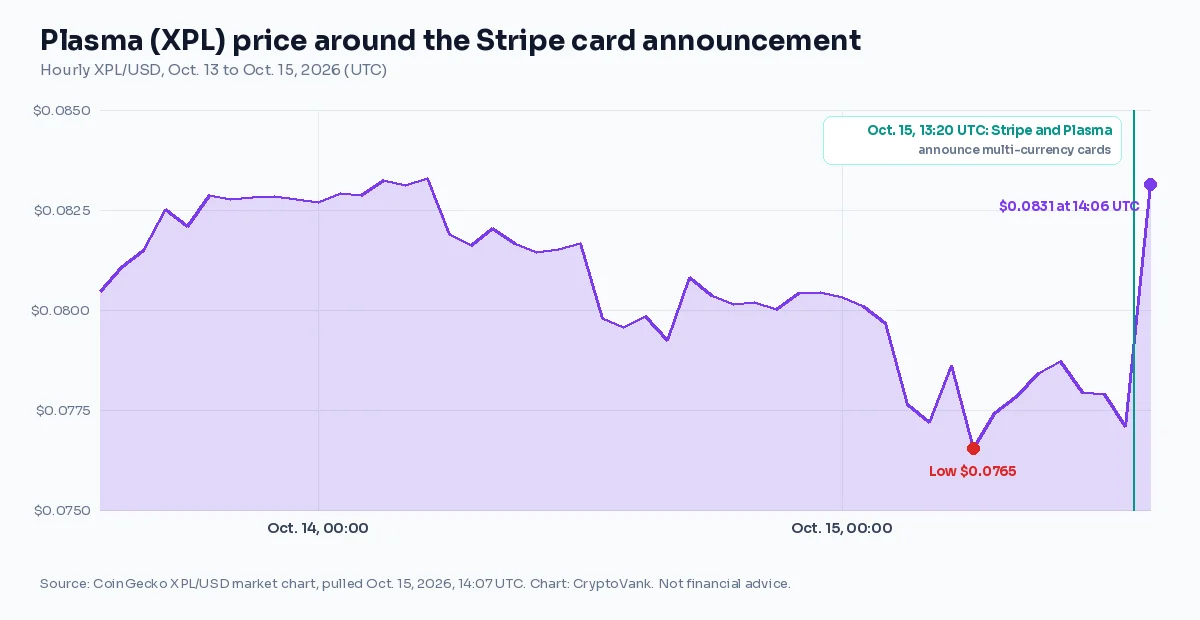
By contrast, the wider market was weak. At the same time, bitcoin was $80,437, down 2.2% on the day, and ether was $2,348, down 3.9%, per CoinGecko. CoinDesk reported that nearly $1 billion in crypto bets were liquidated as prices slid.
Still, a one-hour jump on news is not a trend. Note that Plasma is a design partner, and the release does not say XPL has any role in the Stripe cards.
What to watch next
- Fees and FX rates. The release promises fewer conversions but gives no prices. Real costs will decide whether users switch.
- Country list. “30+ countries” is a broad claim. Watch for the exact markets and the 2027 roadmap to 100+.
- Which stablecoins qualify. “GENIUS-ready” points to the U.S. GENIUS Act rules. Euro users will want to know how this fits MiCA.
- Plasma One rollout. Crypto Briefing says Plasma One launched in June 2026. A firm date for multi-currency cards in that app would be the next real signal.
If you are comparing cards now, our crypto card explainer covers the basics. You can also see the cards we track on our crypto cards page. For background on the coins behind them, read our stablecoins guide.
Stripe stablecoin cards FAQ
Which currencies do the new Stripe stablecoin cards support?
The Oct. 15, 2026, release lists USD, EUR, BRL, MXN and COP as fiat options. On the stablecoin side, it names OUSD and other eligible GENIUS-ready stablecoins.
Where can people use Stripe stablecoin cards?
Stripe says its stablecoin card infrastructure is available in more than 30 countries today. It plans to expand to over 100 countries in 2027, but it has not published the full list.
Is Plasma issuing the card?
Plasma is a design partner, not the only issuer. Stripe provides the card infrastructure that businesses build on, and Plasma helps shape the multi-currency experience, starting with its Plasma One app.
Sources
- Stripe and Plasma co-develop a new multi-currency card (GlobeNewswire)
- Plasma partners with Stripe to build multi-currency stablecoin cards (Crypto Briefing)
- Stripe partners with Plasma on multi-currency stablecoin card (Lookonchain)
- EBA classifies USDC as the first significant e-money token (EBA)
- Nearly $1 billion in crypto bets liquidated (CoinDesk)
- Stablecoin market data (DefiLlama)
- Plasma XPL price (CoinGecko)
This article is for information only and is not financial advice. Do your own research before using any crypto product.




2 comments