
Blockchain.com has asked the US Commodity Futures Trading Commission for two licenses that would let it run its own prediction market and sell crypto derivatives to Americans. The Blockchain.com CFTC filings, disclosed to CNBC on Friday, Oct. 9, would replace partner products with an in-house, federally regulated venue.
What Blockchain.com asked the CFTC for
The company applied for two separate approvals, CNBC reported. First, a designated contract market (DCM) license would let it operate as a futures exchange that lists event contracts. Second, registration as a futures commission merchant (FCM) would let it act as a broker. An FCM takes customer orders and holds their collateral.
Together, the two would cover both sides of the business. Blockchain.com could list its own contracts and also onboard US retail and institutional clients directly.
CEO and co-founder Peter Smith framed it as a product move. “Users should be able to manage their digital assets, trade derivatives, and take positions on real-world events easily, without jumping between different apps,” he said in a statement quoted by CNBC and Quartz.
From reseller to exchange
Right now, Blockchain.com doesn’t run any of these markets itself. This year it began offering prediction markets to some international customers through a partnership with Polymarket. It also offers perpetual futures powered by the decentralized exchange Hyperliquid. Both products sit outside the US.
In other words, Blockchain.com supplies the app and the users, while partners supply the contracts. A CFTC license would change that. The company would set its own listings, keep the trading fees and own the customer relationship in the US. Finance Magnates compared the path to Robinhood’s. Robinhood also started by distributing outside event contracts before it moved to control its own exchange.
In fact, rivals have already made this move. According to CNBC, Crypto.com and Gemini run their own event-contract marketplaces, while Coinbase offers them mainly through a partnership with Kalshi.
A crowded line at the CFTC
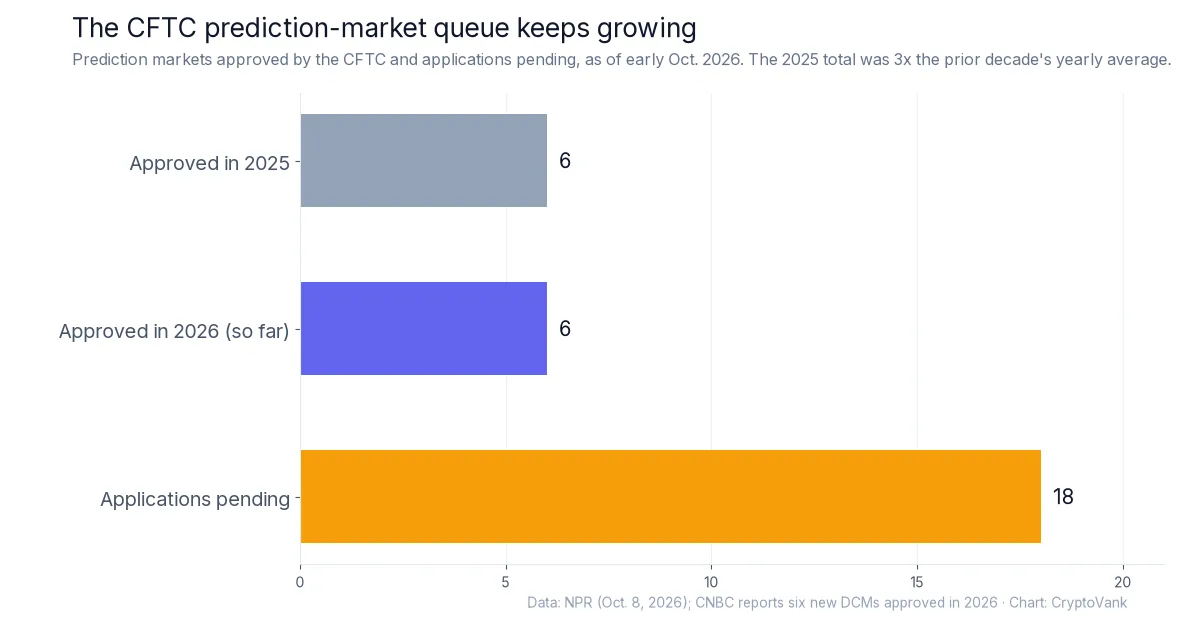
Indeed, Blockchain.com is far from alone. It joins 11 other companies that applied for DCM licenses this year, and the CFTC has approved six new DCMs in 2026, CNBC and Decrypt reported. NPR, using a slightly wider count, said the agency approved six prediction markets in 2025, another six this year, and has 18 applications pending.
Even so, the paperwork isn’t finished. Records at the National Futures Association show that Blockchain.com Derivatives Inc. has had an FCM application pending since Aug. 25, Finance Magnates found. However, the DCM filing does not yet appear in public CFTC records. So there are no public details yet on which contracts it would list or when it could launch.
Why the Blockchain.com CFTC move matters
Above all, a federal license offers legal cover. Several states have sued Kalshi and Polymarket, arguing that sports and election contracts are unlicensed gambling. A CFTC-regulated exchange can argue that federal law overrides those state rules.
That fight is now heading toward the Supreme Court. Last month, New Jersey asked the justices to take up its case against Kalshi, Cointelegraph reported. The NFL has also filed a brief telling the court that sports event contracts are gambling, not swaps, according to The Block and Decrypt. Meanwhile, the CFTC has sent the White House proposed rules that would define event contracts as swaps under its own authority.
In addition, timing works in its favor. CFTC Chair Michael Selig is currently the agency’s only commissioner, with four of five seats empty, NPR and Cointelegraph noted. As a result, he can push rules and approvals without a commission vote. This week he also said the CFTC will write crypto spot-market rules without waiting for Congress. We covered that rulebook in our explainer on the CFTC’s Regulation CTX and CAM proposals.
Our take: a license race with an IPO in the background
In our view, the filing is as much about valuation as about product. Blockchain.com confidentially filed for an IPO in May, CNBC reported. Bloomberg later reported a target valuation of $4 billion to $6 billion. A US derivatives license would give the company a growth story that a plain crypto broker lacks.
Still, a license doesn’t settle the legal fight. If the Supreme Court sides with the states, sports contracts could face state gambling rules even on federal exchanges. Crypto derivatives would be less exposed, since they already sit under the CFTC. For users, these products also carry real risk. Leverage and event bets can wipe out a position fast, as our guide to DeFi risks explains.
Overall, the market barely reacted. At 19:57 UTC on Oct. 9, bitcoin traded at $82,279 and ether at $2,475, both up less than 1% in 24 hours, per CoinGecko. For the bigger picture on flows, see our bitcoin price report.
Blockchain.com CFTC: what to watch next
- The DCM filing. Watch for it to appear in public CFTC records, with details on contracts and clearing.
- FCM approval. The broker application has been pending since August.
- The Supreme Court. Whether it takes the New Jersey v. Kalshi case could decide how far federal licenses protect sports contracts.
- The IPO. Any public S-1 filing would show how much revenue Blockchain.com expects from derivatives.
FAQ
What did Blockchain.com file with the CFTC?
It applied for a designated contract market license, which allows it to run a futures exchange, and for futures commission merchant registration, which allows it to act as a derivatives broker.
Can US users trade prediction markets on Blockchain.com now?
No. Today its Polymarket and Hyperliquid products reach only some customers outside the US. US products would need CFTC approval first.
Why do prediction markets want CFTC licenses?
A federal license offers protection from state gambling laws, which several states are using to sue platforms such as Kalshi and Polymarket.
Sources
- CNBC: Blockchain.com seeks CFTC approval for prediction markets
- Decrypt: Blockchain.com seeks approval for US prediction markets and crypto derivatives
- Cointelegraph: Blockchain.com pursues CFTC approval for prediction markets
- Quartz: Blockchain.com files for CFTC prediction market licenses
- Finance Magnates: From reseller to exchange
- NPR: As crypto and prediction markets expand, the CFTC shrinks
- The Block: NFL tells Supreme Court prediction market sports contracts are gambling
- CoinGecko market data, Oct. 9, 2026, 19:57 UTC
This article is for information only and is not financial advice. Crypto prices are volatile; never invest more than you can afford to lose.