Quick answer: In the Chainalysis breach, an attacker using what the firm calls offensive agentic techniques accessed customer user IDs, full names, email addresses and role labels. Chainalysis said on Oct. 30, 2026 it found no evidence that investigation content, passwords, MFA secrets or session tokens were taken, and that the incident is unrelated to the Binance hack.
The Chainalysis breach exposed customer user IDs, names, email addresses and role labels after an attacker used AI-driven “agentic” methods to get into the firm’s systems. Chainalysis says case files, passwords and login tokens show no sign of access, but its clients now face a clear phishing risk.
What happened in the Chainalysis breach
Chainalysis disclosed the incident in a blog post dated Oct. 30, 2026. The post went live at roughly 5:14 p.m. ET that Friday, according to BleepingComputer. It also published the full email it sent to customers.
The company said it detected “an external actor using offensive agentic techniques” earlier this month. The attacker reached internal systems and tools. Since then, Chainalysis says, its teams have been patching vulnerabilities and hardening the platform.
The data accessed falls into four groups:
- User IDs
- Full names
- Email addresses
- Organization role labels
Chainalysis said it found “no indication” that investigation content, such as graphs, notes or cases, was accessed. It said the same for transaction and query results, clear-text passwords, MFA secrets and user session tokens. It added that the incident “is not related to the recent crypto theft at Binance,” as Cointelegraph also reported.
Why this breach matters
Chainalysis is not a typical crypto company. Its tools are used by police, government agencies, exchanges and banks to trace stolen funds. A list of who uses those tools, with names and job roles, is valuable on its own.
That is the real risk here. No coins were stolen. However, an attacker now holds a directory of investigators and compliance staff. That list can power very convincing phishing. A fake “password reset” email that uses your real name and job title is far harder to spot.
The method also matters. “Agentic” describes AI systems that carry out multi-step tasks with little human input. Chainalysis has not explained how AI agents were used. The Block reported that the firm declined to answer follow-up questions. It also has not said how many customers were hit or which flaws were exploited.
Our reading: if AI agents can probe and chain exploits on their own, attacks get cheaper and faster. Firms with big target lists will need to patch at machine speed, too. Chainalysis itself says it is now using large language models to review its own security.
Data and context
The breach lands in a brutal week for crypto security. On Oct. 30, Chainalysis also published research tying the $6.4 billion Binance theft to the North Korean group TraderTraitor. We covered that link in our TraderTraitor report.
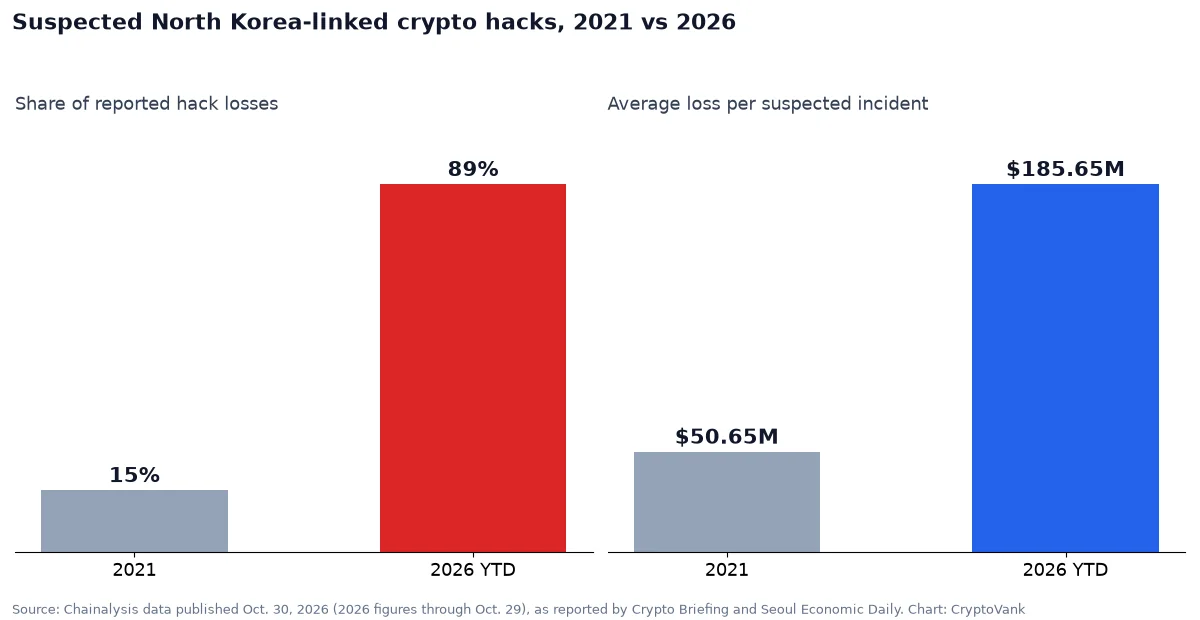
The same day, Chainalysis shared data showing how dominant North Korea has become. Suspected North Korea-linked hacks made up almost 89% of reported crypto hack losses in 2026, up from 15% in 2021, per Crypto Briefing and Seoul Economic Daily. The average loss per suspected incident rose from $50.65 million to $185.65 million.
Other recent attacks also aimed at people, not code. Trezor warned of a suspected implant in Safe 5 devices from one reseller, as we reported in our Trezor Safe 5 story. Meanwhile, hijacked web domains drained DeFi users, covered in our DNS hijack report.
Markets barely reacted to the Chainalysis news. At 17:57 UTC on Oct. 31, CoinGecko showed Bitcoin at $77,655 (+0.77% in 24 hours) and Ether at $2,255.11 (+0.75%).
What Chainalysis users should do now
Chainalysis gave its users clear advice. Here is the short version, plus a few common-sense steps:
- Turn on two-factor authentication. Chainalysis “strongly” recommends it for any organization that has not enabled it.
- Distrust surprise prompts. Treat unexpected password resets and login requests as suspect. Go to the site directly instead of clicking links.
- Watch for impersonators. BleepingComputer said the firm warned about scammers posing as Chainalysis, especially with “fund recovery” or recruiting offers.
- Brief your team. Role labels leaked, so staff in compliance and investigations are the likely targets.
The same rules help everyday crypto users. Never share a recovery phrase, as explained in our seed phrase guide.
What to watch next
- The detailed breakdown. Chainalysis says it will tell each organization which records were accessed.
- Technical details. So far, the firm has not named the flaws or said how long the attacker had access.
- Follow-on phishing. Expect targeted scams aimed at investigators and exchange compliance teams in the coming weeks.
Chainalysis breach FAQ
What data was exposed in the Chainalysis breach?
Chainalysis says the attacker accessed user IDs, full names, email addresses and organization role labels for users on its platform. It is still working out which records belong to each customer.
Were passwords or investigation files stolen?
Based on its investigation so far, Chainalysis says it found no evidence of access to investigation content, transaction or query results, clear-text passwords, MFA secrets or session tokens.
Is the Chainalysis breach linked to the Binance hack?
No. Chainalysis says the incident is not related to the Binance theft. Separately, its researchers attribute the $6.4 billion Binance hack to North Korea’s TraderTraitor group.
Sources
- Chainalysis: Security incident information
- BleepingComputer: Chainalysis discloses data breach
- The Block: Chainalysis says hacker accessed customers’ names and emails
- Cointelegraph: Chainalysis hit by cybersecurity incident
- Chainalysis: Binance hack traced to North Korea
- Crypto Briefing: North Korea-linked hacks near 89% of 2026 losses
- Seoul Economic Daily: Chainalysis on North Korea’s share of hack losses
- CoinGecko: Bitcoin price data
This article is for information only and is not financial advice. Crypto assets are volatile; do your own research before making any decision.