Quick answer: A seed phrase is a list of 12 to 24 words that can rebuild your crypto wallet on any compatible device. Under the BIP-39 standard, each word comes from a fixed list of 2,048 words. Write it down offline, store it in two safe places, and never type it into a website or share it with support.
A seed phrase is the single most important thing you own in crypto. It is a short list of words that can rebuild your whole wallet, coins included, on any compatible device. Lose it and a broken phone can mean lost funds. Leak it and a stranger can drain your wallet in minutes.
This guide explains how a seed phrase works, how to back it up, where to store it, and how to spot the scams that target it.
What is a seed phrase?
A seed phrase (also called a recovery phrase, mnemonic or, at Trezor, a “wallet backup”) is a human-readable version of your wallet’s master secret. Most wallets use 12 or 24 words. From those words, your wallet derives every private key and address it will ever use.
In other words, your device is just a window. The seed phrase is the wallet itself. If your hardware wallet breaks or is stolen, you can buy a new one, enter the words, and get your funds back. That is why we put it at the center of our self-custody wallet setup guide.
How does a seed phrase work under BIP-39?
Most wallets follow BIP-39, a Bitcoin standard that many other chains also use. Here is the short version:
- The wallet generates 128 to 256 bits of random data (entropy).
- It adds a short checksum taken from a SHA-256 hash of that data.
- It splits the result into 11-bit chunks. Each chunk maps to one word from a fixed list of 2,048 words.
So 128 bits gives you 12 words and 256 bits gives you 24 words. The checksum is why a wallet can often tell you when a word is wrong.
Finally, the words are run through PBKDF2 with 2,048 rounds of HMAC-SHA512 to produce a 512-bit seed. That seed is what actually creates your keys.
Are 12 words safe enough?
Yes. 128 bits of randomness is far beyond what anyone can guess by brute force. The real risk is not math. It is people: photos, phishing pages and fake support agents.
What about 20-word backups?
Some Trezor models use SLIP-39 instead. Per Trezor, these backups use 20 words from a 1,024-word list and can be split into several shares. The storage rules below still apply.
How do you back up a seed phrase the right way?
Your wallet shows the words only once, during setup. Trezor’s backup safety guide recommends a few simple habits:
- Do it alone. Make sure no one is watching, and mind cameras and smart speakers nearby.
- Don’t read the words aloud.
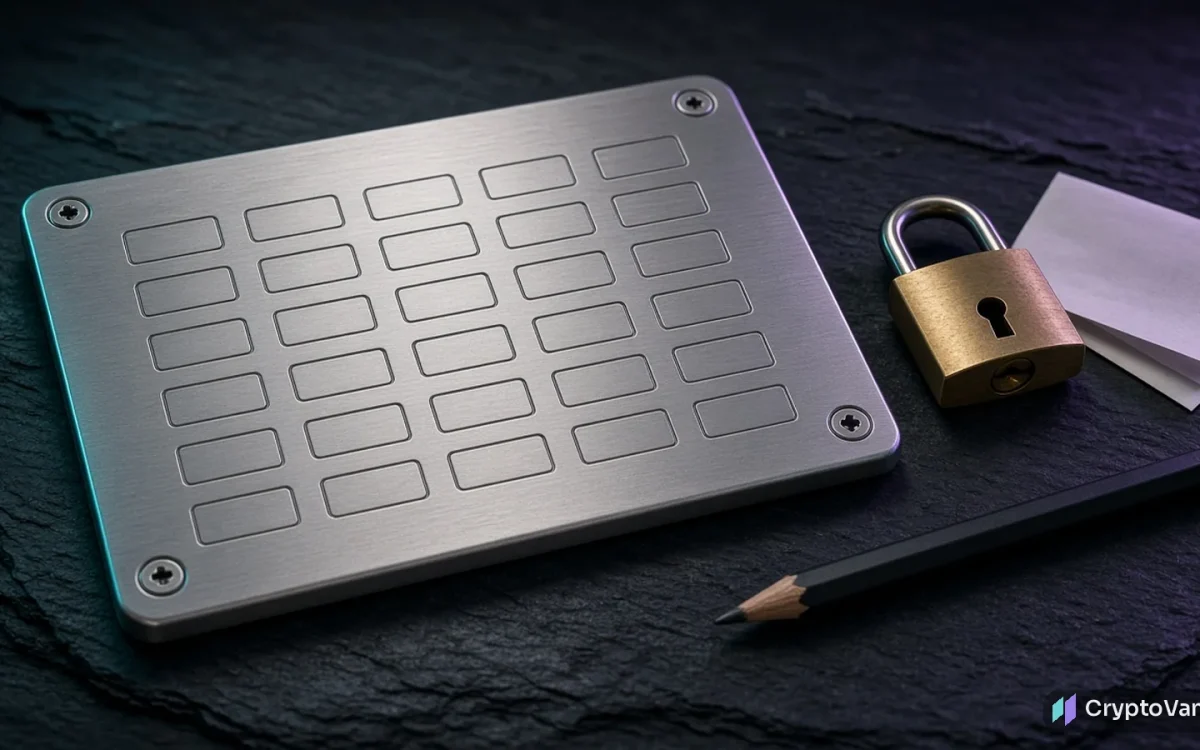
- Write them by hand, in order, on the card that came with your device or on a steel plate.
- Check every word, then let the wallet verify the backup if it offers that step.
- Never make a digital copy. That means no screenshot, phone photo, email, password manager note or cloud file.
A digital copy is the number-one way seed phrases leak. Malware scans phones and computers for exactly these files.
Where should you store a seed phrase?
Think about two threats: someone finding it, and you losing it. A good setup handles both.
| Storage option | Protects against theft | Survives fire or water | Main risk |
|---|---|---|---|
| Paper card at home | Medium | Low | Fire, water, ink fading |
| Steel plate at home | Medium | High | Someone finding it |
| Second copy at a trusted location | Medium | High | Trust in that location |
| Safe deposit box | High | High | Access hours, bank rules |
| Photo, cloud or email | Very low | High | Hacks and malware |
For most people, one steel or paper copy at home plus a second copy in another secure place is a sensible balance. Don’t label it “crypto seed.” And never store it next to the device it unlocks.
Should you add a passphrase for extra protection?
BIP-39 allows an optional passphrase, sometimes called a “25th word.” It is mixed into the seed during the PBKDF2 step. The same 24 words with a different passphrase open a completely different wallet.
That helps if someone finds your words: without the passphrase, they get an empty or decoy wallet. However, there is a catch. Every passphrase opens a valid wallet, so a typo will not show an error. It will just show a wallet with no funds. If you forget the passphrase, nobody can recover it. Store it separately from the words, and test your recovery before you deposit large amounts.
Which scams target your recovery words?
The FBI’s 2025 Internet Crime Report counted 181,565 crypto-related complaints and $11.37 billion in losses, up 22% from the year before. Many of those thefts start with someone handing over their words.
Common tricks include:
- Fake support. Trezor says it will never ask for your backup, not even in a support chat. The same goes for every honest wallet company.
- Phishing emails and texts that claim your wallet needs a “migration” or “verification.” We have seen this against Coldcard users on X and in fake Foundation Passport emails.
- Tampered devices that arrive with a pre-filled recovery card. Learn how to check if a hardware wallet is genuine.
- “Recovery services” that promise to get stolen coins back for an up-front fee. The FBI warns these are often scams.
The rule is simple: only type your seed phrase into your own hardware wallet, when that device asks for it.
What should you do if your seed phrase is exposed?
Act fast, because there is no way to change a seed phrase. You have to move to a new one:
- Set up a new wallet on a clean device and write down the new words.
- Send all funds from the old wallet to the new addresses, starting with the largest balances.
- Revoke token approvals on the old addresses if you used DeFi.
- Treat the old phrase as burned. Never reuse it.
If a theft already happened, report it to local police and, in the US, to the FBI’s IC3.
For deeper protection ideas, see our explainer on crypto bunker mode. You can also track the market on our Bitcoin price page.
This article is for information only. Not financial advice. DYOR.
Seed Phrase FAQ
What happens if I lose my seed phrase?
If your device still works, move your funds to a new wallet with a fresh backup right away. If you lose both the device and the seed phrase, the funds cannot be recovered by anyone, including the wallet maker.
Can I store my seed phrase in a password manager?
Wallet makers advise against it. Trezor’s guidance says never to make digital copies, including photos, email or cloud files, because any online copy can be stolen by malware or a breach.
Is a seed phrase the same as a private key?
Not exactly. Under BIP-39, the seed phrase creates a master seed, and that seed derives every private key in the wallet. One seed phrase can therefore back up many keys and addresses at once.
How many words is a seed phrase?
Most BIP-39 wallets use 12 or 24 words, though the standard allows 12, 15, 18, 21 or 24. Trezor’s SLIP-39 backups use 20 words.