Quick answer: The Kalshi valuation reached $40 billion after a $1 billion Series G round announced on Oct. 29, 2026, co-led by Sequoia and Wellington. That is up from $22 billion in May. Kalshi says its crypto trading volume now runs at $140 billion a year, per its blog, CNBC and Reuters.
The Kalshi valuation now stands at $40 billion after a $1 billion Series G round, the company said on Oct. 29, 2026. In other words, the prediction market nearly doubled its price tag in five months, and crypto is a growing part of that story.
Sequoia and Wellington co-led the round. Ten other investors joined, including Andreessen Horowitz, Coatue, Morgan Stanley Investment Management and Hudson River Trading, according to Kalshi’s announcement.
What happened with the Kalshi valuation
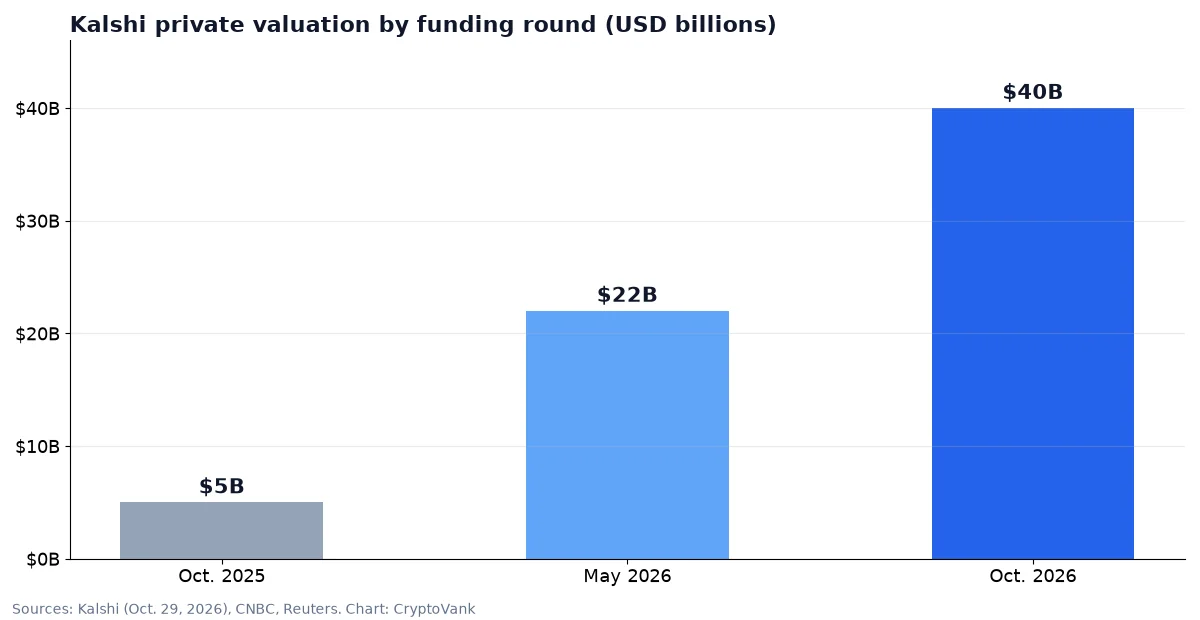
To start, Kalshi raised $1 billion at a $40 billion post-money valuation. CNBC reported that the previous round, in May 2026, valued the firm at $22 billion. A year ago, in October 2025, it was worth just $5 billion.
As a result, that is an eightfold jump in twelve months. Reuters put the rise since May at nearly 82%. It also said Tiger Global and Dragoneer took part, citing a source.
Kalshi shared new growth figures with the deal:
- Annualized trading volume above $1 trillion across all products.
- Over $1 billion in non-sports annualized revenue.
- More than 30 million accounts opened.
- Over 75% of all prediction market trading volume.
- About 500 institutional entities active in September.
However, these are company figures. So far, no outside auditor has confirmed them.
Why the Kalshi valuation matters for crypto
Kalshi is no longer only a place to bet on elections or football. It now calls itself a “next-generation financial exchange.” In fact, crypto is one of its fastest lanes.
According to the company, crypto trading volume has reached $140 billion annualized. Moreover, its perpetual futures, launched in May, have already logged $83 billion in volume and over 500,000 traders. For context, perpetuals are futures with no expiry date. Until recently, US traders mostly reached them through offshore venues.
That puts Kalshi in direct competition with crypto-native platforms. For example, ICE recently moved to bring Hyperliquid perpetual futures to US traders. Meanwhile, Coinbase reported that its own prediction markets passed $200 million in annualized revenue in its Q3 earnings.
Overall, our read is simple. Investors are not paying $40 billion for sports contracts alone. Instead, they are paying for a US-regulated venue that can list almost anything, from bitcoin price brackets to stock perps. If that model works, it pulls retail crypto volume away from offshore exchanges.
Data and context: a crowded, contested market
The raise lands on a rough day for crypto. At 13:57 UTC on Oct. 30, 2026, bitcoin traded at $76,625, down 4.4% in 24 hours, per CoinGecko. Ether was at $2,216.75, down 4.5%. Hyperliquid’s HYPE held steady at $91.32.
Much of that drop followed the $6.3 billion Binance hack. Even so, money keeps flowing into trading venues rather than out of them.
At the same time, rivals are moving fast too. Polymarket has launched 5-minute crypto markets for US users. However, it also had to pause trading after a hack this week. That contrast helps Kalshi pitch itself as the safer, regulated choice.
The legal fight has not gone away, though. CNBC noted that two US appeals courts ruled in August and September that states can regulate sports event contracts. A third court sided with the federal view, so the Supreme Court will likely settle it. Separately, Utah has also filed criminal charges against Kalshi.
What to watch next
First, watch the new products. Kalshi plans single-stock perpetual futures, indices built with S&P, leveraged event contracts and markets on the price of computing power.
Second, watch the courts. A Supreme Court ruling on state versus federal control could reshape the whole sports business, which is still Kalshi’s biggest driver.
Third, keep an eye on a possible listing. CEO Tarek Mansour told CNBC in June that a public offering was under discussion, but not before 2027.
Finally, watch crypto volume share. If Kalshi’s $140 billion crypto run rate keeps growing, it may start to take real share from offshore perp exchanges.
Kalshi valuation FAQ
What is Kalshi’s valuation now?
Kalshi is valued at $40 billion after a $1 billion Series G round announced on Oct. 29, 2026. Sequoia and Wellington co-led it. The previous valuation, in May 2026, was $22 billion, according to CNBC.
How big is crypto trading on Kalshi?
Kalshi says its crypto trading volume has reached $140 billion annualized. Its perpetual futures, launched in May 2026, have logged $83 billion in volume and over 500,000 traders. These figures come from the company and are not independently audited.
Is Kalshi legal in every US state?
Not without dispute. Two federal appeals courts ruled in 2026 that states can regulate sports event contracts, while a third sided with federal control. As a result, the Supreme Court will likely decide the question.
Sources
- Kalshi: Kalshi raises $1B Series G at $40B valuation
- CNBC: Kalshi valuation jumps to $40 billion in latest funding round
- Reuters via Investing.com: Kalshi raises $1 billion at $40 billion valuation
- Cointelegraph: What happened in crypto today
- CoinGecko: live prices
This article is for information only and is not financial advice. Prediction markets and perpetual futures carry a high risk of loss.