Quick answer: Polymarket 5-minute markets went live on the Polymarket US app on Oct. 27, 2026, for BTC, ETH, SOL and XRP. Each contract pays $1 if the price closes higher or lower than its open, settled on CF Benchmarks index prices, with ties going to Up, per Polymarket’s documentation.
Polymarket 5-minute markets are now live for US users. On Oct. 27, 2026, at 20:28 UTC, Polymarket posted on X that five-minute crypto up/down contracts for XRP, SOL, ETH and BTC had gone live in the Polymarket US app. The post passed 290,000 views within a few hours.
The launch shrinks the shortest crypto bet on the regulated US app to five minutes. That means 288 windows per asset every day, and it puts a fast, simple product in front of retail traders who might otherwise use leverage on an exchange.
How do Polymarket 5-minute markets work?
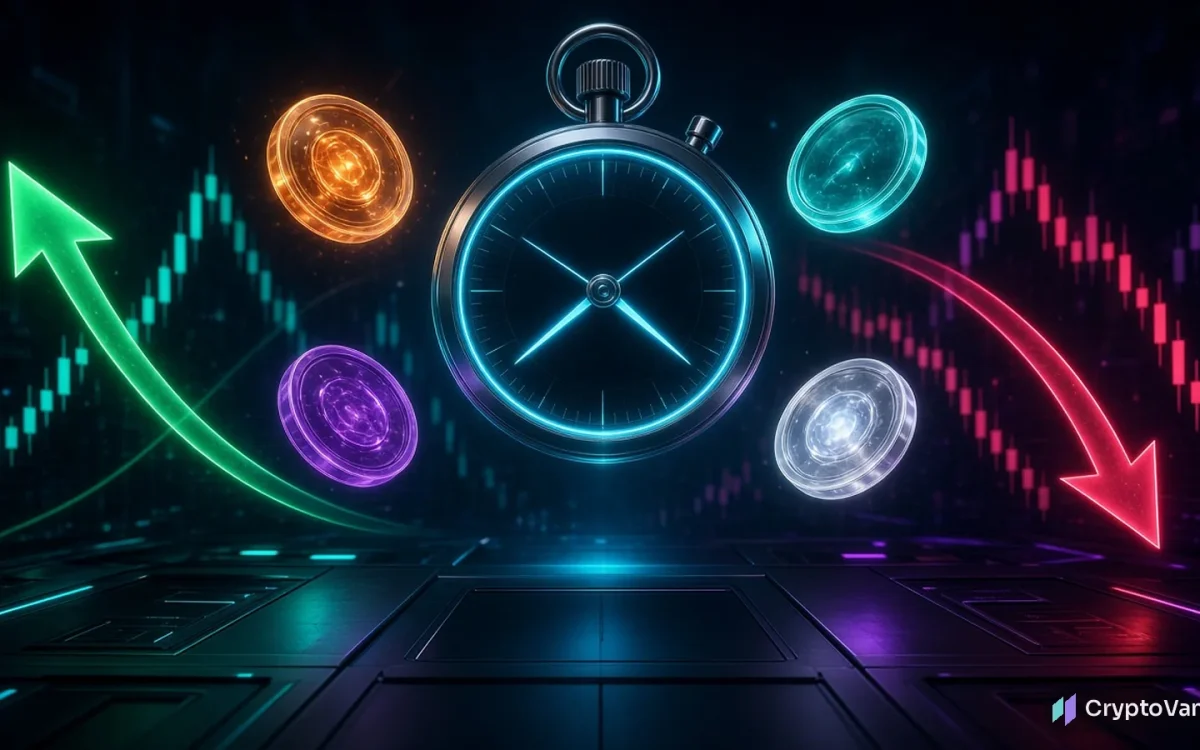
Each window is its own market with one question: will the coin finish the five minutes above or below its starting price? You buy “Up” or “Down” shares priced between $0.01 and $0.99. The winning side pays $1.00 per contract, and the losing side pays nothing.
The share price works as the crowd’s live probability. For example, a 52-cent “Up” price means traders see roughly a 52% chance the coin closes higher. Polymarket US runs under the oversight of the Commodity Futures Trading Commission (CFTC) through QCX LLC, the derivatives exchange it bought in 2025 to return to the US market.
How are the US contracts settled?
This detail matters most, and early coverage got it mixed up. The US app does not settle on a single exchange price. According to the Polymarket US crypto FAQ, crypto markets settle on CF Benchmarks’ regulated real-time index, which publishes once per second.
For up/down markets, the open and the close are each the average of the 60 index prices in the minute before that moment, rounded to two decimals. The long side wins when the close is greater than or equal to the open, so a tie settles Up. Prices on spot exchanges have no effect, and no market settles on partial data. If index prices are missing, settlement waits.
Averaging over a full minute makes the result harder to push with one large order in the final second. It does not remove manipulation risk, but it raises the cost. By contrast, the international site, polymarket.com, resolves its up/down markets with a Chainlink TWAP feed, a time-weighted average price, which is why some reports cited Chainlink.
What fees do traders pay on 5-minute markets?
Fees are where short windows get expensive. The Polymarket US fee schedule charges takers 0.0695 × contracts × price × (1 − price). The fee is highest at a 50-cent price: $1.74 per 100 contracts, or about 3.5% of the $50 stake. At a 90-cent price, the same 100 contracts cost about $0.63. Makers who post resting orders get a small rebate instead.
As a result, a trader who buys near 50 cents needs to be right well over half the time just to break even. That edge disappears quickly when you trade many windows a day.
| Detail | Polymarket US 5-minute market |
|---|---|
| Assets | BTC, ETH, SOL, XRP |
| Launch | Oct. 27, 2026 |
| Payout | $1.00 per winning contract |
| Settlement | 60-second average of CF Benchmarks index |
| Tie | Settles Up |
| Max taker fee | $1.74 per 100 contracts at $0.50 |
Why does this launch matter for crypto markets?
Short-dated crypto bets are one of Polymarket’s busiest products worldwide, and the US app is copying that menu step by step. Polymarket first ran a five-minute Bitcoin format on its international site in February 2026. Then, on Oct. 15, the US app added 15-minute, hourly and daily windows for ETH, SOL and XRP, according to Crypto Briefing.
For the wider market, the direct price impact is small, because these contracts track the index and do not buy or sell the coins. Still, they compete with perpetual futures for the same fast-money traders. At launch, Bitcoin traded near $80,543, per Basis Desk. Live prices are on our Bitcoin price page, Solana price page and XRP price page.
The regulatory fight is not over either. Several US states still oppose federally regulated prediction markets, as the Missouri prediction market lawsuit shows. Meanwhile, rivals keep lining up, including Blockchain.com’s CFTC filing.
What are the main risks?
Five minutes is pure noise for most assets. Small moves, news headlines or a burst of liquidations can flip the result. On X, traders have already raised concerns that fast trading bots will dominate these windows. In short, treat every contract as a binary bet that can go to zero, not as an investment.
Polymarket 5-Minute Markets FAQ
Are Polymarket 5-minute markets legal in the US?
They run on the Polymarket US app, which operates under CFTC oversight through QCX LLC. Availability can still differ by state, so check the app’s rules for where you live.
Which coins have Polymarket 5-minute markets?
At the Oct. 27, 2026, launch on the US app, the markets cover Bitcoin (BTC), Ether (ETH), Solana (SOL) and XRP, per Polymarket’s post on X.
What happens if the price ends exactly where it started?
A tie settles Up. Polymarket US says the long side is paid when the close value is greater than or equal to the open value.
How much does a Polymarket 5-minute trade cost in fees?
Taker fees follow 0.0695 × contracts × price × (1 − price). That is $1.74 per 100 contracts at a 50-cent price and less near the extremes, per the Polymarket US fee schedule.
Not financial advice. Prediction markets are high risk and you can lose your full stake. Always DYOR.
Sources
- Polymarket on X: 5-minute crypto up/downs live in the US app (Oct. 27, 2026)
- Polymarket US Documentation: Crypto FAQs
- Polymarket US Documentation: Fee Schedule
- Polymarket Documentation: Resolution
- Crypto Briefing: Polymarket US launches 5-minute crypto markets
- The Defiant: Polymarket Adds Five-Minute Crypto Contracts to US App