
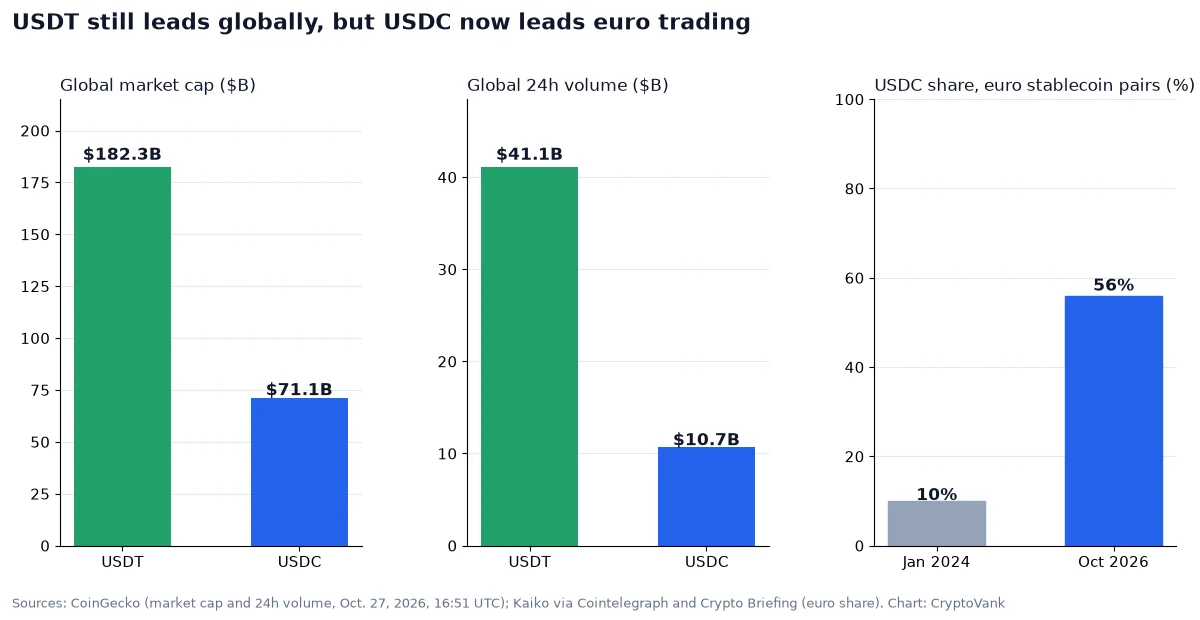
Quick answer: Yes. USDC euro trading has overtaken USDT. Kaiko data published Oct. 27, 2026 shows USDC handles 56% of stablecoin trading against the euro, up from 10% in January 2024, and its euro order books are about 40% deeper. MiCA rules that push exchanges to drop USDT for EU users drove the shift.
USDC euro trading has passed Tether for the first time. New Kaiko data shows Circle’s USDC now handles 56% of stablecoin trades against the euro, up from just 10% in January 2024.
The cause is regulation, not a sudden love for USDC. Below, we look at the data, the deadlines and what the shift could mean for the US market next.
What happened in USDC euro trading?
Kaiko published the figures on Oct. 27, 2026, as reported by Cointelegraph and Crypto Briefing. USDC’s share of stablecoin-euro volume climbed from 10% to 56% in under three years. In addition, its euro order books are now about 40% deeper than USDT’s.
Kaiko called these pairs a “main on-ramp and off-ramp for European customers.” In other words, this is where many Europeans swap euros into dollar tokens before they buy crypto. So the pair that wins here wins the front door.
The jump tracks the EU’s Markets in Crypto-Assets rules, known as MiCA. Its stablecoin rules took effect on June 30, 2024. Then the transition period for issuers ended on July 1, 2026, and it was not extended. Since Tether did not seek MiCA authorization for USDT, exchanges serving EU users have been pulling it.
Why does it matter?
First, it shows that regulation can move liquidity fast. Total stablecoin demand did not change much, according to an academic study of the delistings. Instead, traders simply moved to the token that EU exchanges are still allowed to list.
Second, it gives Circle a regulatory edge. On Oct. 14, 2026, the European Banking Authority named USDC the EU’s first “significant” e-money token. As a result, the EBA will supervise its reserves and liquidity directly from Nov. 12, 2026. That means more scrutiny, but it also gives listing teams certainty.
Third, Tether is losing a channel rather than its demand. USDT still dominates outside regulated venues, including DeFi. However, licensed European exchanges are becoming a more institutional market, and Tether is now largely shut out of it.
The data: global giant vs. euro leader
We pulled live figures from CoinGecko at 16:51 UTC on Oct. 27, 2026. They show how unusual the euro result is.
| Metric | USDT | USDC |
|---|---|---|
| Market cap | $182.3 billion | $71.1 billion |
| 24h trading volume | $41.1 billion | $10.7 billion |
| Share of euro stablecoin pairs (Kaiko) | minority | 56% |
| Euro order-book depth (Kaiko) | baseline | about 40% deeper |
By our math, USDT is still about 2.6 times larger by market cap. Similarly, it trades about 3.8 times more volume worldwide. Even so, USDC now leads in euro pairs. In short, Europe is the one big market where the smaller token is on top.
There is a caveat, though. Euro stablecoins and dollar stablecoins are not the main way Europeans trade. Kaiko’s earlier research found that euro-backed stablecoins made up under 8% of all EUR trading volume. Most volume still runs through plain euro-to-crypto pairs.
The Oct. 30 Coinbase deadline
The next step comes in three days. According to Coinbase’s help center, retail users in the European Economic Area must withdraw USDT and 13 other restricted tokens by Oct. 30, 2026. After that, Coinbase will convert leftover balances at market rates, into USDC where suitable.
The list also includes PYUSD, DAI, USD1 and the gold token PAXG. Notably, a PAXG holder converted to USDC would swap gold exposure for dollars. Coinbase also warns that a conversion may be a taxable event in some countries.
Meanwhile, the wider deadline is later. ESMA’s Oct. 8 opinion gave firms three months to wind down services tied to non-compliant stablecoins. That points to Jan. 8, 2027, as we covered in our report on the ESMA non-MiCA stablecoin deadline.
What to watch next
Watch the US. Kaiko said the GENIUS Act takes a similar approach. On Oct. 21, the OCC issued its first final rule under that law, effective Jan. 18, 2027. Then, from July 2028, US platforms face limits on stablecoins from issuers that lack approval. Tether has answered with a separate US token, USAT, rather than changing USDT.
Next, watch whether USDC’s 56% share keeps rising after Coinbase’s conversion. Also watch how EBA supervision works in practice from Nov. 12. Finally, if you are still choosing between the two, our USDT vs. USDC guide explains the trade-offs. For spending stablecoins day to day, see our crypto card comparison.
USDC euro trading FAQ
Why did USDC overtake USDT in euro trading?
MiCA requires stablecoin issuers to be authorized before EU exchanges can serve their tokens. Circle complied with USDC, but Tether did not with USDT. As a result, exchanges serving EU users restricted USDT, and euro trading moved to USDC.
Is USDT banned in Europe?
No. MiCA restricts what licensed exchanges and crypto firms can offer, not what people hold. Users can still keep USDT in self-custody wallets, and it remains widely used in DeFi.
What happens to my USDT on Coinbase in the EU?
Coinbase says EEA retail users who do not withdraw USDT by Oct. 30, 2026 will have it converted at market rates, usually into USDC. Deposits of USDT sent after that date will not be credited.
Not financial advice. Stablecoin rules differ by country and can change. Always DYOR.
Sources
- Cointelegraph: USDC overtakes USDT in euro stablecoin trading as EU rules reshape market: Kaiko (Oct. 27, 2026)
- Crypto Briefing: Circle’s USDC overtakes Tether’s USDT in euro trading as MiCA rules reshape market (Oct. 27, 2026)
- Coinbase Help: MiCA non-compliant stablecoins
- CryptoSlate: Coinbase sets 3-day MiCA deadline for USDT, PayPal and Trump-linked stablecoins
- arXiv: study of stablecoin trading after MiCA delistings
- CoinGecko: USDC price and market data
- CoinGecko: Tether price and market data