Quick answer: The OCC issued the first GENIUS Act final rule on Oct. 21, 2026, setting reserve, redemption, custody and risk rules for payment stablecoin issuers it supervises. It takes effect Jan. 18, 2027, drops a planned presumption against third-party rewards, and will judge rewards programs case by case, per the OCC and CoinDesk.
The US now has its first finished rulebook for dollar stablecoins. On Oct. 21, 2026, the Office of the Comptroller of the Currency (OCC) announced the GENIUS Act final rule, becoming the first federal regulator to complete its part of the 2025 stablecoin law.
The headline change is about rewards. The OCC dropped a planned presumption that some issuer and exchange deals are illegal, but it also refused to bless existing rewards programs, according to CoinDesk.
What does the GENIUS Act final rule cover?
The rule sets requirements for permitted payment stablecoin issuers and foreign payment stablecoin issuers under the OCC’s watch, plus some custody activities at banks it supervises, per the OCC news release 2026-92. It covers reserve backing, redemption, risk management, custody, applications and supervision.
It does not cover the Bank Secrecy Act, anti-money laundering or sanctions rules. The OCC said those will come in a separate rulemaking with the Treasury Department.
Comptroller Jonathan V. Gould said the agency is “providing a clear, practical framework for payment stablecoin innovation, with strong standards for reserve backing, redemption, and risk management.” Treasury Secretary Scott Bessent compared the law to the National Currency Act of 1863.
When does the GENIUS Act take effect?
The final rule and the GENIUS Act both take effect on Jan. 18, 2027, the OCC said. The agency will announce separately when it starts accepting applications and waiver requests from would-be issuers.
The OCC also said it received hundreds of comments on its proposal, from crypto firms and community banks to trade groups and academics.
What did the GENIUS Act final rule change for rewards?
The GENIUS Act bans issuers from paying anything “solely in connection with the holding, use, or retention” of a payment stablecoin. The question has been whether exchanges can still pay rewards on coins like USDC.
The draft rule had a presumption that certain issuer deals with third parties were unlawful. The final rule removes it, a regulatory official told reporters, according to The Block. Instead, the OCC will review each deal case by case and said it can act against “a clear evasion.”
That is not a free pass. “The OCC declines to presume that rewards programs that predated the GENIUS Act comply with the GENIUS Act,” the rule states, as quoted by CoinDesk. The agency hinted that a reward made “at least in part, for other reasons” may fall outside the ban.
Which stablecoin rewards programs are affected?
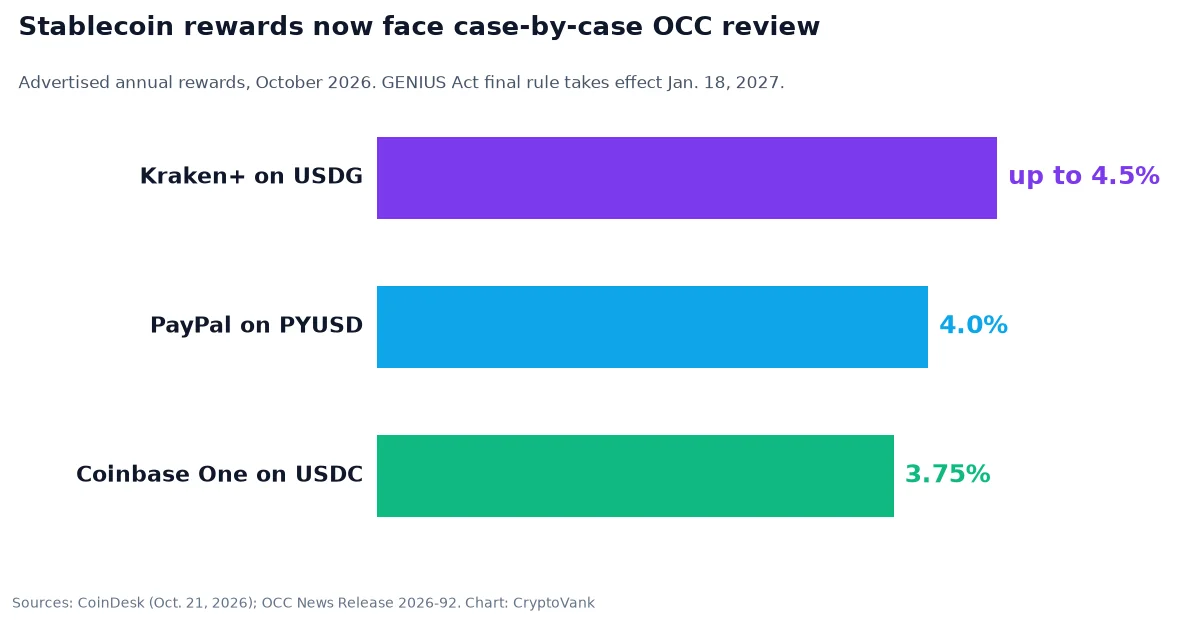
CoinDesk lists three well-known programs: PayPal pays 4% on PYUSD, Coinbase One pays 3.75% on USDC, and Kraken+ members can earn up to 4.5% on USDG. None gets a safe harbor, so each could face review once the rule is live.
Banks have fought these programs because they say rewards pull deposits away. That fight helped stall the broader CLARITY Act in the Senate. The OCC said that “unless and until such legislation passes,” it must apply the yield ban as written.
For background on how these coins work, see our stablecoins guide and our USDT vs USDC comparison.
What about reserves and other regulators?
The OCC moved to “a principles-based approach” for reserve diversification and concentration, backed by minimum daily liquidity and limits on exposure to a single counterparty, CoinDesk reported.
Other agencies are still working. The FDIC proposed its approach for state-chartered banks in April 2026, the Treasury proposed its rules in August, and the Federal Reserve issued proposals in September, per CoinDesk. Not all of them are likely to be final by Jan. 18.
Market implications
For Circle, Paxos and bank issuers, a final federal rulebook lowers legal risk and opens a path for community banks to issue tokens. For exchanges, the open question is rewards: a strict reading could squeeze the yields that drive stablecoin deposits, as covered in our look at Circle’s USDC economics.
The move also fits a busy week for US crypto rules, after Ripple and others pushed the SEC on Regulation Crypto Assets. Bitcoin traded near $83,300 on Oct. 21, per The Block’s price ticker, with no sharp reaction to the rule.
Not financial advice. Do your own research (DYOR) before making any investment decision.
GENIUS Act Final Rule FAQ
What is the GENIUS Act final rule?
It is the OCC’s rule, issued Oct. 21, 2026, that puts the GENIUS Act into practice for stablecoin issuers it supervises. It sets standards for reserves, redemption, custody, risk management, applications and supervision, according to the OCC.
When does the GENIUS Act take effect?
The GENIUS Act and the OCC’s final rule both take effect on Jan. 18, 2027. The OCC will announce separately when it begins taking issuer applications.
Are stablecoin rewards banned under the GENIUS Act?
Issuers cannot pay rewards solely for holding or using a stablecoin. The OCC will judge third-party programs, such as exchange rewards on USDC, case by case, and existing programs get no safe harbor, per CoinDesk.
Does the rule cover anti-money laundering?
No. The OCC said Bank Secrecy Act, anti-money laundering and sanctions rules will come in a separate rulemaking with the Treasury Department.