
Quick answer: In a 31-page reply brief filed Friday, Oct. 16, 2026, the CFTC asked a Washington federal court to dismiss CME Group’s lawsuit over crypto perpetual futures. The agency says CME lacks standing because its own bitcoin and ether futures volumes rose after the CFTC approved Kalshi’s bitcoin perp in May.
The U.S. Commodity Futures Trading Commission told a federal judge that CME Group has no right to sue over crypto perpetual futures, because the exchange cannot show any harm. The CFTC CME perpetual futures fight now decides whether the U.S. perp market keeps growing as futures or gets pushed into tougher swap rules.
The agency filed its 31-page reply brief on Friday, Oct. 16, 2026, in the U.S. District Court for the District of Columbia, according to CoinDesk and CoinMarketCap. Markets barely moved on the news. Bitcoin traded at $81,792 and ether at $2,393.24 on Oct. 19 at 19:53 UTC, per CoinGecko.
What happened in the CFTC CME perpetual futures case?
In May, the CFTC approved Kalshi’s bitcoin perpetual contract, the first U.S. perp. A policy statement followed. It said any CFTC-registered exchange can list perps on digital assets, and the agency will review them case by case as futures.
CME sued on June 18, 2026, according to the court docket. Its core claim is simple. A perp has no expiry date, so CME says it is a swap, not a future. The CFTC moved to dismiss in September. Friday’s brief answers CME’s reply to that motion.
The agency’s main point is standing. In other words, CME must show real injury before a court will hear the case. “Allegations of increased competition, without any plausible inference of an imminent financial injury,” are not enough, the brief says, as quoted by CoinDesk. It goes further: “when a plaintiff cannot identify a dollar of harm, much less explain how the requested relief would remedy that non-existent harm, its case does not belong in a federal court.”
CME’s own numbers became the CFTC’s evidence
The sharpest part of the brief uses CME’s own volume reports. Monthly bitcoin futures volume rose from 259,329 contracts in May to 267,693 in September, CoinMarketCap reports. That is a 3.2% gain. Ether futures climbed from 326,981 to 378,292 contracts, up 15.7%.
The CFTC also quotes CME’s chief executive from the July earnings call. He said CME can launch perps but has “not heard demand from our customers for these products.” The brief adds that 94% of CME’s volume in the first half of 2026 came from institutions. “CME cannot have it one way with the court and another way with the investing public on earnings calls,” the agency wrote.
Finally, the CFTC argues that a win would not fix CME’s problem anyway. Swaps can also trade on the same regulated exchanges. “Reclassifying perpetuals from ‘futures’ to ‘swaps’ would not remove them from DCMs any more than reclassifying a movie from ‘action’ to ‘thriller’ would remove it from a streaming platform,” the brief says.
Why it matters for U.S. crypto traders
Perps are the main way crypto traders use leverage. They track a coin’s price with periodic funding payments, and they never expire. Before May, no U.S. exchange offered them, so traders used offshore venues or onchain apps, as our coverage of Pump.fun’s 40x perps on Hyperliquid shows.
The label matters because swaps come with a different, generally heavier rulebook, including tighter limits on retail traders. So if CME wins, the U.S. perp market could shrink back to a niche, or freeze while exchanges rebuild their products.
There is a timing risk too. Jaret Seiberg, a policy analyst at TD Cowen, wrote on Monday that CME may still hold the stronger hand on both standing and the swap argument. “What increasingly concerns us is the growth in perps while the litigation is playing out,” he added, as quoted by CoinDesk. In short, the bigger the market gets, the harder it is to unwind.
The data: U.S. perps are still a rounding error
For now, the U.S. slice is tiny. CoinGecko lists Kalshi with 27 perpetual pairs, $102 million in open interest and about $987 million in 24-hour volume on Oct. 19 at 19:53 UTC. By contrast, Binance reported $33.0 billion in open interest and Hyperliquid $14.8 billion. These figures are self-reported by each venue.
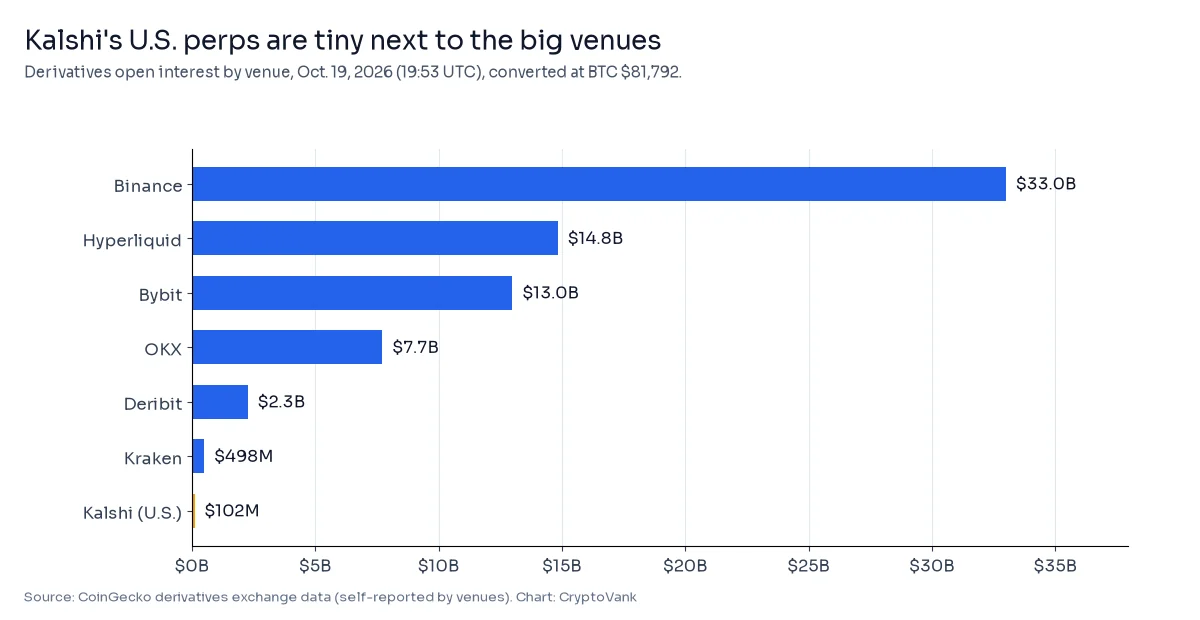
Across the top 100 derivatives venues tracked by CoinGecko, open interest totals about $218 billion. Kalshi’s share is roughly 0.05%. That gap supports the CFTC’s line that CME faces no real threat today. However, it also shows how much room the U.S. market has to grow, which is the very growth CME wants to stop.
What to watch next
Judge Colleen Kollar-Kotelly is hearing the case. In September, she denied a CFTC request for limited discovery into CME’s standing, CoinMarketCap reports. Her next big decision is whether to dismiss the suit. Neither report gives a date for that ruling.
Watch three things meanwhile. First, the ruling on standing, since a dismissal would end the case at the trial level unless CME appeals. Second, new perp listings from other U.S. exchanges. Third, the wider push to bring crypto onshore. The CFTC is already active on several fronts, from Blockchain.com’s prediction market license to the Gemini settlement ruling. The Hyperliquid Policy Center also filed a brief backing the agency in September.
CFTC CME perpetual futures FAQ
Why is CME suing the CFTC over perpetual futures?
CME says crypto perpetual contracts are swaps, not futures, because they never expire. It wants the court to undo the CFTC’s May approval of Kalshi’s bitcoin perp and the policy statement that followed.
What did the CFTC argue in its Oct. 16 brief?
The CFTC says CME lacks standing because it shows no financial harm. It cites CME’s own data: bitcoin futures volume rose 3.2% and ether futures 15.7% from May to September 2026.
Can Americans trade crypto perps on U.S. exchanges today?
Yes. Kalshi lists bitcoin perps under the CFTC’s May 2026 approval, and CoinGecko shows 27 perpetual pairs on the venue. Access could change if a court later rules that perps are swaps.
Sources
- U.S. CFTC rebuffs CME legal stance in consequential fight over perpetual futures (CoinDesk)
- CFTC Presses Court to Toss CME’s Crypto Perpetual Futures Suit (CoinMarketCap)
- Chicago Mercantile Exchange Inc. v. Selig, docket No. 1:26-cv-02157 (CourtListener)
- Derivatives exchanges and Bitcoin price data (CoinGecko)
This article is for information only and is not financial advice. Crypto derivatives are high risk, so do your own research before you trade.