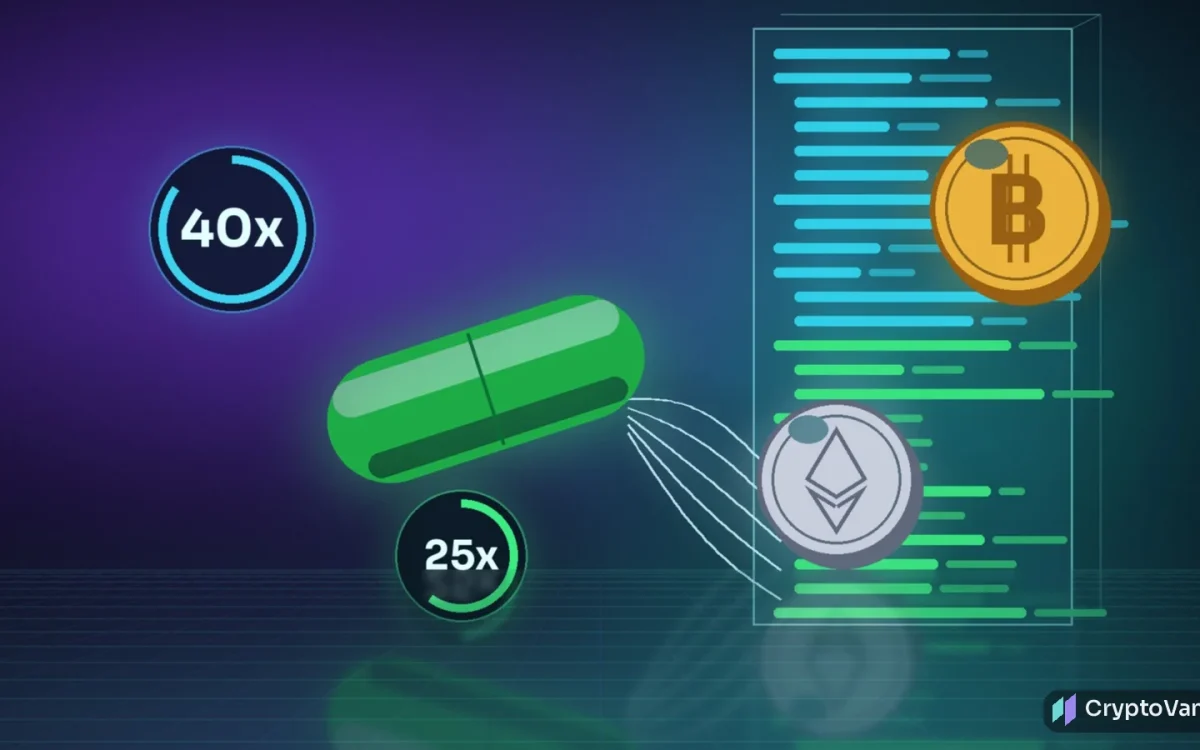
Quick answer: Pump.fun perps went live on Oct. 16, 2026, letting users trade Hyperliquid perpetual futures inside the Pump.fun app with up to 40x leverage on bitcoin and 25x on ether. Hyperliquid runs matching, margin and liquidations, and Pump.fun charges a builder fee of up to 0.10% per order, per its published terms.
Pump.fun perps are live, and they run on Hyperliquid. Since Oct. 16, 2026, users of the Solana memecoin app can open leveraged futures on bitcoin and ether without leaving it.
The launch matters because it turns the biggest memecoin launchpad into a front door for derivatives. In addition, it makes two of crypto’s top fee earners partners instead of pure rivals.
What happened with Pump.fun perps?
Pump.fun added a Perps section to its app on Oct. 16. Early reports put maximum leverage at 40x for BTC and 25x for ETH, according to Bankless and CoinGape.
However, the rollout did not come out of nowhere. Perps data first appeared in Pump.fun’s app interface around Oct. 9, with prices, funding rates and open interest pulled from Hyperliquid. That data also listed stock and commodity contracts, such as Nvidia, Tesla and gold, per ChainCatcher.
How do Pump.fun perps work?
First of all, Pump.fun does not run its own order book. Instead, it uses Hyperliquid’s builder codes. This system lets outside apps send user orders to Hyperliquid and earn a share of the fees.
Pump.fun’s terms, updated Oct. 17, describe the product as a software interface. It sends signed orders to Hyperliquid, which then handles matching, margin, funding, liquidations and settlement, per crypto.news. Pump.fun says it is not the counterparty.
Meanwhile, the published fees are clear. Pump.fun charges a builder fee of up to 0.10% of each order’s notional value. In addition, it takes up to 0.25% per bridge transfer to or from Hyperliquid. At those ceilings, a $10,000 order costs $10 in builder fees. Hyperliquid’s own trading and funding charges come on top.
Access is also limited. The terms block users in the United States and Ontario, plus sanctioned parties.
Why does it matter for Pump.fun and Hyperliquid?
Until now, the two platforms have fought for the top of the crypto revenue charts all year. In late September, Pump.fun briefly out-earned Hyperliquid on a weekly basis, with $15.16 million against $15.06 million, per CoinGape.
Now, however, Pump.fun earns fees by sending its traders to Hyperliquid. In other words, Hyperliquid gains order flow, and Pump.fun gains a second product. This is the builder-code model at work. A front end and a trading venue can compete and cooperate at the same time.
For Pump.fun, the move also cuts its reliance on memecoin launches. After all, those fees rise and fall with retail mania. Perps trading, by contrast, tends to stay busy in both up and down markets.
What does the data say?
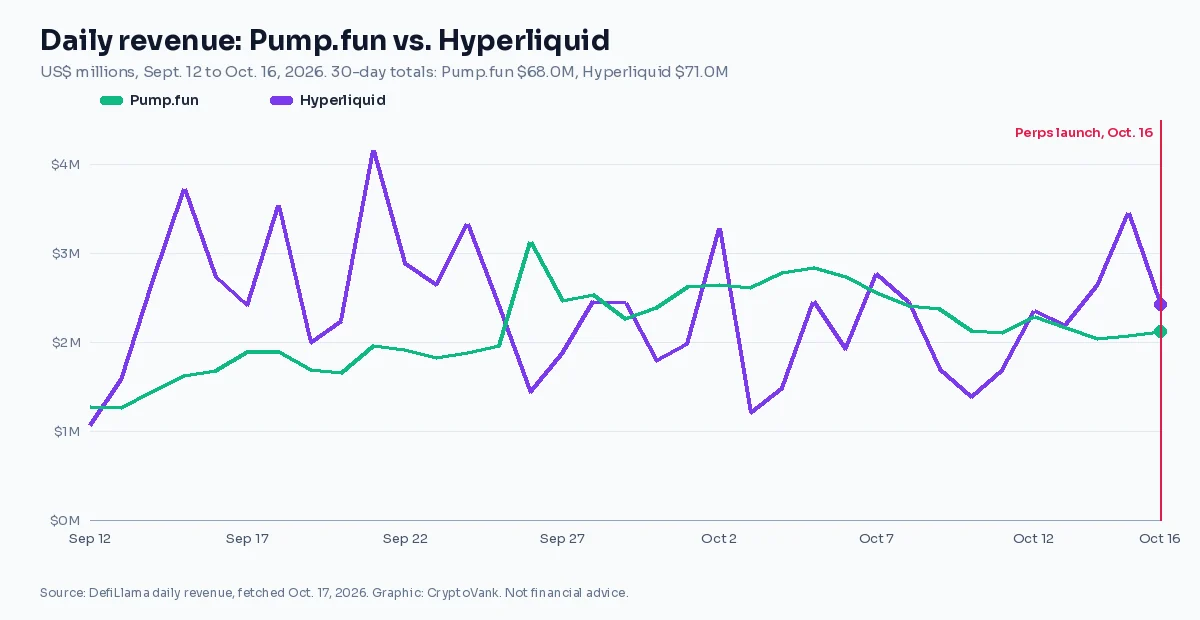
Indeed, DefiLlama’s figures show how close the two businesses are. Over the past 30 days, Pump.fun recorded about $68.0 million in revenue, while Hyperliquid recorded about $71.0 million. Similarly, over seven days, the totals were $14.9 million and $16.2 million.
On Oct. 16, launch day, Pump.fun earned about $2.12 million and Hyperliquid about $2.42 million. So the first day of perps barely moved Pump.fun’s numbers. That is normal, since new features take time to draw volume.
Token prices were also calm. At 07:52 UTC on Oct. 17, 2026, PUMP traded near $0.00461, up 1.7% in 24 hours, per CoinGecko. HYPE traded near $80.16, down 1.3%. At the same time, bitcoin sat near $81,596.
What are the risks for traders?
Of course, high leverage cuts both ways. At 40x, a move of about 2.5% against a position can wipe out the margin. Pump.fun’s own terms warn that users can lose all posted collateral and that Hyperliquid can liquidate positions automatically.
Besides, Hyperliquid has seen dramatic blowups this month. For example, we covered how a well-known trader was liquidated on a 25x ETH long. Meanwhile, rivals keep raising the stakes, from Jupiter’s 1,000x “Yolo” mode to Papertrade’s 1,000x launch on HyperEVM. For that reason, our guide to DeFi risks explains why these products need care.
What to watch next
First, watch whether Pump.fun lists the stock and commodity contracts seen in its interface data. Second, track builder-code revenue on Hyperliquid in the coming weeks. Above all, a real jump would show whether memecoin traders want leverage. Finally, watch PUMP and HYPE for any lasting reaction once volume data arrives.
Pump.fun Perps FAQ
What leverage do Pump.fun perps offer?
Pump.fun perps launched on Oct. 16, 2026, with up to 40x leverage on bitcoin and up to 25x on ether, per Bankless and CoinGape. Trades run on Hyperliquid’s order books.
How much does Pump.fun charge for perps trading?
Pump.fun’s published terms set a builder fee of up to 0.10% of each order’s notional value and up to 0.25% per bridge transfer. Hyperliquid’s own trading and funding fees are charged separately.
Can US users trade Pump.fun perps?
No. Pump.fun’s terms block the perps feature for people and entities in the United States, its territories and Ontario, as well as sanctioned parties.
Not financial advice. Leveraged trading can wipe out your full deposit. Always do your own research.
Sources
- Bankless: Pump.fun Adds Leveraged Perps via Hyperliquid
- crypto.news: Pump.fun adds Hyperliquid perpetuals with fees up to 0.10% per order
- CoinGape: Pump.fun Rolls Out Crypto Perpetual Futures Trading Powered by Hyperliquid
- ChainCatcher: Pump.fun front-end shows Hyperliquid perpetual data
- DefiLlama: Pump revenue
- DefiLlama: Hyperliquid revenue
- CoinGecko: Pump.fun (PUMP) price