
Quick answer: On Oct. 15, 2026, Jupiter Labs launched YOLO in beta on jup.ag: long or short SOL, BTC or ETH at 500x–1,000x against a House pool, with JupUSD collateral. At 1,000x, a 0.1% adverse move liquidates you. Profits can wait in a FIFO queue if the House is short, per Jupiter docs.
Jupiter Labs shipped a product named for exactly how it feels. Jupiter YOLO, live in beta on Oct. 15, 2026, lets traders go long or short SOL, BTC or ETH at 500x to 1,000x leverage — and they bet against a shared House pool, not against each other.
The pitch is speed and size. However, the math is unforgiving: at 1,000x, a 0.1% move against you wipes the position. Before you click Long or Short on jup.ag/yolo, here is how it works and what the docs say about payouts.
What is Jupiter YOLO?
According to Jupiter’s official docs, YOLO is an experimental Jupiter Labs beta. You open it from Labs on jup.ag (Beta tag) or go to /yolo. Markets are SOL, BTC and ETH. Direction is long or short. Leverage steps from 500x to 1,000x in 100x increments.
Collateral and payouts settle in JupUSD. Other tokens are swapped into JupUSD when you open. The minimum collateral is $5 per position; the maximum position size is $1,000,000. There is no expiry and no holding fee. Orders are market only — no stop loss, no take profit.
Importantly, every trade is against the House, a pool funded only by trader losses. YOLO does not use Jupiter’s JLP pool, and its rules differ from Jupiter Perps, which have historically capped leverage far lower.
How fast can a Jupiter YOLO position get liquidated?
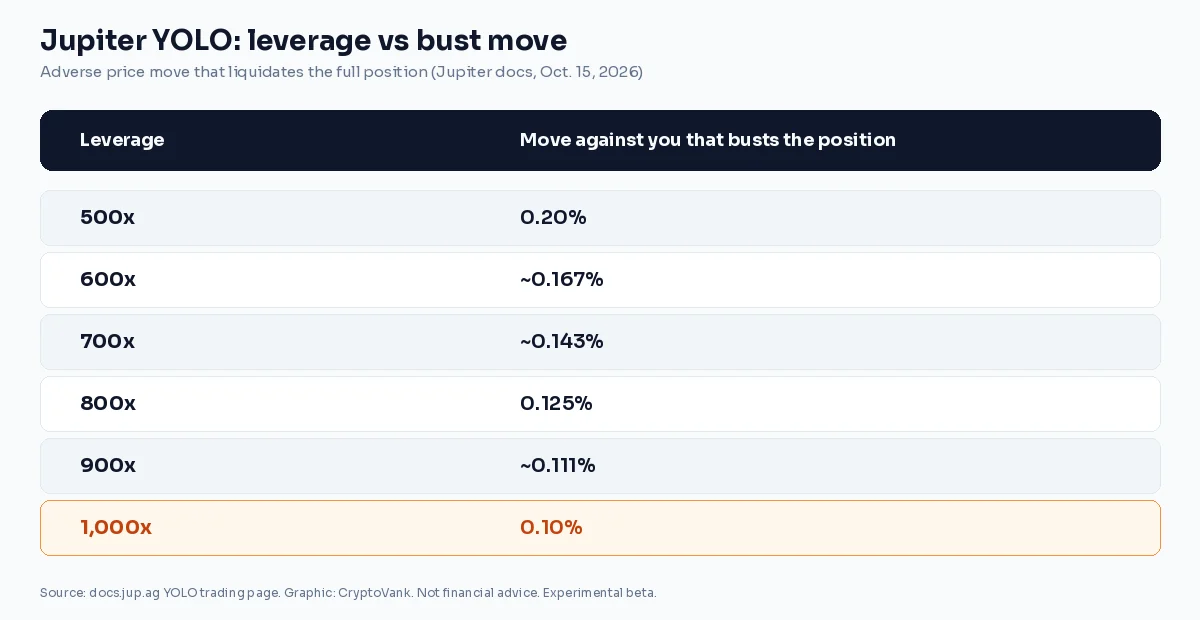
Very fast. Jupiter publishes a bust table: at 500x, a 0.2% adverse move liquidates you; at 1,000x, it is 0.1%. Losses are linear until the bust price, then the position closes automatically and you lose all of that position’s collateral. You never owe more than the collateral you posted.
Because there is no stop loss, you cannot soft-exit before the bust. Signing a close does not guarantee it lands before liquidation if the network, oracle or keepers lag, the risks page warns. Orders fill at the onchain oracle price when they execute, with no price limit.
For a recent reminder of how leverage cascades look in the wild, see Machi Big Brother’s Hyperliquid liquidations and the Bitcoin sub-$80,000 liquidation wave.
Why can YOLO profits wait in a payout queue?
Collateral comes back at close. Profit does not always. Jupiter’s payouts docs say the House pays wins from its bankroll. If that bankroll cannot cover a profit in full — or if any profit is already waiting — the win enters a first-in, first-out queue. Queued profits pay in full, one at a time, only after trader losses refill the pool. There is no fixed wait time.
In addition, winning trades pay less than a simple linear move because of a profit adjustment, plus a 2% fee on the adjusted profit. Losing trades pay no trading fee. Gains and losses are therefore not symmetric.
TokenPost noted on Oct. 15, 2026, that the beta has not been audited and that payouts are not guaranteed to be immediate when House funds run low.
What should Solana traders watch next?
Treat YOLO as high-risk beta, not a cash-and-carry tool. Watch House bankroll and queued profit totals in the app. For Solana context beyond leverage toys, Hong Kong’s Pando Solana ETF shows a more institutional rail for SOL exposure. Spot prices remain the bust trigger: check Solana, Bitcoin and Ethereum before sizing anything you cannot afford to lose.
Market implications
Extreme leverage products pull volume to a chain and create short, violent liquidation bursts. YOLO’s House design concentrates counterparty risk in one bankroll and a payout queue. If the House runs thin after a streak of winners, profitable closes can stall even while losers keep funding the pool.
A visible 1,000x product on Solana’s largest DEX aggregator also raises the bar for risk disclosures. Expect copycats and sharper questions about whether such products are futures, sportsbook-style bets, or something in between.
Jupiter YOLO FAQ
When did Jupiter YOLO launch?
Jupiter Labs launched YOLO in beta on Oct. 15, 2026, on jup.ag under Labs and at jup.ag/yolo, per Jupiter’s documentation and TokenPost coverage.
What markets and leverage does Jupiter YOLO offer?
YOLO supports long or short positions on SOL, BTC and ETH at 500x, 600x, 700x, 800x, 900x or 1,000x. Collateral and payouts use JupUSD, with a $5 minimum collateral and a $1,000,000 maximum position size.
What happens if the House cannot pay my profit?
Your remaining collateral still returns at close. Any unpaid profit enters a first-in, first-out payout queue and is paid in full only when the House bankroll can cover it. Jupiter docs say there is no fixed payout timeline.
Is Jupiter YOLO audited?
TokenPost reported on Oct. 15, 2026, that the YOLO beta has not been audited. Jupiter’s own docs label it Experimental Beta — High Risk and list smart-contract, oracle, wallet and stablecoin risks.
How is YOLO different from Jupiter Perps?
YOLO trades against a House pool funded by trader losses, not the JLP pool, and offers far higher leverage with no stop loss. Jupiter Perps are a separate product with different risk and liquidity design.
Sources
- Jupiter docs: YOLO overview
- Jupiter docs: Trade on YOLO
- Jupiter docs: YOLO payouts and the House
- Jupiter docs: YOLO risks
- TokenPost: Jupiter’s YOLO offers up to 1,000x leverage
- jup.ag/yolo
Not financial advice. Extreme leverage can wipe out your entire stake in seconds. Do your own research (DYOR).



1 comment