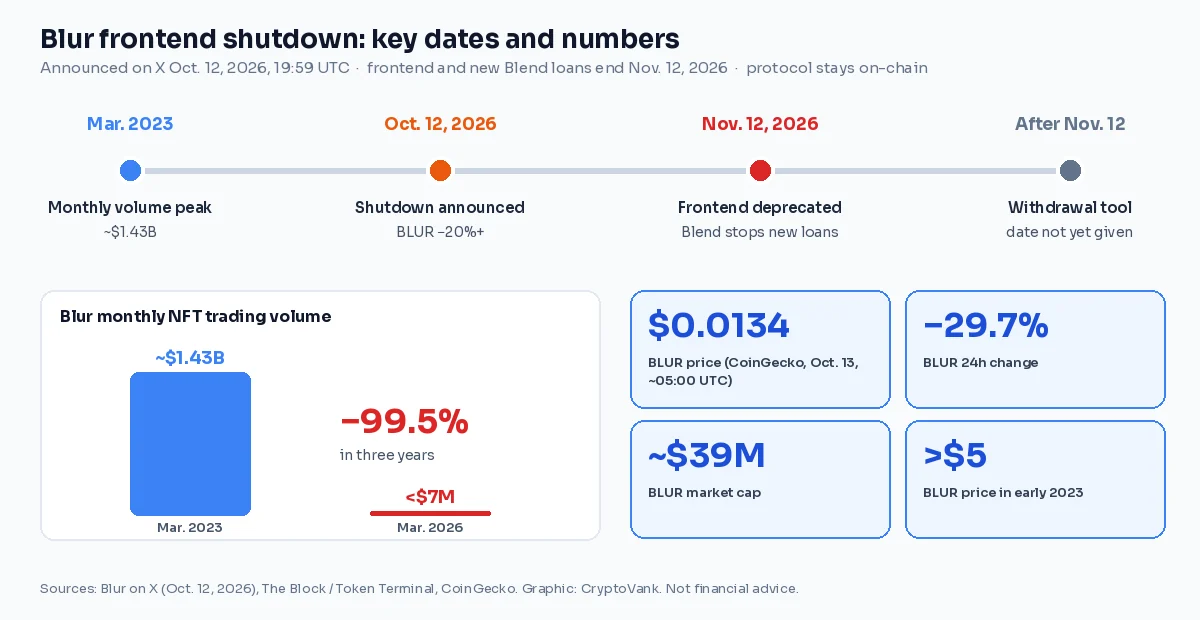
Quick answer: The Blur frontend shutdown takes effect on Nov. 12, 2026, Blur said on X on Oct. 12. The blur.io website will be deprecated and Blend will stop matching new loans that day, while the marketplace protocol stays live on-chain and BLUR keeps control of its fee switch.
The Blur frontend shutdown is now on the calendar. On Monday, Oct. 12, 2026, at about 19:59 UTC, the NFT marketplace said on X that it will deprecate the blur.io website on Nov. 12, 2026. However, the change covers only the website. The Blur marketplace protocol stays live on Ethereum, and the BLUR token keeps control of its fee switch.
At the same time, Blur set a hard deadline for its lending product. In a second post, the team said Blend will stop matching new loans on Nov. 12. Borrowers have until then to repay or let their loans default.
What does the Blur frontend shutdown mean for NFT traders?
In short, you lose the main website, not your NFTs. Your NFTs sit in your own wallet, and the marketplace contracts keep working after Nov. 12. Other tools may still connect to those contracts. Still, Blur has not named a replacement interface, as DefiPrime noted.
So, before the deadline, check open listings and bids placed through blur.io. Also review token approvals you gave the marketplace, and revoke any you no longer need. Fake “migration” sites often appear after shutdown news, so read our guide on how to spot crypto scams before you sign anything.
What happens to Blend loans after Nov. 12, 2026?
Blend is Blur’s peer-to-peer lending protocol for NFT-backed loans. It has no price oracle or fixed end date; loans roll on while a lender will fund them.
From Nov. 12, however, Blend will stop matching new loans through Blur. Borrowers face a simple choice: repay the loan or let it default, in which case the lender can claim the NFT. After the cutoff, Blur says it will provide a frontend tool to help users withdraw assets from Blend. It has not given a release date for that tool.
What should Blend borrowers do now?
First, list every open loan and its current rate. Next, decide whether the NFT is worth more than the debt. If it is, repay early rather than near the deadline, when gas costs and refinancing auctions could spike. Lenders should also plan for the end of new matching, since Blur has not said whether refinancing will work after the cutoff.
Why is Blur shutting down its frontend?
Blur did not give a reason in its posts. Even so, the numbers explain a lot. Blur’s monthly trading volume peaked at about $1.43 billion in March 2023, according to The Block, citing its own data and Token Terminal. Exactly three years later, monthly volume had fallen below $7 million, a drop of more than 99%.
The timing also fits a wider pattern. The news follows the wind-down of Blast, the Ethereum layer-2 created by Blur founder Tieshun “Pacman” Roquerre and built by the same core team. It also comes after the shutdown of Abstract, the Pudgy Penguins-backed layer-2 that we covered in our Abstract shutdown and Pudgy Penguins floor report.
How did BLUR react to the news?
The token sold off hard. BLUR fell more than 20% after the announcement to around $0.015, a market value of about $44 million, The Block reported. As of about 04:58 UTC on Oct. 13, CoinGecko showed BLUR near $0.0134, down about 29.7% in 24 hours, with a market cap near $39 million. In early 2023, the token traded above $5.
Market implications of the Blur frontend shutdown
For BLUR holders, the key question is value. The fee switch survives, but it only matters if trading continues through other interfaces. With volume already below $7 million a month, fee income looks small for now.
For the wider NFT market, liquidity may move to rivals such as OpenSea and Magic Eden. NFT lending could also shrink, because Blend was a major source of loans against blue-chip collections. Meanwhile, Ethereum traded near $2,517, down about 1.8% in 24 hours, per CoinGecko. That suggests the hit stayed mostly within the NFT sector.
Above all, the lesson is self-custody: assets in your own wallet survive a website closing. If you have not set one up, see our self-custody wallet setup guide.
Blur Frontend Shutdown FAQ
When is the Blur frontend shutdown?
Blur said on X on Oct. 12, 2026, that it will deprecate the blur.io frontend on Nov. 12, 2026. Only the website closes; the marketplace protocol keeps running on-chain.
Is Blur shutting down completely?
No. The Blur marketplace protocol remains live on Ethereum after Nov. 12, 2026, and the BLUR token keeps control of its fee switch, according to Blur’s Oct. 12 announcement.
What happens to my Blend loan?
Blend stops matching new loans on Nov. 12, 2026. Borrowers must repay or let loans default by then, and Blur says it will release a tool to withdraw assets from Blend after that date.
Are my NFTs safe after blur.io closes?
NFTs held in your own wallet are not affected by the website closing. Still, review open listings, bids and token approvals before Nov. 12, and beware of fake migration sites.
Why did the BLUR token drop?
BLUR fell more than 20% after the Oct. 12, 2026, news, per The Block, and was down about 29.7% in 24 hours on CoinGecko by Oct. 13, as traders priced in the end of the main interface.
Sources
- Blur frontend deprecation announcement — Blur on X (Oct. 12, 2026)
- Blend loan matching announcement — Blur on X (Oct. 12, 2026)
- Blur to shut down frontend next month as NFT trading volume dwindles — The Block
- Blur sets November 12 shutdown for frontend and new Blend loans — DefiPrime
- Blur (BLUR) price and market data — CoinGecko
Not financial advice. Crypto assets are volatile; DYOR.