Quick answer: Aptos switched on its encrypted mempool on mainnet on Monday, Oct. 12, 2026. Users can opt in to encrypt a transaction’s payload so validators order it blind and decrypt it only after the block is final, per Aptos. Encrypted transactions pay at least 200 Octas per gas unit, twice the base minimum.
The Aptos encrypted mempool is now live on mainnet. On Monday, Oct. 12, 2026, Aptos said users can encrypt a pending transaction so nobody can read what it does until its place in the block is locked. The goal is simple: stop bots from front-running and sandwiching trades.
The launch arrives on a rough day for prices. As of about 01:15 UTC on Oct. 13, 2026, CoinGecko showed APT near $0.78, down about 13% in 24 hours. Most of that move tracks a market-wide sell-off rather than the upgrade itself.
What is the Aptos encrypted mempool?
A mempool is the waiting room where transactions sit before they enter a block. On most public chains, that room is fully visible. Anyone can see the function being called, the tokens, the amounts and the contracts involved.
Aptos put the problem bluntly in its launch note, quoted by Cointelegraph: “Bots use that visibility to trade against you or copy your strategy.” The new feature hides that intent. It is opt-in for each transaction, and the full data is still recorded on-chain once the block is final.
The design is specified in AIP-144. Aptos says it built the tool for institutions placing large orders, traders worried about MEV (maximal extractable value), AI agents and app builders.
How does encrypted ordering work?
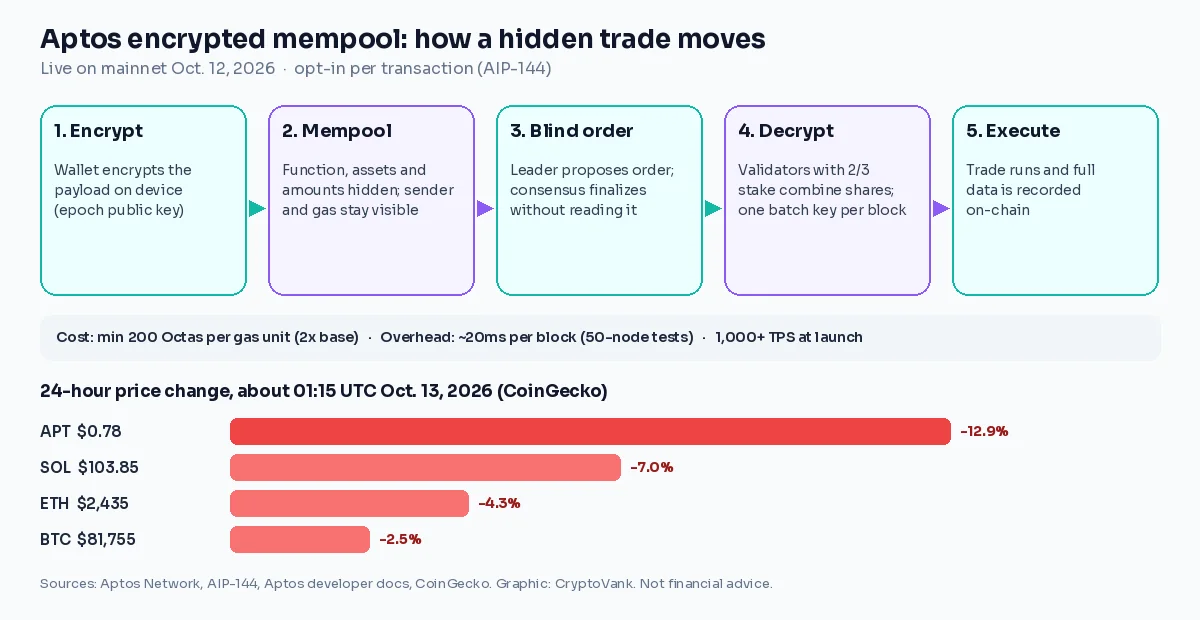
First, a compatible wallet or app encrypts the payload on the user’s device. It uses a public key that validators generate together at the start of each epoch. Next, the encrypted transaction enters the mempool. The block leader then proposes an order without seeing what any transaction does.
After consensus finalizes the block, validators combine their key shares and decrypt the whole batch. Then the transactions execute. No single validator can decrypt a pending transaction on its own. According to Aptos, decryption needs the same two-thirds honest-stake threshold that already secures every block.
That is the main pitch. Other tools ask users to trust someone new, such as a private builder or an outside committee. Here, the validators who order blocks are the same ones who hold the decryption shares.
What stays visible?
Encryption covers the payload, not the whole transaction. The Aptos developer guide says observers can still see the sender address, gas settings, expiration time and signatures. In other words, this is privacy for trade intent, not anonymity.
What does it cost, and is it fast?
The shield is not free. Encrypted transactions must pay at least 200 Octas per gas unit, twice the network’s base minimum, to cover decryption work. The TypeScript SDK bumps lower prices automatically, and nodes reject encrypted submissions priced below that floor.
Speed takes a small hit too. Aptos says its new batched threshold encryption adds about 20 milliseconds per block in 50-node benchmarks. Blocks still finalize in under a second. The AIP says the system can handle more than 1,000 transactions per second at launch. ZKSecurity reviewed the code, and the research paper is under submission to the ACM CCS security conference.
Why sandwich attacks matter to traders
In a sandwich attack, a bot spots a pending swap, buys just before it and sells just after it. The victim gets a worse price, and the bot pockets the gap. Cointelegraph’s analysis of EigenPhi data puts Ethereum sandwich losses near $60 million over the 12 months to October 2025. On Solana, Bitquery counted nearly 6.9 million attacks that earned bots $29.7 million over 11 months.
Aptos is not first to tackle this. Gnosis Chain launched an encrypted mempool with Shutter in July 2024, and Flashbots Protect sends Ethereum trades privately to builders. However, Aptos claims the first version native to the protocol’s own validator set. For a wider primer on these hazards, see our DeFi risks explained guide.
Market implications for APT and DeFi
Short term, the upgrade did not lift the token. CoinGecko data at the same time showed Bitcoin near $81,755 (−2.5%), Ether near $2,435 (−4.3%) and Solana near $103.85 (−7.0%). Coinglass figures cited by The Crypto Post showed about $488.6 million of leveraged positions liquidated over 24 hours on Oct. 12, mostly longs, ahead of the U.S. CPI report on Oct. 14.
Longer term, the real test is adoption. Watch whether major Aptos wallets and DEXs turn encryption on by default, how many transactions actually use it, and whether large traders move volume onto the chain. If usage stays thin, the feature remains a strong technical demo rather than a market driver.
Aptos Encrypted Mempool FAQ
When did the Aptos encrypted mempool go live?
Aptos announced it live on mainnet on Monday, Oct. 12, 2026. It is also available on devnet and testnet, according to the Aptos TypeScript SDK documentation.
Does the encrypted mempool make Aptos transactions anonymous?
No. It hides the payload, such as the function, assets and amounts, until the block is final. The sender address, gas fee, expiration and signatures stay visible, and full details are recorded on-chain after execution.
How much more does an encrypted Aptos transaction cost?
Encrypted transactions pay a minimum gas price of 200 Octas per gas unit, which is twice the network’s base minimum, per Aptos developer documentation.
Can one validator read my encrypted transaction early?
No. Decryption requires key shares from validators holding the same two-thirds stake threshold that produces Aptos blocks, and it happens only after consensus finalizes the block.
Sources
- Encrypted Mempool, Now on Aptos Mainnet — Aptos Network
- AIP-144: Encrypted Mempool — Aptos Foundation on GitHub
- Encrypted pending transactions guide — Aptos Developer Docs
- Aptos rolls out Encrypted Mempool to curb frontrunning, sandwich attacks — Cointelegraph
- Bitcoin price falls below $82K as $406M in longs get liquidated — The Crypto Post
- Aptos price and market data — CoinGecko
Not financial advice. Crypto assets are volatile; DYOR.