Quick answer: South Korea blocks crypto exchanges that skip registration. On Oct. 13, 2026, its Financial Intelligence Unit said it is cutting off domestic access to 27 unregistered platforms, including KuCoin, MEXC, Phemex, BingX and BitMart, after regulator reviews on Oct. 6 and 7, per The Asia Business Daily and Chosun Biz.
South Korea blocks crypto exchanges that never registered with its financial watchdog, and the list includes some of the biggest offshore names. On Tuesday, Oct. 13, 2026, the Financial Intelligence Unit (FIU) said 27 unregistered platforms, among them KuCoin, MEXC, Phemex and BingX, will lose access to Korean users’ browsers.
The Broadcasting Media and Communications Review Commission, the country’s online content regulator, made the call after it reviewed the FIU’s request on Oct. 6 and 7, according to The Asia Business Daily. As a result, the crackdown now covers websites, not just mobile apps.
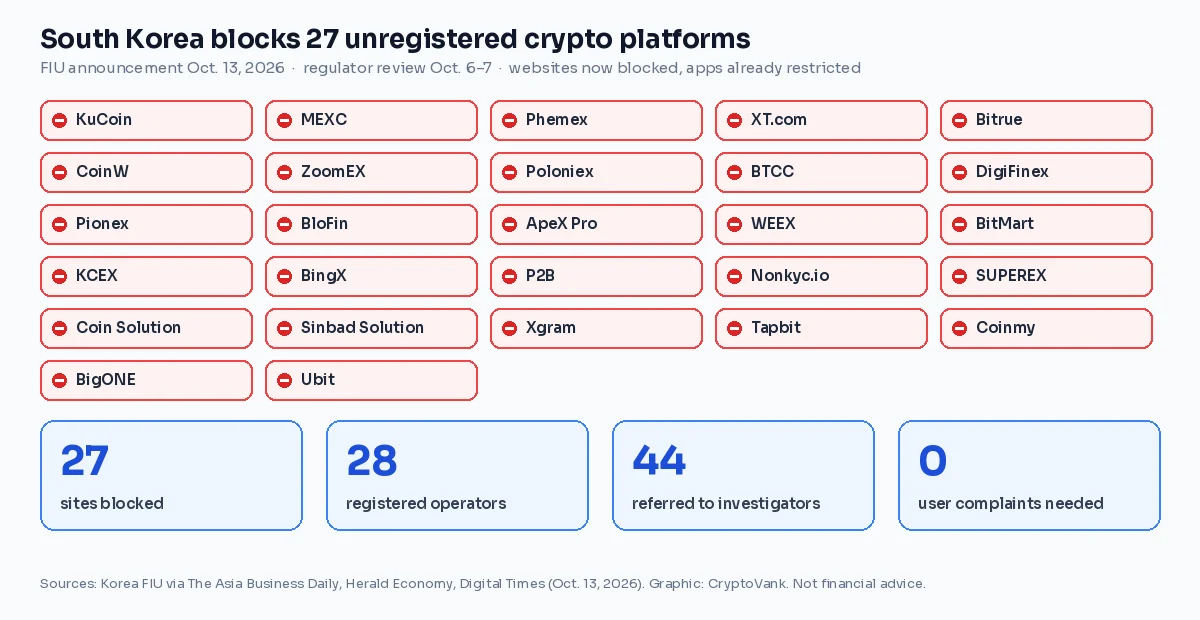
Which crypto exchanges did South Korea block?
The FIU named all 27 operators: KuCoin, MEXC, Phemex, XT.com, Bitrue, CoinW, ZoomEX, Poloniex, BTCC, DigiFinex, Pionex, BloFin, ApeX Pro, WEEX, BitMart, KCEX, BingX, P2B, Nonkyc.io, SUPEREX, Coin Solution, Sinbad Solution, Xgram, Tapbit, Coinmy, BigONE and Ubit.
Most of them are offshore exchanges that serve global users, while a few are smaller brokers and over-the-counter desks. Notably, Binance, OKX, Bybit and Bitget do not appear on this list.
The method also depends on location. For sites run from abroad, regulators order an access block. For domestic operators, they terminate the service contract instead, Herald Economy reported.
Why does Korea block crypto exchanges like these?
Korean law sets a high bar. Under the Act on Reporting and Using Specified Financial Transaction Information, any virtual asset service provider (VASP) that serves Korean customers must hold security certification and register with the FIU. The rule also covers foreign firms that target Korean users, and operating without registration is a crime, Chosun Biz noted.
According to the FIU, unregistered platforms sit outside anti-money-laundering checks and user-protection rules. For example, it warned of hacking, personal data leaks and links to criminal funds. It also flagged fraud risks, such as firms that take payment without delivering coins or charge hidden fees far above registered venues.
How is this different from earlier crackdowns?
In short, it adds a new layer to an existing campaign. Apple and Google already stop Korean users from installing or updating these apps. In addition, registered exchanges must halt crypto transfers to operators the FIU flags. So far, the FIU has referred 44 illegal operators to investigators.
The bigger change, however, is speed. According to Digital Times, the FIU will now request a block as soon as it confirms illegal activity, even if no user has complained. It will also hunt for mirror sites that switch domains to dodge the ban.
What should users of KuCoin, MEXC or BingX do?
For users in South Korea, the message is clear. Only 28 operators currently hold FIU registration, and the agency publishes that list on its website. Anyone who keeps funds on a blocked platform has weaker legal recourse if something goes wrong. On top of that, registered Korean exchanges restrict transfers to these venues.
Users outside Korea, by contrast, face no direct impact, because the block only covers access from inside the country. Even so, it is a good moment to check whether your own exchange holds a license where you live. Our guides on how to spot crypto scams and setting up a self-custody wallet cover the basics.
Market implications for exchanges and traders
So far, prices have barely moved. As of about 02:50 UTC on Oct. 13, CoinGecko showed KuCoin’s KCS token near $7.80, up about 0.8% in 24 hours, and MEXC’s MX near $1.89, down about 0.6%. Meanwhile, Bitcoin traded near $82,750, down about 1.2%, ahead of U.S. CPI data on Oct. 14.
Over time, though, the effect could be larger. Korean retail traders already move altcoin prices on local venues such as Upbit, as our RSR Upbit listing report showed. When Korea blocks crypto exchanges from offshore, even more volume flows to registered platforms. Licensing keeps spreading elsewhere too, as Kraken’s Dubai VARA approval shows. For more rule changes, see our crypto regulation coverage.
South Korea Crypto Exchange Block FAQ
Is KuCoin blocked in South Korea?
Yes. KuCoin is one of 27 unregistered platforms whose websites South Korea’s FIU said on Oct. 13, 2026, it would block for domestic users. Its app was already restricted in the Apple and Google stores in Korea.
Why did South Korea block MEXC and other exchanges?
They served Korean users without registering with the Financial Intelligence Unit, as Korean law requires. The FIU says such operators lack anti-money-laundering controls and user protections, and unregistered operation is a criminal offense.
How many crypto exchanges are registered in South Korea?
The FIU said 28 virtual asset service providers currently hold registration, and anyone can check the list on its website, according to The Asia Business Daily on Oct. 13, 2026.
Does the Korean block affect users in other countries?
No. The measure only blocks access from within South Korea. Users elsewhere should still confirm that their exchange holds a license in their own country.
Sources
- FIU, Broadcasting Media and Communications Review Commission Block Domestic Access to 27 Illegal Crypto Exchanges — The Asia Business Daily
- South Korea FIU blocks 27 illegal crypto sites including KuCoin, MEXC — Chosun Biz
- Unregistered virtual asset operator websites blocked, 27 sites — Herald Economy (Korean)
- Authorities to block 27 unregistered coin operators even without damage — Digital Times (Korean)
- Korea Financial Intelligence Unit
- KuCoin Token price and market data — CoinGecko
Not financial advice. Crypto assets are volatile; DYOR.