Quick answer: The RSR Upbit listing news sent Reserve Rights up as much as 66% in 15 minutes on Oct. 12, 2026, per TokenPost. Trading was set for 2:05 p.m. KST; RSR briefly hit about $0.002820 before settling near $0.002764.
The RSR Upbit listing lit a fast rally in Reserve Rights. On Monday, Oct. 12, 2026, TokenPost reported that Upbit would add Korean won and USDT markets for RSR. Trading was set to begin at 2:05 p.m. Korea Standard Time (05:05 UTC / 1:05 a.m. ET), according to Lookonchain.
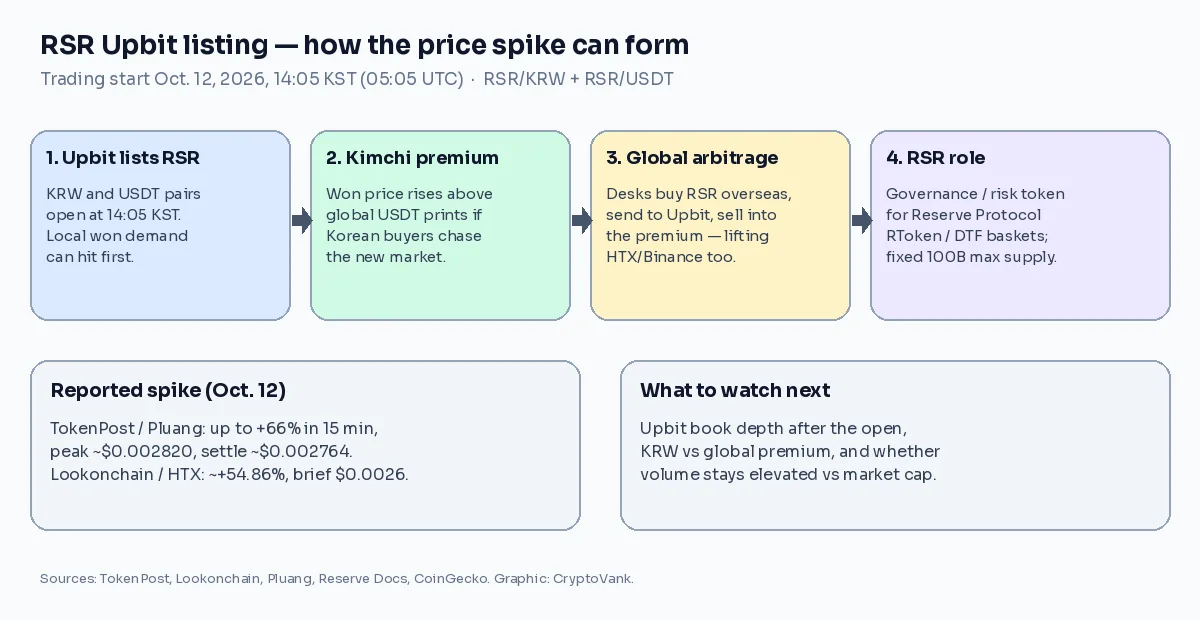
Within minutes of the news, RSR spiked. TokenPost said it jumped more than 66% in 15 minutes, briefly reaching $0.002820 before trading near $0.002764 around 05:00 UTC. Lookonchain cited HTX prints that briefly tagged $0.0026 with a 54.86% gain, and Pluang carried the same TokenPost peak and settle figures.
How big was the RSR move after the Upbit news?
The tape shows a classic listing pop, then a partial fade. TokenPost and Pluang put the 15-minute high near $0.002820 and the post-spike quote near $0.002764. Lookonchain’s HTX snapshot was slightly cooler — about $0.0026 at the top and roughly $0.0025 afterward — but still a mid-50% surge in a quarter hour.
Later on Oct. 12, CoinGecko showed RSR near $0.00238, still up about 49% over 24 hours, with a market cap near $148 million and 24-hour volume above $129 million. That sharp open, heavy volume and pullback from the first print matches other won-market debuts, including the Kaia Upbit listing on Oct. 9.
What is Reserve Rights (RSR)?
RSR is the Reserve Rights token. It is the governance and risk asset for Reserve Protocol, which lets people mint and redeem asset-backed token baskets often called RTokens or DTFs.
According to Reserve’s docs, RSR mainly does three jobs:
- Stake on Yield DTFs: Staked RSR can earn a share of protocol revenue and acts as first-loss capital if collateral defaults.
- Vote-lock on Index DTFs: Locked RSR governs basket changes, fees and upgrades.
- Burn sink: A portion of Index DTF mint and TVL fees is used to buy RSR on the market and burn it.
CoinGecko lists a fixed maximum supply of 100 billion RSR, with roughly 62.5 billion circulating as of Oct. 12, 2026. A capped max supply means fresh exchange demand can matter — but unlocks and staking still shape free float.
Why do Upbit listings move altcoin prices so fast?
Upbit is South Korea’s deepest crypto venue, and its won book is mostly local. Real-name bank accounts keep foreign capital from flooding KRW order books directly. When Korean buyers chase a newly listed token, the won price can jump above the global price — the so-called kimchi premium.
Arbitrage desks then buy RSR on global venues and send it to Upbit to sell into that premium. That buying lifts Binance, HTX and other books too, which is why Lookonchain’s HTX spike lined up with TokenPost’s broader print. Once the premium closes or early holders take profit, the first-hour high often fails — which is why the later CoinGecko print sat below the $0.00282 peak even while the 24-hour change stayed green.
What should traders watch after the RSR Upbit listing?
Watch three things. First, whether Upbit’s KRW and USDT books keep depth after the opening rush — thin books usually mean a news-only spike. Second, the gap between Upbit’s won price and global USDT prices; a lasting premium signals ongoing Korean demand, while a quick collapse means the move is fading. Third, 24-hour volume versus market cap. CoinGecko already showed volume near the full market-cap size on Oct. 12, which is typical of listing days and rarely lasts.
RSR is a governance and risk token tied to Reserve’s basket products, not a pure meme float. That does not protect it from listing volatility, but it does change how long-term holders think about staking, burns and unlocks. Our Kaia Upbit listing report covers the same premium-and-arbitrage path on another Oct. 2026 debut.
RSR Upbit listing FAQ
When does Upbit start trading RSR?
Upbit scheduled RSR/KRW and RSR/USDT trading for Oct. 12, 2026, at 2:05 p.m. Korea Standard Time (05:05 UTC), according to Lookonchain’s summary of the official notice.
How much did RSR rise after the Upbit announcement?
TokenPost and Pluang reported a move of more than 66% in 15 minutes, with a brief high near $0.002820 and a settle near $0.002764. Lookonchain cited HTX data showing about 54.86% and a brief $0.0026 print.
What is the Reserve Rights (RSR) token used for?
RSR is Reserve Protocol’s governance and risk token. Holders can stake it on Yield DTFs, vote-lock it on Index DTFs, and benefit from fee burns that buy and destroy RSR.
Why do Upbit listings often create short spikes?
Korean won markets are mostly local. Strong KRW demand can open a premium versus global prices, and arbitrage buying then lifts overseas venues until that gap closes.
Is the RSR Upbit listing financial advice?
No. This article is for information only. Newly listed tokens are highly volatile. Always do your own research (DYOR) before buying or selling RSR or any other crypto asset.
Sources
- Upbit To Add Reserve Rights Trading Pairs in Korean Won and USDT — TokenPost
- Reserve Rights Token Surges 66% in 15 Minutes After Upbit Listing News — TokenPost
- Upbit to list RSR trading pairs with KRW and USDT — Lookonchain
- RSR briefly rose to 0.0026 USD, with a 54.86% gain in 15 minutes — Lookonchain
- Reserve Rights (RSR) jumps 66% after Upbit plans KRW and USDT trading pairs — Pluang
- RSR (Reserve Rights) — Reserve Docs
- Reserve Rights price — CoinGecko
Disclaimer: This article is for information only and is not financial advice. Newly listed tokens are highly volatile. Always do your own research (DYOR) before investing.