Quick answer: Jeonbuk Bank, part of JB Financial Group, started South Korea’s first Bitcoin-backed won loans for corporate clients on Oct. 12, 2026, per EDAILY and Herald Business. A registered custodian holds the BTC; the bank recovers via court sale on default, not by taking the coins.
Jeonbuk Bank Bitcoin loans are now live in South Korea. On Oct. 12, 2026, EDAILY and Herald Business reported that the JB Financial Group affiliate began offering won-denominated credit secured by Bitcoin — the first product of its kind from a domestic Korean bank.
The move lands while Bitcoin trades near $84,000 on CoinGecko, after foreign banks such as JPMorgan already opened institutional Bitcoin-backed credit lines.
What exactly did Jeonbuk Bank launch?
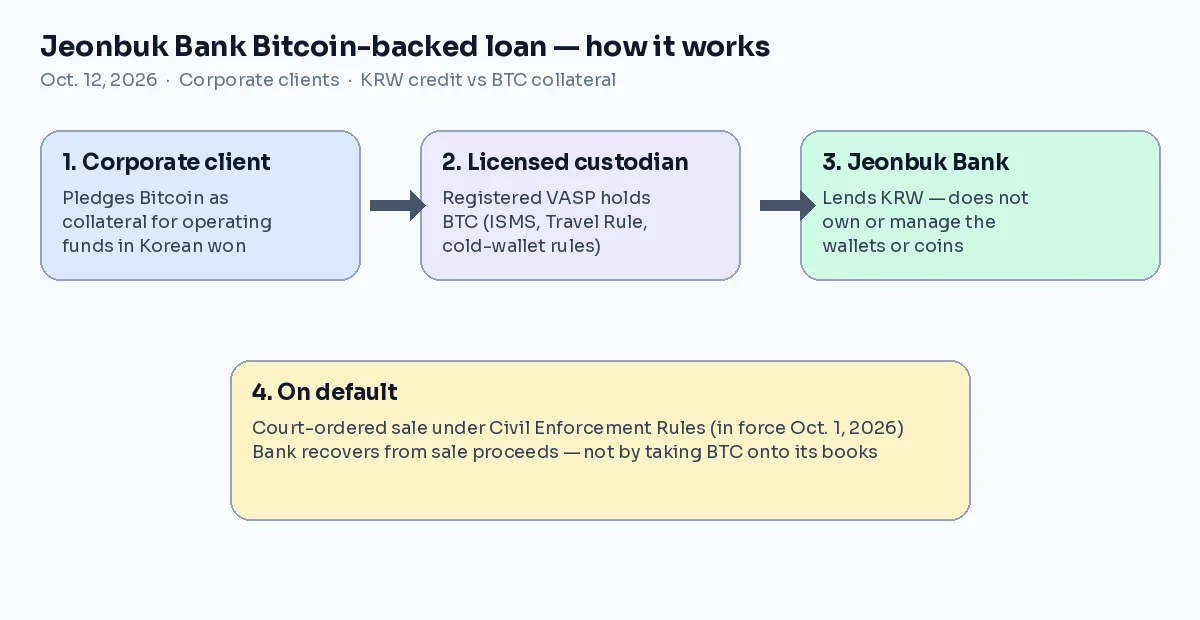
Jeonbuk Bank is lending Korean won to corporate clients and taking Bitcoin as collateral. Herald Business says the structure looks a lot like stock-backed lending: the borrower keeps economic exposure to the asset but pledges it to unlock cash for the business.
At launch the product is narrow on purpose:
- Only Bitcoin qualifies as collateral.
- Only corporate clients can apply.
- Loan proceeds are limited to business operating funds.
EDAILY says the bank chose Bitcoin because it has the deepest market cap and trading volume among digital assets, which supports clearer price discovery and easier liquidation if needed. The bank ran its own stress tests and concluded Bitcoin stayed usable as collateral even in sharp drawdowns.
President Park Chun-won had floated a “crypto bank” vision earlier in 2026, and both outlets call this the first concrete product from that plan. Jeonbuk Bank was already the only regional bank issuing real-name verified deposit accounts to virtual-asset exchanges.
How does the bank avoid holding Bitcoin directly?
The custody design is the legal heart of the product. EDAILY reports that pledged Bitcoin sits inside a specialized custodian’s management system. Jeonbuk Bank does not take ownership of the coins and does not run the wallets itself.
Custody is limited to registered virtual-asset service providers under Korea’s specified financial-information rules. Those firms need ISMS certification, Travel Rule compliance, segregated custody, a required cold-wallet ratio, and insurance or reserves.
On default, amended Civil Enforcement Rules that took effect on Oct. 1, 2026, let the bank recover through a court-ordered sale and apply the cash proceeds to the loan — without taking Bitcoin onto its own books. That path is how the bank argues it can lend against BTC inside existing law.
How is collateral valued and controlled?
Jeonbuk Bank built what EDAILY calls the first dedicated digital-asset valuation framework in the Korean banking sector. Instead of trusting a single exchange print, it uses a weighted-average index of prices from multiple global venues, plus the median of market-volatility measures, as the benchmark.
Herald Business says the bank reviewed loan-to-value ratios and margin-call thresholds for major assets including Bitcoin and ether before setting limits. Exact LTV percentages were not published. Executive Vice President Jeong Sang-hoon told EDAILY the design lets the bank reuse existing lending systems “without directly holding virtual assets,” and that it will refine monitoring as rules change.
What does this mean for Bitcoin and other banks?
For Bitcoin holders and corporate treasuries, a regulated Korean bank loan is another way to raise cash without selling spot BTC. That matters when companies want liquidity but still want upside. Live Bitcoin price moves will still drive margin calls, so the product is credit risk management as much as it is a bullish headline.
For other Korean banks, the launch tests whether the post-2017 practice of refusing crypto collateral is cracking. Herald Business notes no current law explicitly bans virtual-asset collateral, and observers expect Jeonbuk Bank to seek innovative-financial-service designation as it scales.
EDAILY also cites JPMorgan’s institutional Bitcoin-backed loans from March and similar facilities at Switzerland’s Sygnum Bank. South Korea’s version stands out because custody sits with licensed local VASPs and enforcement follows the October civil-procedure update. No origination volume was disclosed on Oct. 12; the next watchpoints are copycat products at larger banks and any later move into retail or ether collateral.
Jeonbuk Bank Bitcoin Loans FAQ
Which Korean bank started Bitcoin-backed loans first?
Jeonbuk Bank, a JB Financial Group affiliate, became the first domestic Korean bank to offer won loans backed by Bitcoin, according to EDAILY and Herald Business reports published Oct. 12, 2026.
Who can borrow against Bitcoin at Jeonbuk Bank?
At launch, only corporate clients can apply, and the cash must be used for business operating funds. Only Bitcoin is accepted as collateral for now.
Does Jeonbuk Bank hold customers’ Bitcoin?
No. A registered virtual-asset custodian holds the pledged BTC. The bank does not own or directly manage the wallets, per EDAILY.
What happens if a borrower defaults?
Under Civil Enforcement Rules updated Oct. 1, 2026, the bank seeks a court-ordered sale of the collateral and recovers from the sale proceeds instead of taking the Bitcoin onto its own balance sheet.
Will the product expand beyond Bitcoin and companies?
The bank says it will review expansion based on regulation and demand. Herald Business also notes the bank studied LTV and margin rules for ether, but ether is not accepted at launch.
Not financial advice. This article is for information only. Always do your own research (DYOR) before making any decision about your crypto or borrowing against it.