
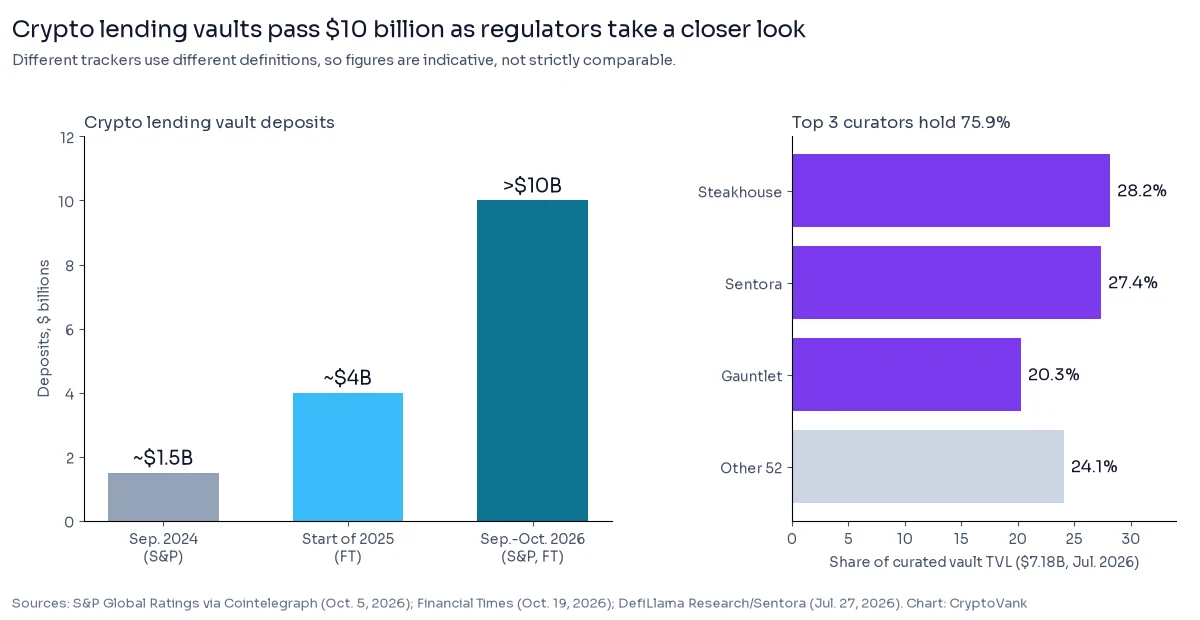
Quick answer: Crypto lending vaults now hold more than $10 billion, up from about $4 billion at the start of 2025, the Financial Times reported on Oct. 19, 2026. US and European regulators think the sector, where ‘curators’ pick lending markets like fund managers, may need closer supervision.
Crypto lending vaults have quietly become one of the biggest businesses in DeFi. More than $10 billion now sits in them, up from about $4 billion at the start of 2025, the Financial Times reported on Oct. 19, 2026. The growth has drawn US and European regulators, who believe the products may need closer supervision.
The money keeps arriving even as the market stalls. In short, investors are chasing yield, not price.
What are crypto lending vaults?
A vault is a smart contract that pools one asset, most often a stablecoin such as USDC. Depositors get a receipt token for their share. The pooled money is then lent to borrowers who post other crypto as collateral, and their interest flows back to the vault.
The key player is the “curator”. This is a firm that chooses which lending markets the vault uses, sets loan limits and rebalances. The FT describes curators as acting like fund managers. Morpho is the main platform for these products. It held about $11.1 billion in deposits on Oct. 18, 2026, per DefiLlama.
Who runs the biggest vaults?
A handful of firms control most of the money. Across 55 tracked curators, curated lending held $7.18 billion, up 51% in a year, according to a Sentora report on DefiLlama Research from July 27, 2026. Over the same period, overall lending TVL fell 36%.
Steakhouse Financial ($2.03 billion), Sentora ($1.97 billion) and Gauntlet ($1.46 billion) held 75.9% of that total. Meanwhile, big apps are building on the same rails. Coinbase, Kraken and Robinhood all run products on top of vaults, Forbes noted in July, so many users don’t know they hold one.
Why are regulators looking at crypto vaults?
The worry is simple: who is managing the money, and are they following fund rules? On July 22, 2026, SEC Commissioner Hester Peirce warned that vaults can fall under securities, investment company or investment adviser laws. That depends on how much discretion a curator has. She spoke for herself, not the full Commission, and it is not a rule.
Still, curators push back. Gauntlet’s Nicholas Cannon told The Block that broad claims that vaults are unregistered funds are “misinformed”. He said Gauntlet’s work is “much closer to programmatic vault curation”.
At the same time, rating agencies are moving. On Oct. 5, 2026, S&P Global Ratings launched a framework that scores vaults on six risks, including curator and liquidity risk. S&P put sector deposits at about $10 billion in September, up from $1.5 billion two years earlier.
Where does the yield come from, and what can go wrong?
In most cases, the yield comes from borrowers paying interest. Lending vaults tracked by vaults.fyi averaged about 3.7% in July, while riskier strategy vaults averaged about 7.7%, The Block reported.
However, a higher rate means more risk. In November 2025, Stream Finance said an outside fund manager had lost about $93 million. Soon after, its xUSD stablecoin fell toward $0.30, and some curated vaults that accepted it as collateral were hit. Smart-contract bugs, bad collateral choices and paused withdrawals all land on depositors. There is no deposit insurance.
What does it mean for the crypto market?
As a result, vault deposits are now a core source of stablecoin demand in DeFi. Tighter rules could push curators to register, cap retail access or disclose more, which may lower yields but raise trust. For context on how yield shapes stablecoin competition, see our USDT vs USDC guide, our stablecoins hub and Circle’s defence of USDC economics.
For now, prices were calm on the news. Bitcoin traded at $82,714 and ether at $2,427 on Oct. 19, 2026, at about 06:57 UTC, per CoinGecko. Follow ETH on our Ethereum price page. For a protocol-level example, read about Lido’s plan for its own Morpho-based lending market.
Not financial advice. Crypto is volatile; do your own research (DYOR) before you deposit or trade.
Crypto Lending Vaults FAQ
How much money is in crypto lending vaults?
More than $10 billion, up from about $4 billion at the start of 2025, according to the Financial Times on Oct. 19, 2026. S&P Global Ratings put the figure at about $10 billion in September 2026.
What does a vault curator do?
A curator picks the lending markets a vault can use, sets limits such as loan-to-value caps and rebalances deposits. The FT says curators act like fund managers, which is why regulators are paying attention.
Are crypto lending vaults safe?
No vault is risk-free. Depositors can lose money through bad collateral, hacks, curator mistakes or frozen withdrawals, as Stream Finance’s roughly $93 million loss in November 2025 showed. There is no deposit insurance.
Will the SEC regulate crypto vaults?
There is no vault rule yet. On July 22, 2026, SEC Commissioner Hester Peirce said some vaults may already fall under securities laws, depending on how much discretion the curator has, and invited firms to talk with the agency.
Sources
- Financial Times: Rise of crypto vaults channels billions of dollars into risky lending (Oct. 19, 2026)
- SEC: Commissioner Peirce, statement on crypto vaults and lending strategies (Jul. 22, 2026)
- Cointelegraph: S&P Global launches risk assessments for crypto lending vaults (Oct. 5, 2026)
- DefiLlama Research / Sentora: The Vault Economy (Jul. 27, 2026)
- The Block: Are crypto vaults funds and curators fund managers? (Jul. 27, 2026)
- Chorus One: DeFi curators in 2025
- DefiLlama: Morpho TVL
- CoinGecko: Bitcoin and Ethereum prices