Quick answer: Moody’s Ratings assigned Ripple’s RLUSD stablecoin an A2 long-term and a P-1 short-term deposit rating on Oct. 27, 2026. Both are investment grade. The rating covers RLUSD issued natively on the XRP Ledger and Ethereum, and reflects reserve quality, 103% target coverage and redemption arrangements.
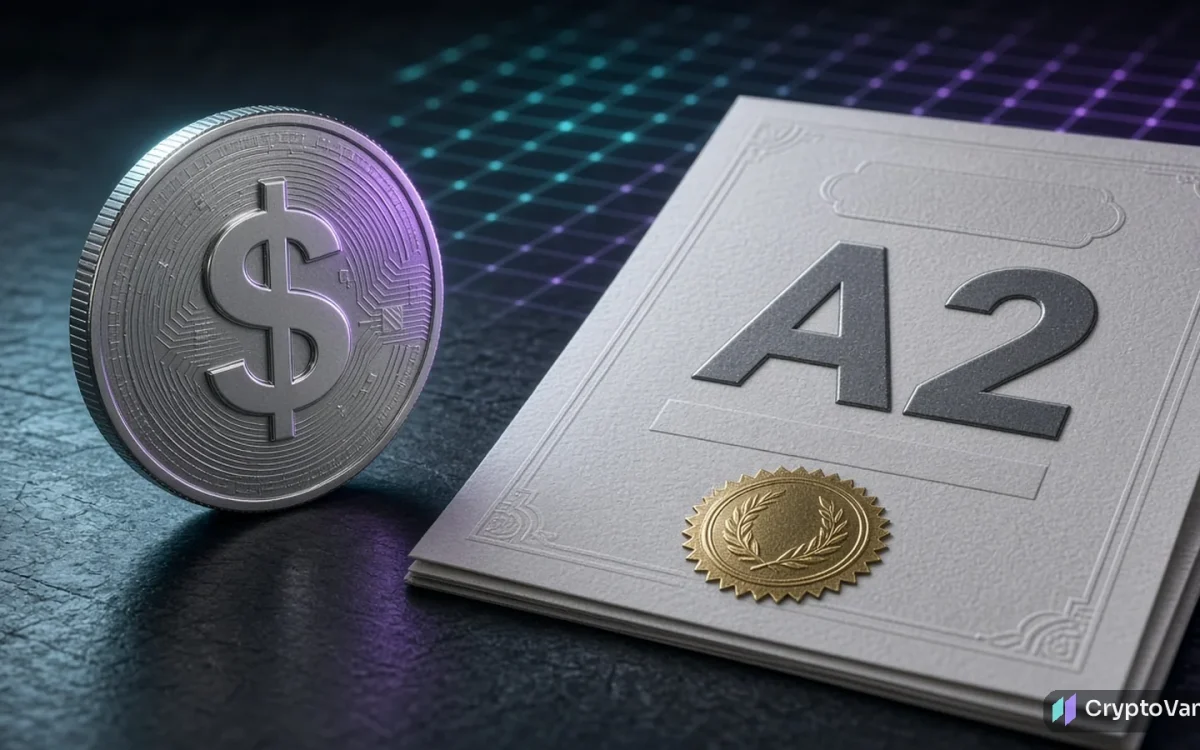
The RLUSD Moody’s rating is in, and it is investment grade. In a notice dated Oct. 27, 2026, Moody’s Ratings assigned Ripple USD (RLUSD) an A2 long-term deposit rating and a P-1 short-term deposit rating. Ripple says no other stablecoin has received an investment-grade rating from Moody’s.
The move gives banks and treasurers a familiar yardstick for a dollar token. It also lands days after Ripple won a federal trust bank charter, which makes the timing hard to ignore.
What exactly did Moody’s rate?
Moody’s rated the deposit-like claim that RLUSD holders have on the reserve, not Ripple as a company. The issuer is Standard Custody & Trust Company, LLC, a wholly owned Ripple subsidiary supervised by the New York State Department of Financial Services (NYDFS).
The rating applies only to RLUSD issued natively on the XRP Ledger and Ethereum. Bridged or wrapped versions on other chains are outside its scope, so they do not carry the grade. The agency used its stablecoin methodology, published in March 2026.
| Detail | RLUSD rating |
|---|---|
| Long-term deposit rating | A2 (investment grade) |
| Short-term deposit rating | P-1 (highest short-term grade) |
| Notice date | Oct. 27, 2026 |
| Issuer | Standard Custody & Trust Company, LLC |
| Covered chains | XRP Ledger and Ethereum (native only) |
| Target reserve coverage | 103% |
| Market cap | About $2.6 billion (CoinGecko, Oct. 28, 09:55 UTC) |
Why did RLUSD get an A2 grade?
Moody’s said the A2 reflects the credit quality and market value of the reserve, the level of reserve coverage, and the liquidity and redemption setup. It also cited segregation of reserve assets, third-party custody, and operational, technological, legal and regulatory factors. The P-1 short-term grade is aligned with the A2.
According to The Block, Moody’s said the reserve “is predominantly invested in highly liquid, short-duration U.S. government assets and cash.” The issuer targets 103% coverage, above the minimum tied to the rating. Most assets sit with The Bank of New York Mellon (BNY), itself rated Aa1 as a custodian.
Moody’s also pointed to the US GENIUS Act, which takes effect in January 2027. The law is set to shield required reserves from an issuer’s bankruptcy estate. For more on that rulebook, see our report on the Ripple national trust bank approval.
Is A2 a top rating?
No. A2 sits in the upper-medium part of the investment-grade scale, below Aaa, Aa and A1. P-1, however, is the best short-term grade Moody’s gives. In plain terms, Moody’s sees a low risk that holders would fail to get paid, but not the lowest risk possible.
A downgrade could follow if reserve quality or market value slips, coverage falls, or liquidity and redemption capacity weaken, Moody’s said. So the grade can move, and it should be watched like any bank rating.
Why does this matter for stablecoins?
For institutions, a Moody’s deposit rating is a known input in risk and treasury policies. Ripple says RLUSD is used mainly inside its payment network and as collateral in Ripple Prime. A rating could make it easier for corporate and bank treasuries to hold it, per crypto.news.
Jack McDonald, Ripple’s senior vice president of stablecoins, called the rating a “massive validation” on X. The bigger rivals are rated differently. S&P Global uses a separate stablecoin stability score, which crypto.news noted puts USDC at 2 (strong) and USDT at 5 (weak). Those scores and Moody’s deposit ratings are not directly comparable.
RLUSD launched in December 2024 and has grown to about $2.6 billion, per CoinGecko. That is still small next to USDT and USDC. Recent data on USDC euro trading shows how fast the leaders keep moving. Rules are tightening elsewhere too, as the Canada stablecoin rules show.
What does it mean for XRP?
Not much directly. RLUSD is a dollar token, so the rating does not change XRP’s supply or fees. Still, more RLUSD use on the XRP Ledger can add activity to the network. XRP traded near $1.33 at 09:55 UTC on Oct. 28, per CoinGecko; follow it on our XRP price page. For the bigger roadmap, read what to expect from Ripple Swell 2026.
RLUSD Moody’s Rating FAQ
What is the RLUSD Moody’s rating?
Moody’s assigned RLUSD an A2 long-term and a P-1 short-term deposit rating on Oct. 27, 2026. Both grades are investment grade.
Is RLUSD the first stablecoin rated by Moody’s?
Ripple says RLUSD is the first stablecoin to get an investment-grade rating from Moody’s. Moody’s notice itself does not make that claim.
Does the rating cover RLUSD on every chain?
No. It covers only RLUSD issued natively on the XRP Ledger and Ethereum, not bridged or wrapped versions.
Does an A2 rating guarantee I can redeem RLUSD for $1?
No. A rating is an opinion on credit risk, not insurance or a guarantee. Redemption depends on the issuer’s terms and reserve.
Not financial advice. Stablecoins carry issuer, smart contract and regulatory risk. Always DYOR.