
Quick answer: Galaxy Research says the bitcoin bear market ended in June 2026. Its head of research, Alex Thorn, points to five straight weekly closes above the 50-week moving average and slower selling by long-term holders. The view fails if bitcoin posts a weekly close below $76,540 and does not regain it within a month.
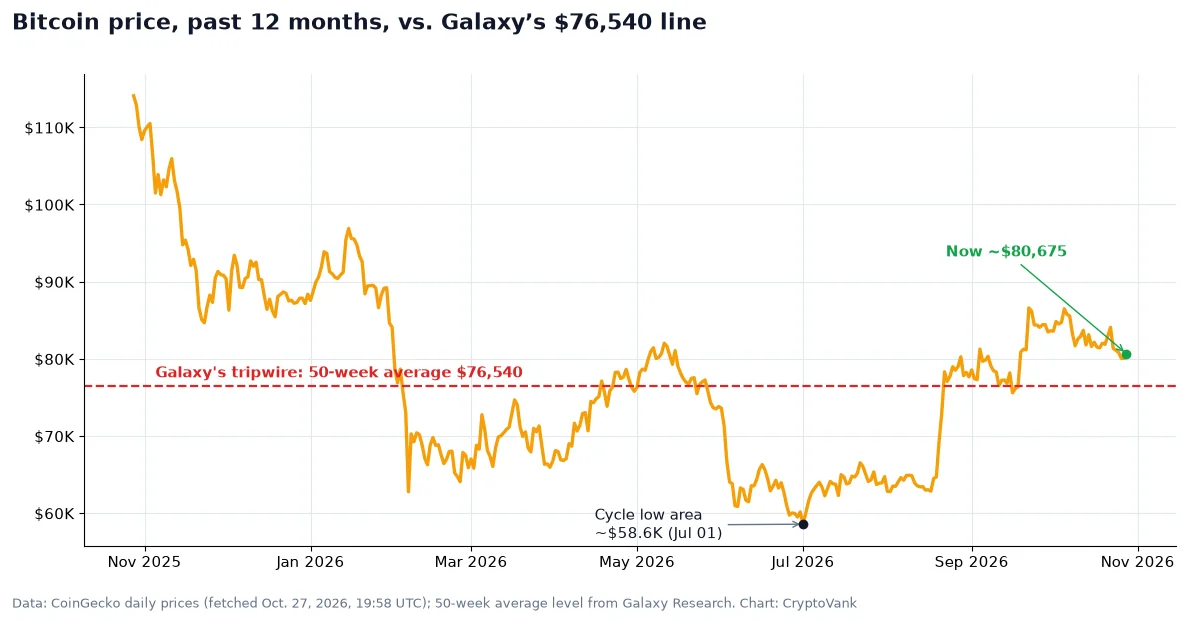
Galaxy Research says the bitcoin bear market is over and that it ended in June. Bitcoin traded at $80,649 on CoinGecko at 19:58 UTC on Oct. 27, 2026, about 5% above the level Galaxy says would break its call.
The report landed one day before the Federal Reserve’s rate decision. So the next few weekly closes will test the thesis quickly. Below, we look at the evidence, the weak spots and the dates that matter.
What did Galaxy say about the bitcoin bear market?
Alex Thorn, head of firmwide research at Galaxy, published the note on Monday, Oct. 26. Both The Block and Decrypt reported its main points. “Our conclusion is simple: we believe now is an attractive time to buy and hold bitcoin,” Thorn wrote.
His case rests on four pieces of evidence:
- Trend. Bitcoin spent 44 weeks below its 50-week moving average. It then posted five straight weekly closes above it through Oct. 18.
- Floor. The June low tested the 200-week average. The worst weekly close came only 4.7% below that line.
- Sellers. Coins idle for five years or more moved at about 34,000 BTC a month in 2026. That compares with 47,000 in 2025 and 67,000 in 2024.
- Cycle timing. Past cycles bottomed 777 to 912 days after a halving. Oct. 22 was day 916 of this cycle.
Galaxy also noted that this drawdown, about 53%, was the shallowest on record. In addition, bitcoin’s market value never fell below its realized value, which is the average price at which each coin last moved.
Why does the call matter?
First, Galaxy is not a small voice. It is one of the largest crypto firms, so its research moves headlines and, sometimes, flows. Galaxy and Thorn both disclose that they hold bitcoin, which readers should weigh.
Second, the signal has a strong history. According to Bitcoin Magazine, Galaxy counted 13 reclaims of the 50-week average since 2011. The four that ended a spell of 20 weeks or more were all higher a year later. By contrast, seven of the nine shorter spells fell more than 25% within a year.
Still, four cases is a small sample. In our view, the stronger part of the report is the supply data. Long-held coins are moving more slowly, and ETFs and treasury firms have absorbed much of what did move. For example, Strive just bought 6,182 BTC in one week.
The data: where bitcoin stands now
CoinGecko’s daily data shows the price near $58,600 on July 1, close to the June 30 low that Galaxy cites. At $80,649, bitcoin is up roughly 38% from there. However, it remains about 36% below its October 2025 record of around $126,000, per The Block. By our math, it would need to rise about 56% to get back to that peak.
Meanwhile, the cushion is thin. The gap between today’s price and the $76,540 tripwire is only about $4,100. A routine 5% drop would put it in play. Bitcoin has already slipped below $80,000 more than once this month.
Flows are mixed, too. CoinDesk reported that US spot bitcoin ETFs took in $110 million on Monday, citing Farside Investors. That ended two days of outflows. Yet bitcoin options traders still pay more for downside protection than for upside bets.
What to watch next
The first test is the Fed. Its two-day meeting began on Tuesday, and the decision comes on Wednesday, Oct. 28. CME’s FedWatch tool showed about a 90% chance of no change, according to CoinDesk. Therefore, the tone of the statement may matter more than the decision itself. For more, see our Fed week preview.
Next, watch the weekly closes on Sundays. One close below $76,540 would not kill the thesis on its own. Galaxy’s rule needs that close and then a failure to recover the level within a month. That gives the call room to breathe, but it also means a clear answer may take weeks.
Finally, watch long-term holders. If five-year-old coins start to move faster again, the core of Galaxy’s supply argument weakens.
Bitcoin bear market FAQ
Is the bitcoin bear market over?
Galaxy Research says yes, and that it ended in June 2026. Its case rests on five weekly closes above the 50-week average and slower selling by long-term holders. Other analysts may disagree, and no one can confirm a bottom until much later.
What would prove Galaxy wrong?
Galaxy named a clear tripwire. If bitcoin posts a weekly close below its 50-week average, about $76,540 now, and does not regain it within a month, the bullish view is challenged.
Why does the Fed decision matter for bitcoin?
Rate decisions shift how much money flows into risky assets. A hold is widely expected on Oct. 28. As a result, any hint about future hikes could move bitcoin more than the decision itself.
Not financial advice. Crypto prices are volatile. Always DYOR.
Sources
- The Block: Galaxy says bitcoin bear market is over; now is the time to buy and hold (Oct. 26, 2026)
- Decrypt: Bitcoin’s bear market is over, Galaxy Research says (Oct. 26, 2026)
- Bitcoin Magazine: Galaxy calls the bottom
- Crypto Briefing: Galaxy Research says bitcoin’s bear market ended in June
- CoinDesk: Bitcoin drops below $80,000 as Fed meeting begins (Oct. 27, 2026)
- CoinGecko: Bitcoin price and market data