
Quick answer: Canada stablecoin rules were published in draft on Oct. 24, 2026. Issuers could not pay interest or yield for holding coins, but usage rewards are allowed. Coins need 1:1 reserves with a Canadian custodian and redemption within three business days. Comments are due Dec. 23, 2026.
The new Canada stablecoin rules keep a firm ban on paying yield to holders. The draft, published on Oct. 24, 2026, opens a 60-day consultation that ends on Dec. 23.
The Department of Finance released the regulations under the Stablecoin Act, which passed earlier this year. They set out how issuers must hold reserves, redeem coins and report to the Bank of Canada.
What happened: Canada stablecoin rules reach the draft stage
The proposed Stablecoin Regulations appeared in the Canada Gazette, Part I on Saturday, Oct. 24. On Monday, CoinDesk reported that the full framework is not expected to take effect until around late 2027.
The core rule is simple. An issuer may not pay interest or yield just for holding its coin. The ban also covers deals with third parties and income-sharing that the issuer funds. However, rewards tied only to using the coin, such as payments, are allowed “to encourage adoption,” according to the Gazette.
The Logic described this carve-out as Ottawa softening the ban. It noted that the United States has a similar exception for genuine transaction rewards.
The reserve and redemption rules
Beyond yield, the draft is strict about backing. Each coin must be backed 1:1 in its reference currency. At the end of each day, reserves must be worth at least the value of coins in circulation.
Eligible reserve assets are narrow:
- Cash and demand deposits
- Government debt with three months or less to maturity
- One-day reverse repurchase agreements
- Money market funds that hold only these assets
Reserves cannot be pledged. They must also sit with a qualified custodian incorporated in Canada, such as a bank, credit union or trust company. The accounts must be segregated and protected if the issuer goes bankrupt.
Holders must be able to redeem within three business days, with no minimum amount. Redemption fees are capped at 1%. For comparison, the Gazette says current market fees are about 0.1%. Issuers must also give seven days’ notice before raising fees.
Why the Canada stablecoin rules matter
First, the yield ban shapes the business model. Without yield, a stablecoin competes on payments, speed and reach, not on returns. That favours banks, which can still pay interest on deposits. Indeed, the Canadian Bankers Association has said it “firmly supports” the ban on direct and indirect yield, as The Logic reported in June.
Second, the rules apply widely. According to crypto.news, they cover domestic and foreign non-bank issuers that serve Canadians, whatever currency the coin tracks. As a result, a US dollar coin offered in Canada would face the same reserve and redemption tests as a Canadian dollar coin.
Third, the draft aims to fit global standards. The Gazette points to the US GENIUS Act and to work by the Financial Stability Board, the UK and the EU. Matching these rules could help with mutual recognition later. For the US side of that story, see our report on the OCC’s GENIUS Act final rule.
Data and context: who pays and how much
The Bank of Canada will register and supervise issuers. In turn, issuers pay yearly assessment fees based on size. The largest pay a base fee plus a share of the bank’s remaining costs.
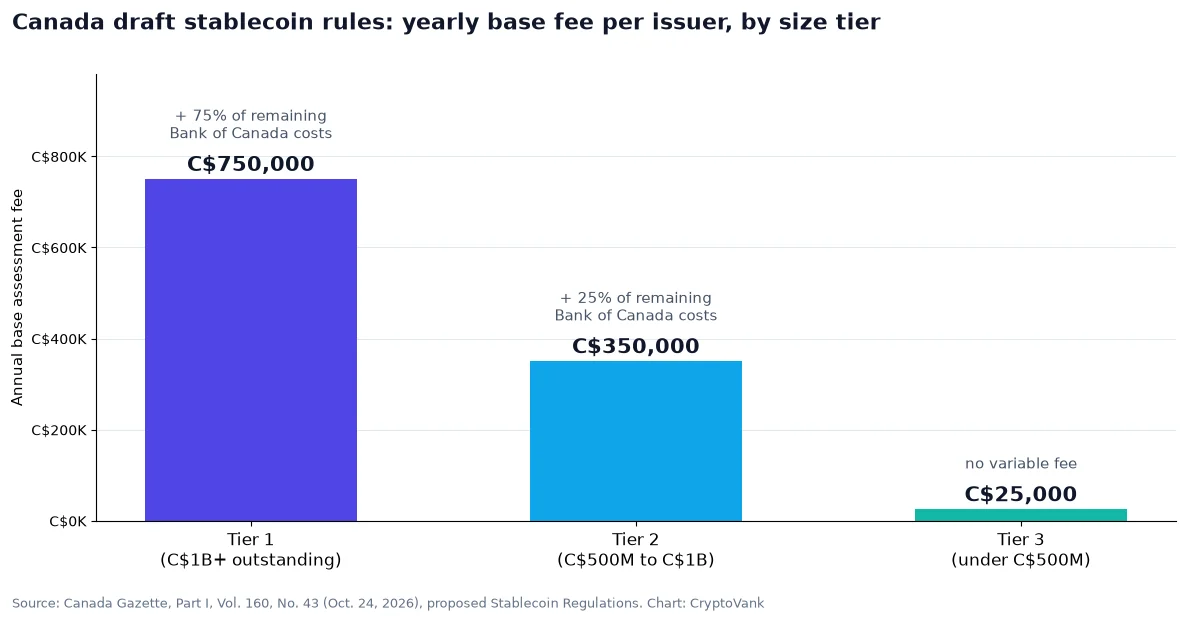
By the government’s own estimate, five issuers are likely at the start. The Gazette names QCAD from Stablecorp, CADC from Loon Technology and USDC from Circle as examples, plus possible new entrants. It puts total compliance costs at about C$1.69 million over 10 years, or roughly C$240,648 a year.
Meanwhile, the market these rules touch is large. At 19:54 UTC on Oct. 26, CoinGecko showed USDT at a market value of about $182.3 billion and USDC at about $71.2 billion. Bitcoin traded near $79,877, down 0.8% in 24 hours. If you are new to the topic, our stablecoin hub explains how these coins work, and our USDT vs USDC guide compares the two leaders.
Banks are also moving. CoinDesk noted that Canada’s six largest banks are exploring a tokenized Canadian dollar system. In addition, banking regulator OSFI said on Sept. 10 that tokenized deposits are “not legally distinct from traditional deposits.” Banks elsewhere are testing similar ideas, as our story on HSBC’s RedCoin stablecoin launch shows.
What to watch next
The key fight is over rewards. In a Sept. 8 submission, the Canadian Web3 Council asked the government to confirm that “third-party rewards based on usage or transaction volume fall outside the prohibition.” The final text will show whether exchanges can still offer such perks.
Next, watch how this sits with existing products. CoinDesk reported that Coinbase Canada won permission from the Ontario Securities Commission this year to offer yields on eligible tokens, with risk warnings. The new rules could narrow that space.
Finally, watch the timeline. Comments close on Dec. 23, 2026. After that, Finance Canada can revise the text before final rules arrive, likely ahead of a late-2027 start. Users of stablecoin-linked crypto cards should follow the reward rules closely.
FAQ
When are comments on the Canada stablecoin rules due?
Comments are due by Dec. 23, 2026, which ends the 60-day consultation that began with publication in the Canada Gazette on Oct. 24, 2026.
Can Canadian stablecoin issuers pay yield?
No. Issuers cannot pay interest or yield for simply holding a coin, even through third parties. Rewards tied only to using the coin, such as payments, are allowed.
Do the rules apply to foreign stablecoins like USDC?
Yes. The draft covers domestic and foreign non-bank issuers that serve people in Canada, whatever currency the coin tracks. The Gazette lists Circle’s USDC among the likely issuers.
Sources
- Canada Gazette, Part I, Vol. 160, No. 43: Stablecoin Regulations (Oct. 24, 2026)
- CoinDesk: Canada opens consultation on draft stablecoin rules, maintains ban on yields
- crypto.news: Canada stablecoin consultation and yield ban
- The Logic: Draft regulation on stablecoin yield
- Department of Finance Canada: Canada’s stablecoin framework
- CoinGecko: live prices and market caps
This article is for information only and is not financial advice. Do your own research before you invest.