
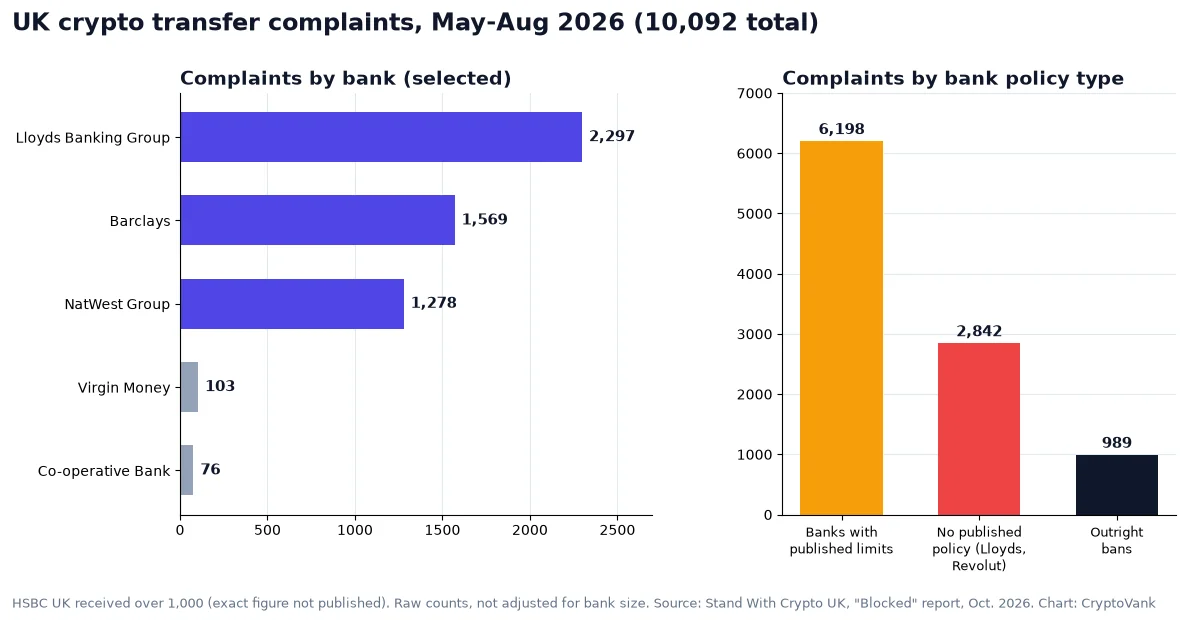
Quick answer: UK bank customers filed 10,092 complaints over crypto transfer limits and blocks between May and August 2026, says Stand With Crypto UK. Lloyds Banking Group drew 2,297, Barclays 1,569 and NatWest Group 1,278. Most complaints, 6,198, hit banks that publish caps, while 989 involved banks that ban crypto payments outright.
UK banks drew 10,092 complaints in just 90 days over crypto transfer limits and outright blocks, according to a new report from advocacy group Stand With Crypto UK. Most of the anger came from customers who could not move their own money to exchanges that the UK regulator has already registered.
What happened
First, the report, titled “Blocked: Britain’s Crypto Access Problem,” was published on Oct. 21. It covers complaints sent between May and August 2026 through the group’s online tool. In total, 9,803 people filed 10,092 complaints in their own names.
Notably, every complaint involved a payment to a platform registered with the Financial Conduct Authority (FCA). These are not offshore venues. Moreover, the complaints came from all 650 UK parliamentary constituencies, so the problem is not limited to one region.
Lloyds Banking Group, which includes Halifax and Bank of Scotland, received the most, with 2,297. As a result, it accounts for about 23% of the total. Barclays followed with 1,569, and NatWest Group, which owns Royal Bank of Scotland, had 1,278. HSBC UK also passed 1,000, although the report does not give its exact figure.
Which banks set crypto transfer limits or bans
The report sorts lenders into three groups. First, several banks publish crypto transfer limits:
- Barclays: £2,500 per transaction and £10,000 every 30 days.
- NatWest: £1,000 a day and £5,000 every 30 days, per Decrypt’s summary of the report.
- Santander UK: £1,000 per transaction and £3,000 every 30 days.
Second, some banks block crypto transfers entirely. The report names Starling, TSB, Chase UK, Metro Bank, Virgin Money and the Co-operative Bank.
Finally, some banks have no published rules at all. Lloyds is the main example. Similarly, Revolut, which even sells crypto in its own app, also drew complaints.
Why it matters
Perhaps the most striking result is the gap between policy and practice. Banks with published limits received 6,198 complaints, or about 61%. Lloyds and Revolut, the two with no published policy, received 2,842, or about 28%. Meanwhile, lenders with outright bans received only 989, just under 10%.
In other words, clear bans produced few complaints, likely because customers knew not to try. By contrast, rules that look open on paper still left many people stuck. “A customer cannot reliably use their bank’s published policy to predict whether they will be able to transfer their own money to a crypto asset platform,” the report said.
Coinbase also weighed in, too. Katie Harries, its UK policy lead, told CoinDesk that “A country cannot credibly invite innovators in while allowing banks to lock consumers out.” She cited UK Cryptoasset Business Council research showing that 40% of attempted transfers to FCA-registered exchanges were blocked or delayed in the prior 12 months.
Banks, for their part, usually point to fraud instead. That risk is real, as shown by the $833 million in frozen scam funds in a recent US crackdown. Still, the report argues that blanket rules hit honest users far more often than criminals.
Crypto transfer limits: the data in context
However, these numbers need care. They are raw complaint counts from people who chose to use a campaign tool. For example, they are not a survey, and they are not adjusted for each bank’s customer base. Also, one person could complain about more than one bank.
So the list is not a ranking of which bank blocks most often. Even so, the share tied to banks with no clear policy suggests that silence causes as much friction as strict caps.
At the same time, the tension is growing elsewhere. Some big lenders are moving closer to crypto, such as HSBC’s RedCoin stablecoin launch in Hong Kong and Sparkasse opening Bitcoin trading in Germany. Meanwhile, regulators keep pressing exchanges on safety, as the Coinbase Ireland fine showed.
For context, CoinGecko priced Bitcoin at $80,304, or about £60,043, at 13:53 UTC on Oct. 25, 2026. At that price, the Barclays cap of £10,000 a month buys roughly 0.17 BTC.
What to watch next
- FCA and Treasury response: The group wants both to state that sector-wide blocks are not proportionate before the UK crypto regime starts next year.
- Bank replies: Decrypt said it had asked Lloyds Banking Group and HSBC UK for comment. A published Lloyds policy would remove the biggest blind spot.
- Policy shifts: Watch whether banks with bans start offering limits instead, or whether caps rise once exchanges come under full FCA rules.
- Other payment routes: Some users already rely on payment apps or crypto cards. These do not change bank rules, but they show how demand moves when one door closes.
FAQ
How many UK crypto transfer complaints were filed?
Stand With Crypto UK says 9,803 people filed 10,092 complaints between May and August 2026. All of them concerned payments to FCA-registered crypto platforms, and they came from all 650 UK constituencies.
What are the main UK crypto transfer limits?
Barclays caps crypto transfers at £2,500 per transaction and £10,000 every 30 days. NatWest allows £1,000 a day and £5,000 every 30 days, and Santander UK £1,000 per transaction and £3,000 every 30 days.
Which UK banks block crypto transfers completely?
The report lists Starling, TSB, Chase UK, Metro Bank, Virgin Money and the Co-operative Bank as banks that block crypto transfers entirely. However, bank policies can change, so check your own bank’s current terms.
Not financial advice. Do your own research before investing.
Sources
- Decrypt: UK banks hit with 10,000 complaints over blocked crypto transfers
- CoinDesk: UK banks hit by 10,000 crypto transfer complaints
- Crypto Briefing: Stand With Crypto logs 10,092 complaints
- The Crypto Times: Lloyds, Barclays, NatWest, HSBC top complaints
- Stand With Crypto UK: report announcement
- CoinGecko: Bitcoin price