Quick answer: Tokenized stock objections at OKXICE TSV have reached 22, as companies refuse to have their shares traded as tokens on the venue run by OKX and NYSE owner ICE. The Oct. 23 notice added Wells Fargo, Cisco, Arm, Moderna, Intuit and Marvell. Each objection removes that stock from this venue only, under the SEC’s tokenization exemption.
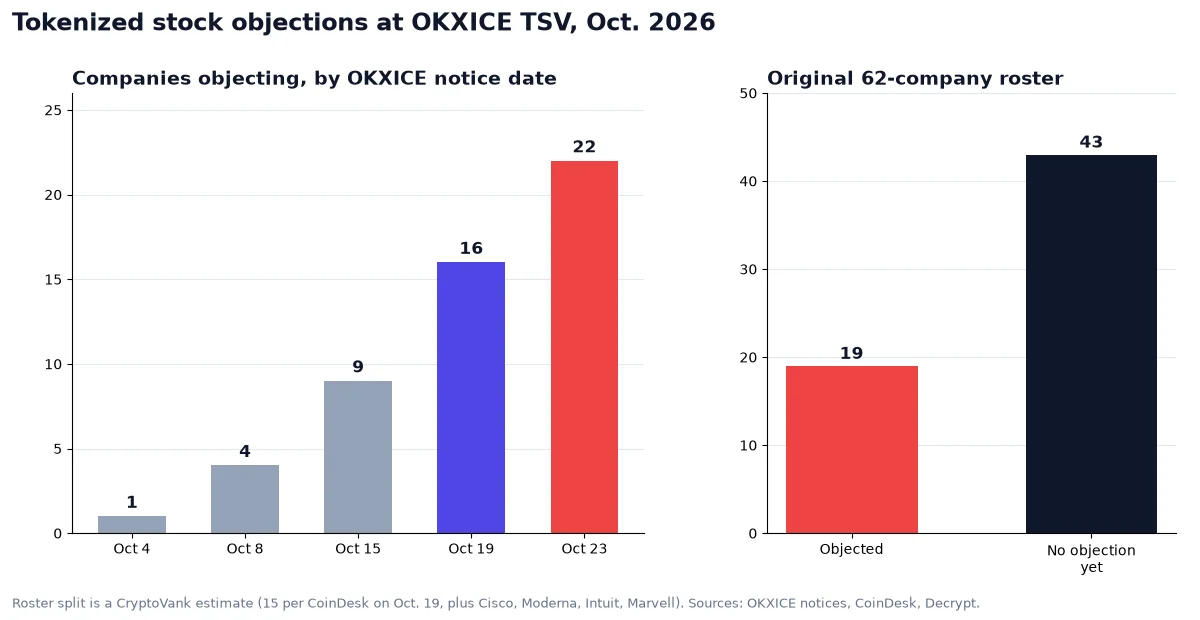
Tokenized stock objections at OKXICE have climbed to 22, after Wells Fargo, Cisco, Arm, Moderna, Intuit and Marvell asked the new venue not to trade tokens of their shares. The count has more than doubled since Oct. 15, and it now includes some of the biggest names in U.S. tech and banking.
What happened
OKXICE TSV is a tokenized securities venue owned 50-50 by Intercontinental Exchange (ICE), which runs the New York Stock Exchange, and the U.S. holding company of crypto exchange OKX. It plans to let approved users trade tokens that track U.S. stocks around the clock.
On Oct. 23, the venue posted its latest public notice. It lists 22 issuers that have objected, up from 16 in the Oct. 19 notice. The six new names are Arm Holdings, Wells Fargo, Moderna, Cisco, Intuit and Marvell, as both CoinDesk and Decrypt reported.
They join an earlier group. Cerebras was first on Oct. 4. Then AppLovin, Applied Digital, Rocket Lab, CoreWeave, Verizon, Applied Optoelectronics, Broadcom and UnitedHealth followed. The Oct. 19 notice added Goldman Sachs, Microsoft, Qualcomm, Caterpillar, McDonald’s, Western Digital and Alphabet. We first covered the dispute when nine companies had objected.
How tokenized stock objections work
The venue runs under the SEC’s Innovation Exemption, a five-year order issued on Sept. 17. Under that order, a venue must give each company 30 calendar days’ notice before trading tokens of its stock. During that window, the company can object in writing.
An objection only blocks this one venue. It does not ban tokenized versions of that stock elsewhere. Also, each token must carry the same dividend and voting rights as the real share.
Trading itself would run through permissioned Uniswap v4 pools on X Layer, OKX’s own blockchain. Users would pair stock tokens with the USDC, USDG or USDT stablecoins. Since Oct. 19, the venue can also list shares that companies tokenize themselves. So far, none of the objectors appear to have chosen that route.
Why it matters
Wells Fargo is the second major U.S. bank to object, after Goldman Sachs. That matters because large banks are also building their own tokenization plans, such as Morgan Stanley’s tokenized equities push. In short, banks may want tokenized shares, but on rails they help control.
The tokenized stock objections also show how wide the pushback has become. It now spans chips, software, health care, telecoms, fast food and finance. However, OKXICE co-chair Andrew Cuomo told Reuters that objections were expected and that many firms prefer to wait and see, according to CoinDesk.
Nasdaq has said it will opt its own shares out of such venues too. Meanwhile, the DTCC tokenization service offers issuers a route that runs through existing market plumbing.
Tokenized stock objections: data and context
Not every objector was on the venue’s first list. The original roster had 63 tickers for 62 companies, since Alphabet has two share classes. Wells Fargo, Arm and Cerebras were not on it, while Cisco, Moderna, Intuit and Marvell were.
CoinDesk counted 15 of the original 62 objecting as of Oct. 19. Adding the four new roster names gives roughly 19, or about 31%, by our own estimate. That still leaves about 43 roster companies that have not objected.
The Oct. 23 notice also spells out real risks for traders:
- No circuit breakers: The venue does not apply circuit breakers or price bands. It only pauses when the underlying stock is halted.
- No MEV policy: It has no procedures to address maximal extractable value (MEV), where bots profit by reordering trades.
- Upgradable contracts: Smart contracts can be upgraded, and an admin key could in theory be misused.
- Internal audits only: The access-control contract has been audited internally, not by outside firms, so far.
Demand is real, though. The IMF found strong interest in tokenized stocks outside market hours, but warned of thin liquidity. Recent stock perp flash crashes show what can happen when that liquidity dries up.
For market context, CoinGecko priced OKB, OKX’s exchange token, at $108.01, up 0.4% in 24 hours, at 16:58 UTC on Oct. 25, 2026. Bitcoin traded at $80,727, up 0.7%.
What to watch next
- More tokenized stock objections: Each new notice has added names. Watch whether more of the 43 remaining roster firms say no.
- Issuer tokens: A company that objects but tokenizes its own shares on the venue would be a strong signal.
- Launch date: The venue has not started trading yet, so its first live tokens will show which stocks survive.
- Rival venues: Watch platforms such as Binance bStocks and DeFi lenders like Aave’s tokenized stock market for spillover demand.
FAQ
How many companies have objected to OKXICE tokenized stocks?
Twenty-two companies are listed as objectors in the OKXICE notice dated Oct. 23, 2026. The list includes Microsoft, Alphabet, Goldman Sachs, Wells Fargo, Cisco, Broadcom and UnitedHealth.
Does an objection ban tokenized versions of that stock?
No. Under the SEC’s Innovation Exemption, an objection only stops trading of that stock on the OKXICE venue. Other venues follow their own notice process, so tokens of the same company could still trade elsewhere.
Where would OKXICE tokenized stocks trade?
They would trade in permissioned Uniswap v4 pools on OKX’s X Layer blockchain, paired with stablecoins such as USDC, USDG or USDT. Only approved users with on-chain credentials could trade.
Not financial advice. Do your own research before investing.
Sources
- OKXICE TSV public notice, Oct. 23, 2026 (PDF)
- OKXICE TSV public notice, Oct. 19, 2026 (PDF)
- CoinDesk: Wells Fargo, Cisco, Marvell among latest firms objecting
- Decrypt: Wells Fargo, Cisco, Intuit and more object to tokenized stocks
- CoinDesk: Microsoft, Alphabet and Goldman Sachs join objections
- Decrypt: Microsoft, Alphabet, Goldman Sachs join growing list
- TokenPost: OKXICE objections coverage
- CoinGecko: OKB price