
Quick answer: On Oct. 15, 2026, Binance said bStocks, its 1:1-backed tokenized U.S. stocks and ETFs, passed $1 billion AUM about four months after launching on June 11, 2026 — the fastest tokenized equity product to that mark, per Dune Research cited in the release.
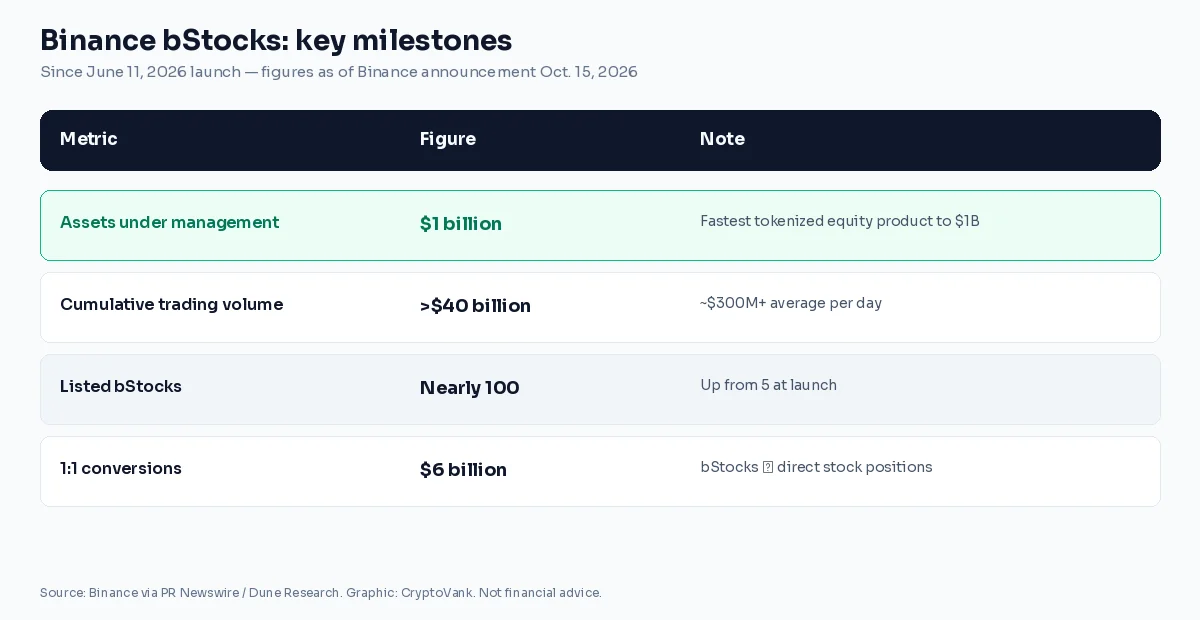
Binance said on Oct. 15, 2026 that Binance bStocks — tokenized U.S. stocks and ETFs backed 1:1 by the underlying securities — have passed $1 billion in assets under management. The exchange called it the fastest tokenized equity product to reach that mark, citing on-chain data from Dune Research as of that day.
The product launched on June 11, 2026. In roughly four months it also logged more than $40 billion in cumulative trading volume, expanded from five listings to nearly 100, and facilitated $6 billion in 1:1 conversions between bStocks and direct stock positions, according to the PR Newswire release.
What are Binance bStocks?
bStocks are tokenized representations of selected U.S.-listed stocks and ETFs. Each token is fully backed 1:1 by the underlying security, trades around the clock, settles on-chain, and can move between the exchange and compatible wallets. Holders can also convert 1:1 into direct stock holdings inside a Binance account, the release said.
CryptoBriefing reported that the tokens are issued by BTech Holdings Limited, a Binance-affiliated ADGM entity, and operate on BNB Smart Chain. Binance does not onboard U.S. persons; the offering runs under an approved ADGM prospectus for eligible users in permitted jurisdictions. Binance’s disclaimer stresses that bStocks are certificates — not stocks or shares that confer direct ownership of the underlying company’s equity.
How big is Binance bStocks trading volume?
Cumulative trading volume has exceeded $40 billion since June 11, averaging more than $300 million per day, Binance said. Listings grew from five at launch to nearly 100 by the Oct. 15 announcement. Users also moved $6 billion between direct stock positions and bStocks at 1:1 parity, per the release and CoinMarketCap Academy.
After-hours demand is clear in the mix: only 38% of bStocks volume in July occurred during regular U.S. market hours, versus 89.2% for conventional U.S. equities, Binance reported.
How are holders using bStocks in DeFi and margin?
Holders are not only parking exposure. In early October, bStocks utilization measured by total value locked (TVL) deployment in DeFi rose to 11.2%, about 3.8 percentage points above comparable tokenized equities, the release said. Outstanding borrowing against deposited bStocks collateral climbed to 46.2% by Sept. 10, from 5.5% at end-June.
Last month, Binance extended collateral support so all eligible users can post supported bStocks as margin and futures collateral — including up to 5x leverage uses described in the PR and CMC Academy. End-July data showed 58.5% of early bStocks users also traded perpetual futures and/or direct equities on Binance.
Where do tokenized equities stand industry-wide?
Binance framed the milestone against a hotter tokenization market. On-chain transfers of tokenized stocks exceeded $100 billion in Q3 2026 — more than 16x Q1’s $6 billion — with bStocks accounting for over 90% of weekly transfer volume at an early-August peak. Tokenized equities’ market capitalization more than quadrupled to over $3 billion by late September, the release said.
That growth sits beside a broader institutional push. Morgan Stanley’s tokenized equities timeline has slipped toward Q1 2027, while the IMF’s tokenized-stocks report warned that round-the-clock trading can come with sharper swings. On-chain venues such as Base have also seen heavy flow — see our Base $100M daily volume note. For chain context, check our BNB price page.
Market implications
A four-month sprint to $1B AUM, paired with $40B+ turnover and nearly 100 listings, puts exchange-native tokenized equities firmly in the RWA spotlight. The mix of 24/7 trading, 1:1 conversion, DeFi deployment and futures collateral suggests the product is being used as working capital, not only as a paper claim.
Eligibility and the certificate structure still matter: bStocks do not convey direct share ownership and remain limited to eligible users in permitted jurisdictions. Competitors expanding stock offerings — CMC Academy noted Bybit opening trading in over 1,000 U.S. stocks earlier that week — will keep pressure on liquidity, listings and collateral rules.
Binance bStocks FAQ
When did Binance bStocks pass $1 billion AUM?
Binance announced on Oct. 15, 2026, that bStocks had surpassed $1 billion in assets under management roughly four months after launching on June 11, 2026, citing Dune Research on-chain data in its PR Newswire release.
What trading volume have Binance bStocks reached?
Cumulative trading volume exceeded $40 billion since the June 11, 2026 launch, averaging more than $300 million per day over the period, according to Binance.
How many bStocks are listed, and how much was converted?
Binance listed nearly 100 bStocks as of the Oct. 15, 2026 announcement, up from five at launch. Users converted $6 billion between bStocks and direct stock positions at 1:1 parity.
Can eligible users use bStocks as collateral?
Yes. Last month before the Oct. 15 announcement, Binance extended support so all eligible users can post supported bStocks as margin and futures collateral, including up to 5x leverage uses described in the release and CoinMarketCap Academy coverage.
Are Binance bStocks the same as owning the underlying stock?
No. Binance states that bStocks are certificates representing certain financial instruments, not stocks or shares, and do not give holders direct ownership of the underlying listed company’s equity. They are available only to eligible users in permitted jurisdictions.
Sources
- PR Newswire: Binance bStocks surpass $1B AUM
- CryptoBriefing: Binance tokenized stocks surpass $1 billion
- CoinMarketCap Academy: Binance’s tokenized bStocks top $1B
Not financial advice. Tokenized securities involve jurisdiction limits, smart-contract and market risks. Do your own research (DYOR).




1 comment