Quick answer: The France stablecoin tax cleared the National Assembly by 38 votes to 37 on Oct. 16, 2026, with only 100 of 577 deputies taking part, per the Assembly’s official vote record. From Jan. 1, 2027, swapping crypto into euro- or dollar-backed stablecoins such as USDC would trigger France’s 31.4% flat tax. It is not law yet.
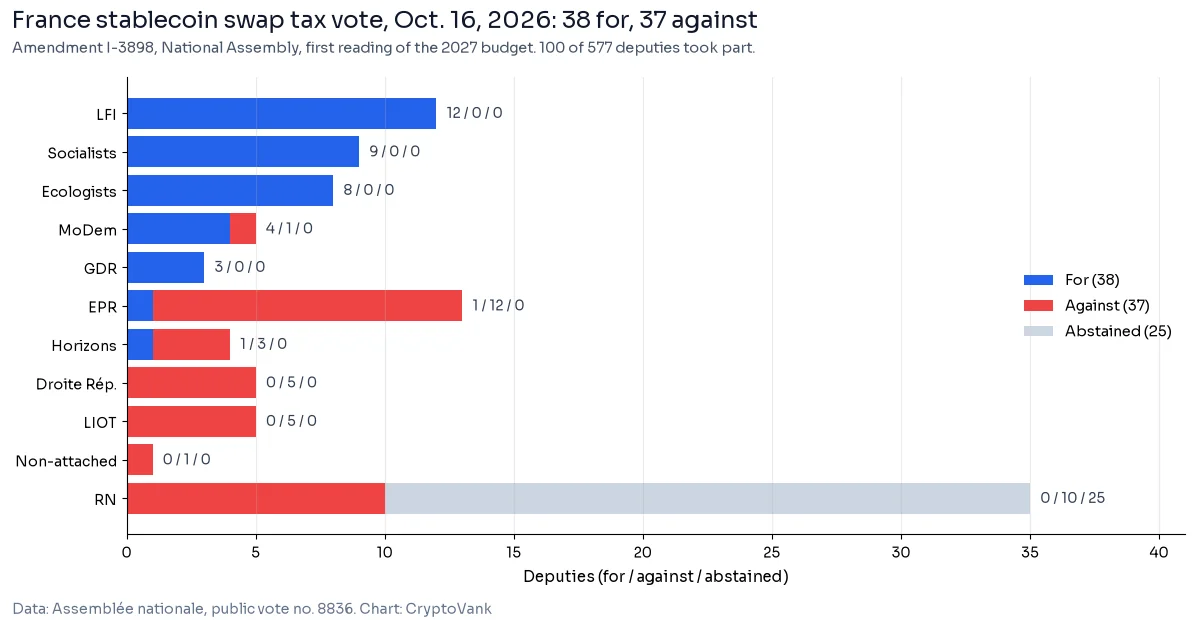
The France stablecoin tax has cleared its first real test, and it did so by a single vote. On Friday, Oct. 16, 2026, France’s National Assembly adopted amendment I-3898 by 38 votes to 37, with 25 abstentions, according to the Assembly’s official record of public vote no. 8836. Only 100 of the 577 deputies took part.
As a result, swapping crypto into a euro- or dollar-backed stablecoin would become a taxable event in France from Jan. 1, 2027. That moves the plan we covered when it cleared the finance committee one step closer to law, though several hurdles remain.
What did France’s Assembly vote for?
Today, French investors pay no tax when they trade one crypto asset for another. Tax falls due only when they cash out to euros or buy something, as the French tax office explains. That rule lets traders park gains in stablecoins without paying anything.
The amendment, tabled on Oct. 10 by Nicolas Sansu and 16 other left-wing GDR deputies, ends that deferral for swaps into “e-money tokens” as defined by the EU’s MiCA rules. In plain terms, these are stablecoins pegged to one official currency, such as Circle’s USDC and EURC. The amendment text calls the current rule a gap in the law. Swaps from bitcoin to other cryptocurrencies would stay tax-deferred.
How much tax would a stablecoin swap cost?
The gain would be taxed under France’s flat tax, which rose to 31.4% on Jan. 1, 2026, per Service Public. That rate combines 12.8% income tax and 18.6% social charges.
For example, Journal du Coin works through a bitcoin bought for €30,000 and swapped for 70,000 USDC. The €40,000 gain would mean €12,560 in tax, even though no euros reached a bank account. If you track the coin itself, our live Bitcoin price page shows where that gain stands today.
Does the cost-basis rule change too?
Yes, and this part has drawn less attention. The amendment replaces France’s whole-portfolio formula with a weighted-average cost for the specific asset sold. Holders of crypto bought before 2027 could either prove the real cost of each asset or split their total portfolio cost at Dec. 31, 2026 across holdings. However, that second option would be irrevocable.
Why did the vote pass by one vote?
Attendance decided it. Of the 100 deputies present, 25 abstained, so a majority of 38 votes was needed, and the measure reached exactly 38. All 25 abstentions came from the Rassemblement National, while 10 of its deputies voted against, TSN reports from the official breakdown.
The left voted as one bloc: La France insoumise (12), Socialists (9), Ecologists (8) and GDR (3) all backed it. In addition, centrist deputy Olivia Grégoire later said she had meant to vote against, a correction the record notes but which does not change the result.
Two other votes went against crypto holders the same afternoon. A 10-year loss carry-forward backed in committee was rejected 75 to 18, and amendments to lift the €305 tax-free threshold were not even defended, according to Journal du Coin.
Is the France stablecoin tax now law?
No. This was one amendment at first reading. Public accounts minister David Amiel gave the government’s unfavourable opinion, Journal du Coin reported. Next, the full Assembly holds a solemn vote on the revenue part of the budget on Tuesday, Oct. 20, followed by the Senate and a joint committee. If the government uses Article 49.3, it can pick which amendments survive, Cryptoast notes.
What does it mean for stablecoin markets?
The vote hits euro stablecoins just as the EU tries to grow them. The European Banking Authority recently named USDC a significant e-money token, and ESMA has set a Jan. 8 deadline for non-MiCA stablecoins. Meanwhile, the measure keys off the legal definition of an e-money token, not MiCA compliance, so Cryptoast says even USDT could be caught. Traders weighing the two can compare them in our USDT vs USDC guide.
France Stablecoin Tax FAQ
When would the France stablecoin tax start?
It would apply to swaps made from Jan. 1, 2027, if the 2027 budget keeps amendment I-3898. The Assembly adopted it on Oct. 16, 2026 by 38 votes to 37, but the Senate and a final vote still have to confirm it.
What is the tax rate on crypto-to-stablecoin swaps in France?
Gains would be taxed under France’s flat tax of 31.4%, made up of 12.8% income tax and 18.6% social charges, per Service Public. Taxpayers can opt for the progressive income tax scale instead.
Are crypto-to-crypto trades still tax-free in France?
Yes. Swaps between crypto assets such as bitcoin and ether stay tax-deferred. Only swaps into e-money tokens, meaning stablecoins pegged to a single official currency like USDC or EURC, would lose that deferral.
Can the France stablecoin tax still be dropped?
Yes. The government opposes it, the Assembly votes on the full revenue section on Oct. 20, 2026, and the Senate can delete it. Under Article 49.3, the government could also leave it out.
Sources
- Assemblée nationale: public vote no. 8836, Oct. 16, 2026
- Assemblée nationale: amendment I-3898 to the 2027 budget bill
- Service Public: flat tax rate rises to 31.4%
- impots.gouv.fr: how crypto gains are declared and taxed
- Journal du Coin: stablecoin tax voted by 100 deputies out of 577
- Cryptoast: deputies vote to tax crypto-to-stablecoin conversions
- TSN: French MPs back stablecoin swap tax by 38 votes to 37
This article is for information only and is not financial or tax advice. Rules may change before they take effect; DYOR and consult a qualified tax adviser.