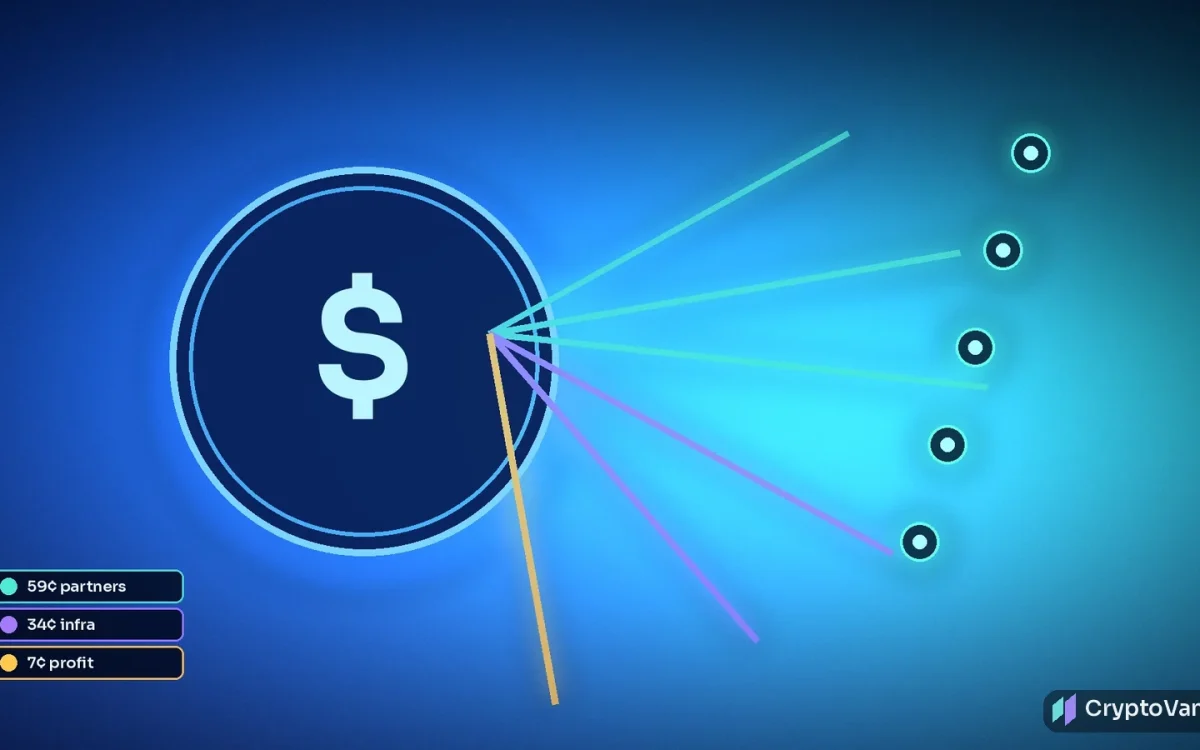
Quick answer: Circle USDC economics, per an Oct. 16, 2026 blog post: about $1.4 billion H1 revenue, $819 million to partners and costs, and about 7 cents net profit per revenue dollar. CoinDesk and Cryptopolitan covered the figures as rivals court partners with bigger reserve-yield cuts.
Circle is putting hard numbers behind Circle USDC economics after rivals courted the same wallets and exchanges with bigger reserve-yield cuts. In a company blog post dated Oct. 16, 2026, Chief Commercial Officer Kash Razzaghi said Circle earned about $1.4 billion in first-half revenue, paid $819 million to distribution partners and transaction costs, and kept about 7 cents of net profit on each revenue dollar.
However, that framing matters because Coinbase, Circle’s largest USDC partner, also backs Open USD, a rival that passes reserve income to participants after a management fee. CoinDesk and Cryptopolitan both covered the post on Oct. 16–17 without Circle naming Open USD directly.
What did Circle say about USDC revenue?
Razzaghi’s post breaks H1 2026 into three buckets. About 59 cents of every revenue dollar, or $819 million, went to the wallets, exchanges, banks, fintechs and payment firms that distribute USDC, plus related transaction costs. About 34 cents, or $473 million, went back into licenses, banking relationships, settlement liquidity, compliance and product work. Circle says that left 7 cents of net profit per revenue dollar.
CoinDesk notes that the $473 million reinvestment figure also included about $214 million in stock-based compensation and related costs. So readers should treat “infrastructure” as a wide bucket, not only cash spent on banks and blockchains.
Scale numbers sit beside the split. Circle says USDC settled more than $36 trillion onchain in H1 2026, and that it minted and redeemed more than $315 billion of USDC, or about $1.7 billion a day including weekends. It also claims USDC carried roughly 77% of global stablecoin transaction volume in June, up from 60% a year earlier. Those claims come from Circle’s blog, so treat them as company figures.
Why Circle USDC economics are under pressure
Specifically, the fight is about who keeps the interest earned on cash and short Treasuries that back dollar tokens. Open USD, launched by the Open Standard Consortium, markets free minting and redemption and says partners can collect reserve earnings minus a management fee. Stripe integrated OUSD across its stablecoin stack, and Coinbase sits on both sides of the table, per CoinDesk.
Circle’s reply is simple. Partners already share most of the economics, and free redemption already exists. Razzaghi writes that every Circle customer can redeem USDC for free on standard banking rails, with settlement in up to two business days. Flows on the Circle Payments Network, or builds on Circle Platform products such as Arc, Circle Mint and Circle Wallets, can now redeem for free with near-real-time, 24/7 settlement.
To show the cost of that promise, Circle says it redeemed $71.8 billion of USDC in Q1 2026 alone, about 90% of circulating supply at the time. Near-real-time payouts need cash parked at partner banks, and that cash earns less than Treasuries. “The costs of redemption, compliance, and resilience don’t disappear just because the issuer declined to pay them,” Razzaghi wrote.
Meanwhile, Circle is still buying distribution to protect Circle USDC economics. In September, Binance took a $100 million stake and signed a five-year commercial deal, the post says. Coinbase remains the clearest example of balance-driven payouts: its Q2 results showed average USDC held in Coinbase products at an all-time high of $20 billion, up 44% year over year.
Data and context: USDC size versus Open USD
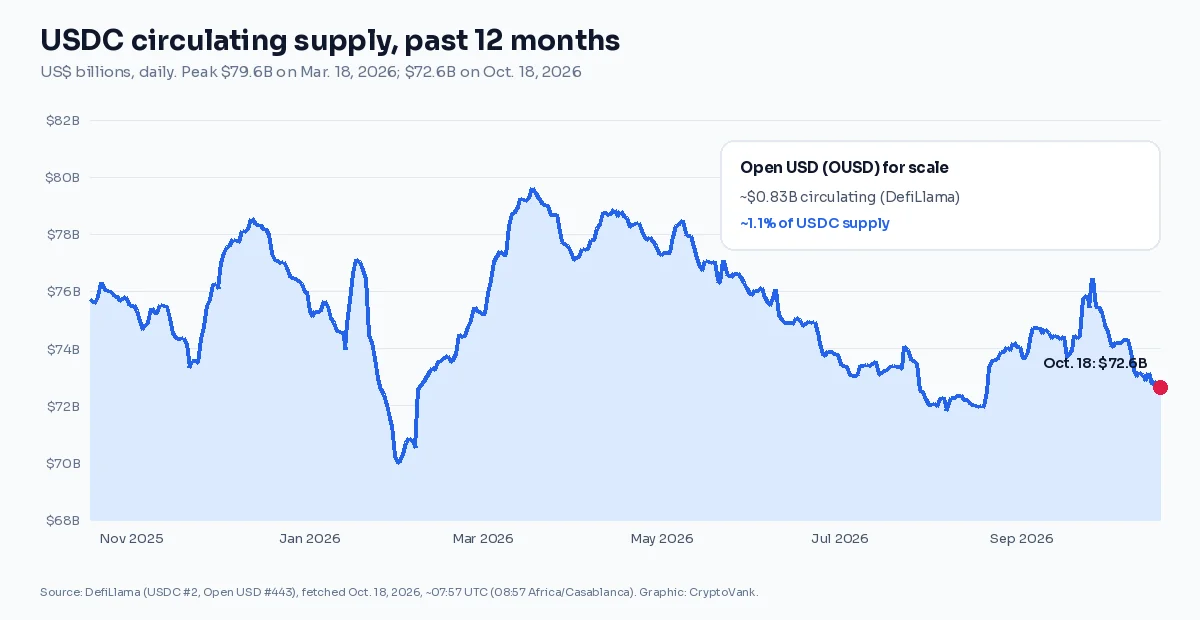
Overall, live market data still shows a wide gap. At about 07:57 UTC on Sunday, Oct. 18, 2026 (08:57 Africa/Casablanca), CoinGecko put USDC near $1.00 with a market cap of about $72.4 billion. DefiLlama’s circulating print for the same day sat near $72.6 billion. Tether’s USDT was about $183.4 billion. Open USD (OUSD) stood near $0.83 billion, or roughly 1.1% of USDC’s supply, per DefiLlama asset #443.
Bitcoin traded near $81,600 and Ether near $2,407 at the same CoinGecko snapshot, both little changed overnight. Those spot moves do not drive the partner-yield debate, but they set the weekend market backdrop.
Payments rails keep expanding around USDC even as the economics fight runs. We covered Visa Direct USDC prefunding going live with Inyo Global and the EBA labeling USDC the first significant EU e-money token under MiCA. For how dollar tokens differ in reserves and regulation, see our USDT vs USDC guide.
Spend-side products matter too. If you want a card that turns crypto or stablecoin balances into everyday spend, our crypto cards hub tracks options such as KAST and RedotPay, separate from Circle’s issuer model.
What to watch next
First, therefore, watch whether Open USD’s partner-yield pitch pulls measurable balances from USDC wallets, or whether USDC’s settlement share stays near Circle’s claimed 77%. Second, watch Circle’s next earnings for whether the 59 / 34 / 7 split holds after H2 distribution deals. Third, watch redemption terms in practice: free near-real-time settlement only helps if liquidity holds through a stress week, a risk the FSB has already flagged for global stablecoins.
In addition, watch Coinbase’s dual role. Supporting both USDC and Open USD strengthens its leverage with issuers. As a result, partner payouts can rise industry-wide even if USDC remains the default settlement coin.
Circle USDC Economics FAQ
How much of Circle USDC economics goes to partners?
In H1 2026, Circle said about $819 million of roughly $1.4 billion in revenue, or 59 cents per dollar, went to distribution partners and transaction costs. It said it kept about 7 cents of net profit per revenue dollar, per its Oct. 16, 2026 blog post.
Does Circle charge to redeem USDC?
Circle says all customers can redeem USDC for free on standard banking rails, with settlement in up to two business days. Customers using Circle Payments Network or eligible Circle Platform products can redeem for free with near-real-time, 24/7 settlement, according to the same post.
How big is Open USD compared with USDC?
On Oct. 18, 2026, DefiLlama showed about $72.6 billion of USDC in circulation versus about $0.83 billion of Open USD. That puts OUSD near 1.1% of USDC’s supply, so any partner migration would need sustained balance growth to change market structure.
Not financial advice. Stablecoin issuer revenue splits, reserve yields and redemption terms can change. DYOR.
Sources
- Circle: The Economics of USDC and Why Our Partners Win (Oct. 16, 2026)
- CoinDesk: Circle defends USDC economics as stablecoin rivals court its partners (Oct. 17, 2026)
- Cryptopolitan: Circle defends USDC economics as OUSD courts its partners (Oct. 16, 2026)
- CoinGecko: USDC market data
- DefiLlama: USDC and Open USD circulating supply