Quick answer: On Oct. 19, 2026, Mesh and Visa unveiled crypto payments that let participating wallet apps spend crypto and stablecoin balances at more than 175 million Visa merchant locations, with no separate card. Mesh converts funds at checkout and merchants get a normal Visa payment. Neither firm has named a launch date or wallets yet.
Mesh and Visa announced on Oct. 19, 2026 that participating wallet apps will soon spend crypto and stablecoin balances anywhere shops take Visa. The Mesh Visa crypto payments setup skips the separate crypto card, but neither firm has named a launch date or wallet list yet.
The news landed at 11:00 ET (15:00 UTC) through a Mesh press release. Markets were steady at the time. Bitcoin traded at $81,935 and ether at $2,401.39 on Oct. 19 at 16:55 UTC, per CoinGecko, both up between 1% and 2% in 24 hours.
What happened with Mesh Visa crypto payments?
Mesh, founded in 2020, plugs wallets and exchanges into Visa’s acceptance network. Visa reaches more than 175 million merchant locations in over 200 countries and territories, and it handled $14.2 trillion in payments volume in fiscal 2025, according to the release and crypto.news.
Here is how a payment works. Mesh creates a Visa credential behind the scenes inside the wallet app. The user then taps a normal contactless terminal or checks out online. Mesh decides how the purchase is funded and converts crypto, stablecoins or fiat at that moment. As a result, the merchant receives a standard Visa payment and needs no new hardware.
Mesh also acts as the program manager. That means it handles user onboarding and identity (KYC) checks for the wallets that join. “Crypto never had a spending problem — it has a last-mile problem, and until now, closing it meant getting a separate card,” Mesh CEO Bam Azizi said, as quoted by The Block.
Visa’s global head of growth, Rubail Birwadker, said the deal “helps expand how digital asset balances can connect to the trusted payment experiences consumers and merchants rely on every day.”
Why it matters for crypto card users
Most people who spend crypto today use a dedicated card, as our guide to what a crypto card is explains. You top up a card tied to one platform, and that platform converts your coins when you pay. If you hold funds in three apps, you often need three cards, or you move money around first.
The Mesh model flips that. The wallet itself becomes the payment method, so the card program sits in the background. For wallet makers, that is the bigger change. They no longer need to build and run their own card program. One Mesh integration replaces it.
It also explains why the partner list matters. Mesh says it already serves more than 200 enterprises, including Kalshi, Tools for Humanity, Félix Pago, Majority and KAST. However, neither company has said which of them will switch on Visa spending first. KAST already runs its own card, which we compare with RedotPay on our crypto cards page.
The data: crypto spending is still tiny next to Visa
The release itself shows how small crypto spending still is. Citing American Banker, Mesh says crypto card volumes ran at about $1.5 billion a month by late 2025. Annualized, that is roughly $18 billion. Set against Visa’s $14.2 trillion, it equals about 0.13% of the network’s yearly volume.
Meanwhile, the pool of dollars waiting in wallets is large and stable. USDT and USDC had a combined market cap of $255.8 billion on Oct. 19 at 16:55 UTC, per CoinGecko. Over the past 90 days, that total stayed in a narrow band between $254.8 billion and $259.1 billion.
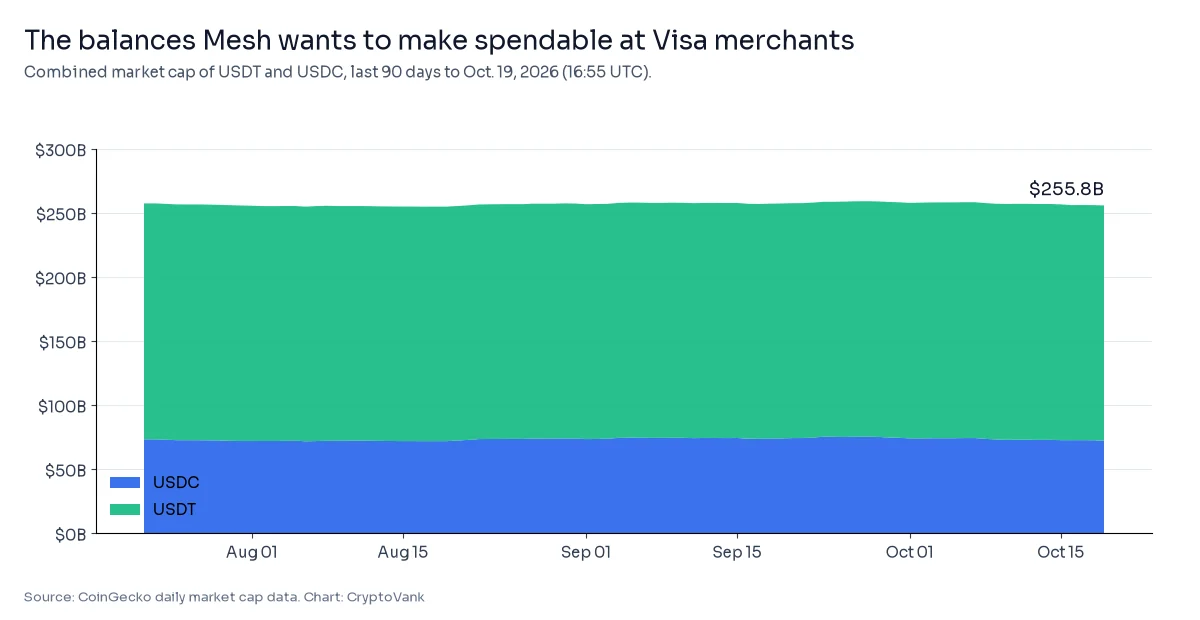
In short, the money is already there. The missing piece is an easy way to spend it at a shop till. Card networks are racing for the same slot, as our reports on Mastercard’s Global Money Platform and Stripe’s stablecoin cards show.
Open questions before launch
First, refunds and disputes. A shopper can charge back a card payment, but not an onchain transfer. The release does not say who handles a refund after Mesh converts crypto at checkout. That detail will shape how much protection buyers get.
Second, fees and spreads. Every conversion has a cost. Mesh has not said how it prices the crypto-to-fiat step. A wide spread could make a “free” tap more expensive than a prepaid card.
Third, taxes. In many countries, swapping crypto to pay for something counts as selling it. Paying for coffee with bitcoin could therefore create a taxable gain. Stablecoins reduce that problem, which is why most spending will likely run on USDT and USDC. Our stablecoins explainer covers how they hold their peg.
What to watch next
The first milestone is a named wallet going live. Until then, the 175 million merchant figure measures where a payment could work, not how many people can use it. Watch which Mesh partners announce Visa spending, and in which countries.
Next, watch the terms. Look for clear fee tables, refund rules and supported assets. Then watch usage. Repeat spending, not sign-ups, will show whether crypto holders want to pay this way.
Finally, keep an eye on Visa’s own stablecoin push. It already lets businesses prefund payouts in USDC, as our story on Visa Direct’s USDC prefunding explains. The Mesh deal adds the consumer side.
Mesh Visa crypto payments FAQ
When can I use Mesh Visa crypto payments?
Not yet. Mesh said on Oct. 19, 2026 that it will name the launch date, supported devices and participating platforms once it finalizes rollout details.
Do merchants receive crypto from Mesh Visa payments?
No. Mesh converts the user’s crypto or stablecoin balance at the moment of payment. The merchant receives a standard Visa payment through its existing checkout, with no new hardware.
Do I need a crypto card to pay this way?
No. Mesh creates a Visa credential in the background inside a participating wallet app. You then tap a contactless terminal or pay online from your existing balance.
Sources
- Mesh and Visa Partner to Make Stablecoin and Crypto Balances Spendable Across 175 Million Merchants (PR Newswire)
- Mesh taps Visa to let users spend crypto without a separate card (The Block)
- Visa partners with Mesh to enable crypto payments at 175 million merchants (crypto.news)
- Bitcoin, Tether and USD Coin market data (CoinGecko)
This article is for information only and is not financial advice. Crypto prices are volatile, so do your own research before you invest.