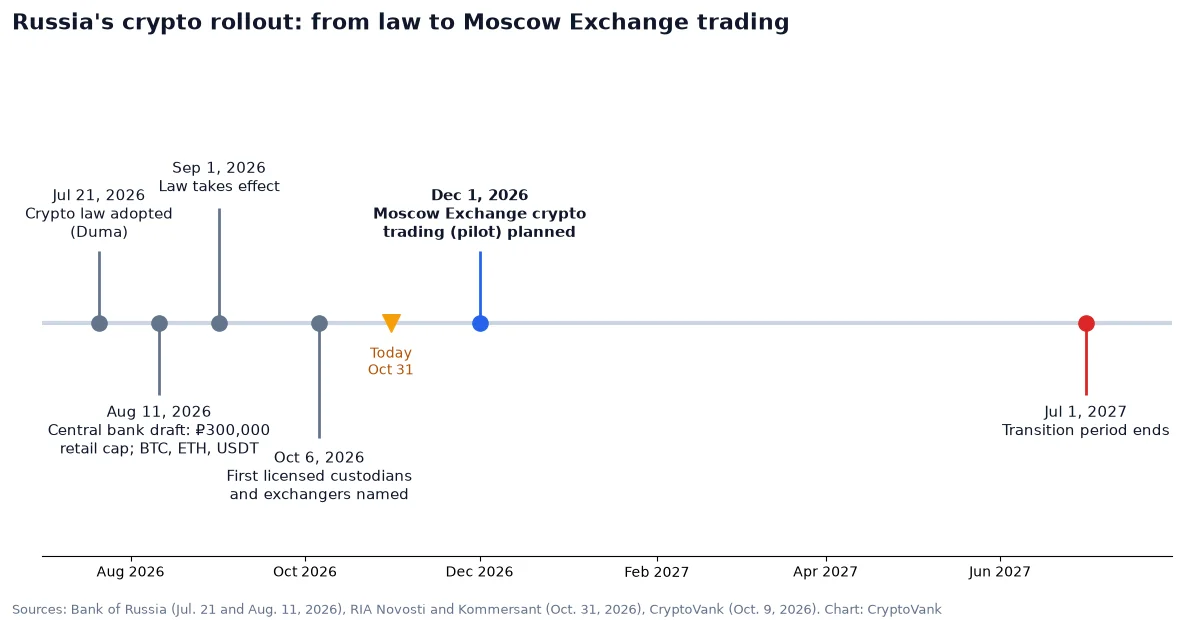
Quick answer: Moscow Exchange plans to start crypto trading on Dec. 1, 2026, with Bitcoin, Ether and USDT, executive Boris Blokhin said on Oct. 31, per RIA Novosti and Kommersant. Trades run on its stock market from 06:50 to 23:50 Moscow time, and retail buyers face a ₽300,000 yearly cap per intermediary.
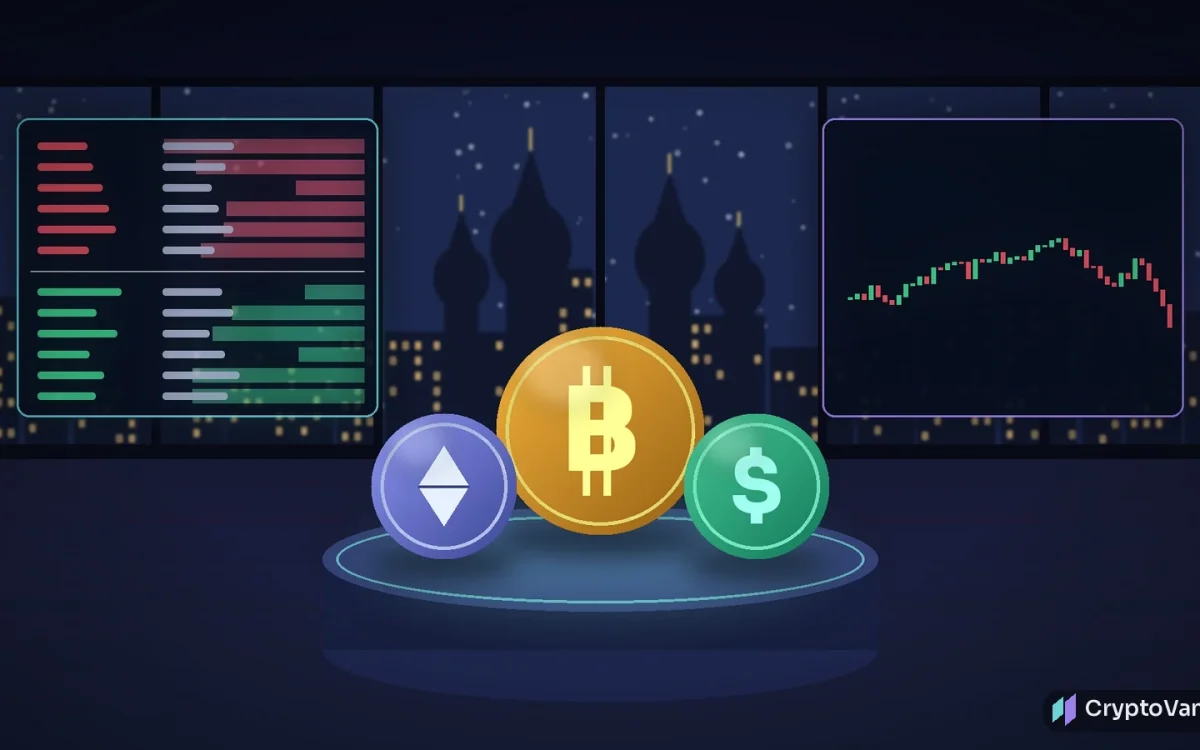
Russia’s largest exchange now has a launch date for crypto. Moscow Exchange crypto trading is set to begin on Dec. 1, 2026, with three coins at first: Bitcoin, Ether and Tether’s USDT.
What did Moscow Exchange announce about crypto trading?
Boris Blokhin, a senior managing director at Moscow Exchange, gave the date on Oct. 31, 2026, at the Smart-Lab investor conference, RIA Novosti reported. “We plan to launch crypto trading from Dec. 1,” he said. He added that clients are already testing in the exchange’s systems.
In addition, the details line up across several outlets. Kommersant and Vedomosti report the same three coins and the same plan:
- Venue: trades run on the exchange’s existing stock market infrastructure.
- Order types: buyers and sellers meet in a normal order book, and swap deals will be available to manage liquidity.
- Hours: 06:50 to 23:50 Moscow time, or 03:50 to 20:50 UTC, per Kommersant.
- Custody: coins are held and recorded by partner digital depositories, not by the exchange itself.
Blokhin called the December start a pilot. He said enough firms have joined testing to launch on time.
Why does Moscow Exchange crypto trading matter?
Spot crypto only became legal to trade through Russian intermediaries when the new law took effect on Sept. 1, 2026. Dec. 1 would bring it onto the country’s main exchange. Until now, Russians who wanted Bitcoin mostly used offshore platforms or peer-to-peer deals. Many of those doors are closing. For example, Bitget cut off users in the region in October, as we covered in our report on its exit deadline.
Moreover, the launch fits a clear pattern. Moscow wants crypto inside the banking system it already supervises. In early October, the Bank of Russia named its first licensed custodians and exchangers, led by state-linked banks such as VTB and Sberbank. We broke down who made those first lists. Sberbank has said it aims to offer BTC, ETH and USDT to clients from the same date, Dec. 1.
Meanwhile, the listing of USDT stands out. A dollar stablecoin on a Russian exchange gives local investors dollar exposure through a regulated venue. That could draw attention from regulators abroad, given ongoing sanctions on Russian finance.
What are the rules for buyers?
The rules come from a crypto law that took effect on Sept. 1, 2026, according to the Bank of Russia. Every investor must pass a test first. After that, the caps depend on investor status:
- Retail (non-qualified) investors can buy only the most liquid coins, up to ₽300,000 a year through each intermediary.
- Qualified investors can trade any listed coin with no limit.
In an Aug. 11 draft rule, the central bank listed Bitcoin, Ethereum and USDT as the coins that meet its rules for retail access. Coins need high market value, strong daily volume and at least five years of price history abroad. That is why Moscow Exchange starts with exactly these three.
Even so, crypto still cannot be used to pay for goods inside Russia. The law also sets a transition period until July 1, 2027, for firms to get licenses.
How much crypto does the ₽300,000 cap buy?
However, the cap is small by global standards. At CoinGecko prices on Oct. 31, 2026, at 20:54 UTC, ₽300,000 bought about:
| Asset | Price (CoinGecko) | ₽300,000 buys |
|---|---|---|
| Bitcoin | ₽6,221,534 ($77,478) | about 0.048 BTC |
| Ether | ₽180,899 ($2,252.76) | about 1.66 ETH |
| USDT | ₽80.27 ($0.9996) | about 3,737 USDT |
In dollar terms, that is roughly $3,700 a year per intermediary. Bitcoin was up 0.75% over 24 hours at that time, after its worst October since 2014.
So retail flows alone are unlikely to move global prices. Instead, the bigger factor is qualified investors and firms, who face no cap.
What to watch next for Moscow Exchange crypto trading
- The Dec. 1 start. Blokhin called it a plan and a pilot, so watch for a final notice from the exchange.
- Broker readiness. Banks and brokers still need to connect and set up the investor test.
- Liquidity. Early volumes and spreads will show whether demand is real or limited by the cap.
- Foreign reaction. A ruble market for USDT may draw comments from Tether and from sanctions authorities.
- July 1, 2027. That is when the transition period ends, and Vedomosti reports that peer-to-peer crypto deals will be banned for Russians from that date.
Moscow Exchange crypto trading FAQ
When does Moscow Exchange crypto trading start?
Moscow Exchange plans to start crypto trading on Dec. 1, 2026, in pilot mode. Senior managing director Boris Blokhin gave the date on Oct. 31, 2026, per RIA Novosti and Kommersant.
Which coins can be traded on Moscow Exchange?
Only Bitcoin, Ether and Tether’s USDT at launch. The Bank of Russia says these three meet its liquidity and five-year price history rules for retail investors.
Can retail investors in Russia buy crypto without limits?
No. Retail investors must pass a test and can buy up to ₽300,000 a year through each intermediary, per the Bank of Russia. That was about $3,700 at CoinGecko rates on Oct. 31, 2026. Qualified investors have no cap.
What are the trading hours?
Kommersant reports trading from 06:50 to 23:50 Moscow time, which is 03:50 to 20:50 UTC. That covers both the morning and evening stock market sessions.
Sources
- RIA Novosti: Moscow Exchange plans to launch trading in three cryptocurrencies from Dec. 1
- Kommersant: Moscow Exchange names coins and trading hours
- Vedomosti: Moscow Exchange to launch Bitcoin, Ethereum and USDT trading
- TASS: Moscow Exchange plans to offer crypto trading from Dec. 1 (Oct. 8)
- Bank of Russia: Russia introduces cryptocurrency regulation
- Bank of Russia: Rules for non-qualified investors buying crypto
- CoinGecko: Bitcoin price
This article is for information only and is not financial advice.