
Quick answer: BlackRock PBIT is the iShares Bitcoin Managed Protection ETF, filed with the SEC on Oct. 19, 2026. It would hold options on IBIT, BlackRock’s spot Bitcoin ETF, aiming to limit each tranche’s loss to about 10% before fees while capping gains. Fee, exchange and launch date are blank in the filing.
BlackRock PBIT is the world’s largest asset manager’s answer to a nervous Bitcoin market. On Oct. 19, 2026, iShares Trust filed a Form 485APOS with the SEC for the iShares Bitcoin Managed Protection ETF, ticker PBIT. Bloomberg ETF analyst James Seyffart flagged the filing on X at 21:19 UTC.
The pitch is simple: Bitcoin exposure with a safety net. However, the net costs you part of the upside, and it is not a fixed guarantee.
What did BlackRock file?
The filing adds a new fund to iShares Trust. Its stated goal is to “provide upside exposure to the iShares Bitcoin Trust ETF (IBIT)” up to an approximate limit, “while seeking to provide a level of downside protection.”
Several key details are still blank. The management fee, the listing exchange and the prospectus date all show “____” in the document. Seyffart added that PBIT will be a 1940 Act fund and BlackRock’s third Bitcoin ETF filing. BlackRock still only offers Bitcoin and Ethereum products.
How does the BlackRock PBIT buffer work?
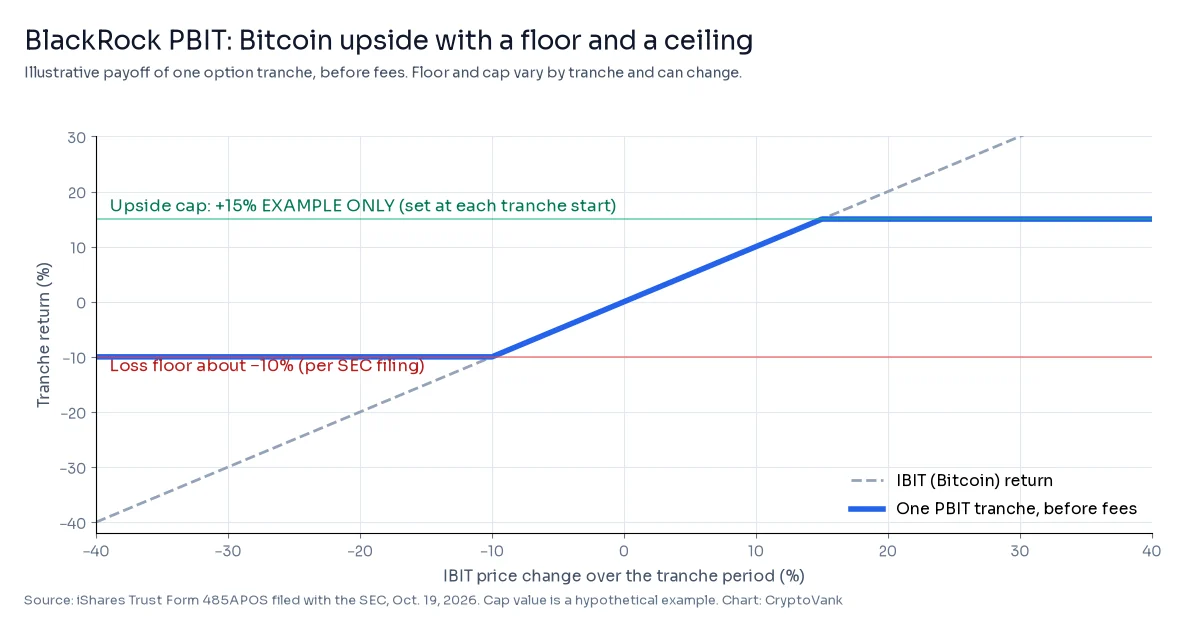
PBIT does not buy bitcoin directly. Instead, it uses options on IBIT, which tracks the Bitcoin price. According to the filing, the strategy typically has three parts:
- Buy call options that start in the money, with a strike near 90% of IBIT’s price. That sets the “Floor,” an initial maximum loss of about 10% for each tranche, before fees.
- Sell higher-strike calls to help pay for the protection. Their strike becomes the “Tranche Cap Value,” the limit on gains.
- Hold cash and short-term bonds whose interest helps offset option costs.
The fund holds three overlapping tranches with staggered monthly start dates across a calendar quarter. So each month one tranche expires and a new one begins. BlackRock expects to use FLEX options, which are customizable exchange-listed contracts.
What is the catch with BlackRock PBIT?
The protection is real, but it is not fixed. The filing warns that PBIT “does not provide a fixed” floor or cap, and BlackRock has “broad discretion” to change them at any time.
There are three practical limits. First, caps are set by market conditions at each tranche start, so you will not know your maximum upside in advance. Second, if IBIT rises after a tranche begins, the potential loss from the new, higher level is larger than 10%. Third, fees come on top. The filing is blunt: “investors may lose some or all of their money.”
Why is BlackRock launching it now?
Timing matters. Bitcoin traded near $81,919 at 23:53 UTC on Oct. 19, about 35% below its $126,080 record from Oct. 6, 2025, per CoinGecko. Meanwhile, US spot Bitcoin ETFs saw about $907 million of net outflows from Oct. 5 to Oct. 16, according to Farside data on our Bitcoin ETF flows tracker.
That backdrop explains the demand for downside protection. It also follows a weak month, as we covered in our look at Bitcoin’s October returns. Still, this is not a first. Seyffart noted that Calamos and First Trust already run defined-outcome Bitcoin ETFs.
What does BlackRock PBIT mean for the Bitcoin market?
In the short term, nothing changes, because the fund cannot launch yet. The filing chose the 75-day path under Rule 485(a)(2). As a result, January 2027 is the earliest realistic start.
Longer term, PBIT could pull in cautious financial advisers who skipped spot ETFs because of volatility. Because it would hold IBIT options rather than coins, any inflows would mainly hit the IBIT options market. Selling upside calls at scale could also add supply to that market. For background, read how crypto ETFs work and how to read Bitcoin ETF flows.
BlackRock PBIT FAQ
What is BlackRock PBIT?
PBIT is the proposed iShares Bitcoin Managed Protection ETF, filed by iShares Trust with the SEC on Oct. 19, 2026. It would use options on IBIT to give capped Bitcoin upside with about 10% initial downside protection per tranche, before fees.
When could the PBIT ETF launch?
The filing uses the 75-day effectiveness path, which points to early January 2027 at the earliest. Its prospectus is dated “2027,” and BlackRock has not announced a launch date.
Does PBIT hold bitcoin?
No. According to the SEC filing, the fund does not invest directly in bitcoin or Bitcoin ETPs. It holds options on IBIT plus cash and short-term fixed-income investments.
How much can you lose in a buffer Bitcoin ETF?
Each PBIT tranche starts with a maximum loss of about 10% before fees. However, the floor can change, it shifts as IBIT moves, and the filing warns investors may lose some or all of their money.
What is the PBIT expense ratio?
It is not known yet. The management fee is left blank in the Oct. 19, 2026 filing and should appear in a later amendment.
Not financial advice. Crypto and leveraged or options-based products are risky. DYOR before investing.
Sources
- SEC: iShares Trust Form 485APOS, iShares Bitcoin Managed Protection ETF (Oct. 19, 2026)
- James Seyffart on X: BlackRock files buffer Bitcoin ETF, ticker PBIT
- James Seyffart on X: third Bitcoin ETF filing, 1940 Act fund
- Cointelegraph on X: BlackRock files for PBIT
- CoinGecko: Bitcoin price and all-time high
- CryptoVank: Bitcoin ETF flows today (Farside data)