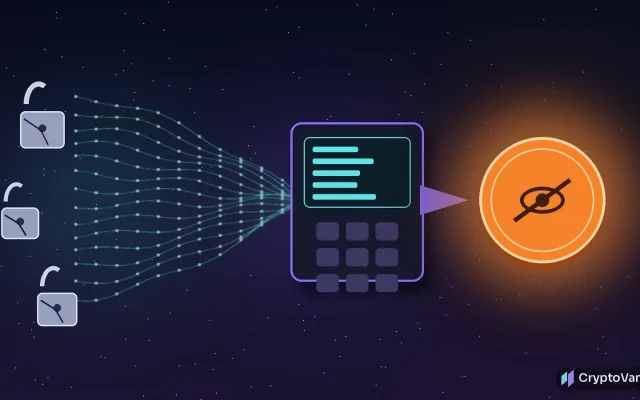
Quick answer: The Fhenix mainnet went live on Oct. 21, 2026, putting its CoFHE encryption coprocessor into production on Ethereum and Arbitrum. Smart contracts can now compute on encrypted balances and positions, and dual-mode tokens let holders switch a balance between public and confidential in one transaction. Access is allowlisted at launch.
Ethereum’s public ledger just gained an optional privacy layer. The Fhenix mainnet went live on Oct. 21, letting smart contracts on Ethereum and Arbitrum work with balances and trading positions that stay encrypted.
That matters because full transparency has kept many funds and companies away from onchain finance.
What happened with the Fhenix mainnet?
Fhenix said its CoFHE coprocessor is now in production on both networks, Unchained reported. Until this week, CoFHE ran only on public test networks.
CoFHE uses fully homomorphic encryption, or FHE. In simple terms, FHE lets a computer do math on data without decrypting it first. The heavy work runs offchain, and the results flow back to contracts on Ethereum or Arbitrum. Developers add it with one Solidity import, according to the Fhenix website.
The launch also brings dual-mode tokens into production. A holder can move a balance into confidential mode in one transaction and switch it back later. The tokens stay on their home chain, so there is no bridge and no wrapped copy.
Two design partners went live on day one: Fluton, built on encrypted intents, and AlphaEngine, where strategists compete for liquidity without revealing their methods. Fhenix said Consensys Diligence audited the system. However, Unchained could not find a public copy of that audit.
Why does encrypted DeFi matter?
On Ethereum today, anyone with your address can see what you hold and when you trade. For a retail user, that is a privacy problem. For a trading desk, it is also a cost. Bots can front-run large orders, and rivals can copy strategies in real time.
Our view is that the Fhenix mainnet targets the right buyer. Institutions want public settlement but private positions. Meanwhile, tokenized U.S. Treasuries alone held about $14.5 billion on Oct. 20, per RWA.xyz figures cited by HackerNoon. If confidential balances become a normal token feature, more of that capital could move into DeFi apps.
There are clear limits, though. Fhenix’s own dual-mode token explainer says the sender, receiver and timing of confidential transfers stay visible. Only amounts and balances are hidden. In addition, the confidential side works with fewer DeFi apps than the public side.
Regulation is the other open question. Founder Guy Zyskind said Fhenix is working on a confidential stablecoin with Tandem, the venture arm of Arbitrum developer Offchain Labs. Yet Unchained noted that a court order in May led Circle to freeze about $12.6 million in a confidential USDC contract run by Zama, another FHE team. Privacy tools still have to coexist with issuers that can freeze funds.
What does the market data show?
Privacy is one of the stronger crypto themes this autumn. We covered the Zcash NU7 upgrade rally this morning and the move of Monero above $600 last week. On the other hand, privacy also draws scrutiny, as the FreedomXMR laundering case on Hyperliquid showed today.
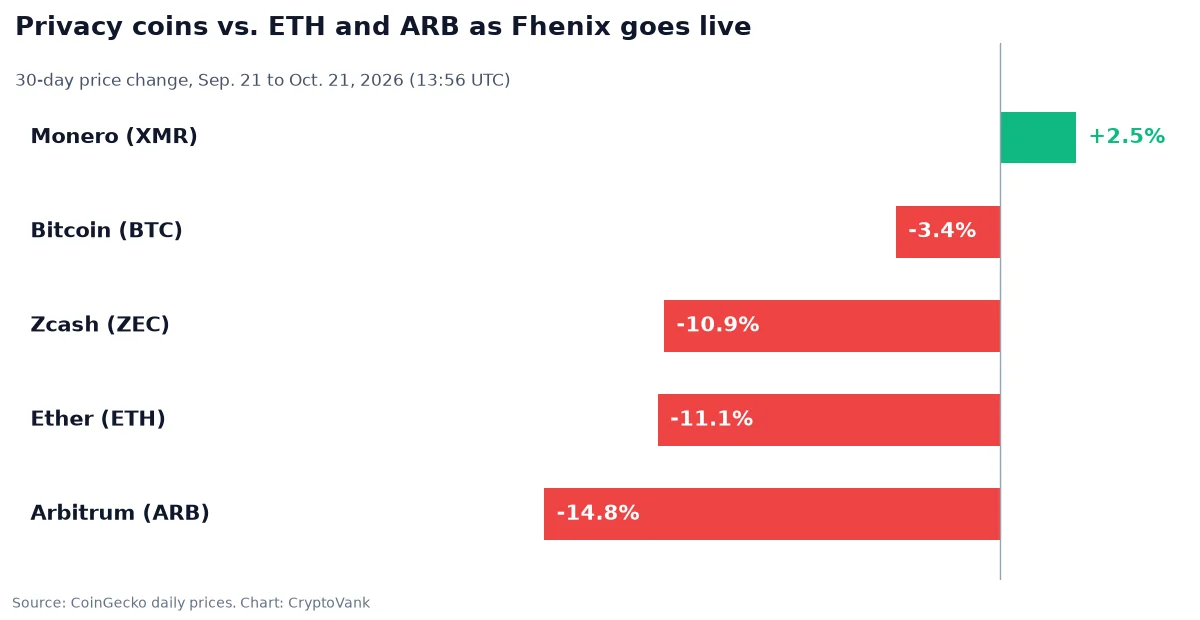
Over 30 days, Monero rose 2.5% while Ether fell 11.1% and Arbitrum’s ARB fell 14.8%, per CoinGecko data at 13:56 UTC on Oct. 21. At that time, ETH traded at $2,466.88, up 2.8% in 24 hours. ARB sat at $0.1924, up 1.7%. Ether funds remain under pressure too, as our report on Ether ETF outflows passing $1 billion explains.
Fhenix has no token in this launch, so there is no direct price to trade. Instead, the test is usage. Watch how many contracts join the allowlist and how much value moves into confidential mode.
What should DeFi users watch next?
First, access. Mainnet deployment is permissioned at launch, and contracts must be approved before they can submit CoFHE workloads. Testnets on Ethereum Sepolia, Arbitrum Sepolia and Base Sepolia remain open.
Second, apps. Fhenix said three more apps will launch on CoFHE in the fourth quarter. It also plans to name two strategic partnerships with institutions in the coming weeks.
Third, performance. The announcement gave no figures for latency, sustained throughput or cost per transaction, HackerNoon noted. A payments or trading app needs those numbers before it can commit real volume.
Finally, the stablecoin. A confidential stablecoin on Arbitrum would be the clearest sign that issuers accept the model. If you want to spend stablecoins in daily life today, our crypto cards guide compares the main options.
Fhenix mainnet FAQ
What is the Fhenix mainnet?
The Fhenix mainnet is the production launch of CoFHE, an encryption coprocessor for EVM chains. Since Oct. 21, 2026, it lets contracts on Ethereum and Arbitrum compute on encrypted balances, positions and strategies without decrypting them.
Can anyone build on Fhenix now?
Not yet on mainnet. Contracts must be approved to an allowlist before they can submit CoFHE workloads. The Ethereum Sepolia, Arbitrum Sepolia and Base Sepolia testnets remain open to all developers.
Does Fhenix hide who sent a transaction?
No. Dual-mode tokens hide amounts and balances, but Fhenix says the sender, receiver and timing of confidential transfers are still visible onchain.
Not financial advice. Crypto prices are volatile; always do your own research.