
Quick answer: On Oct. 20, 2026, The Block reported that a new Citi Research report calls Aave a “decentralized collateral mobility ecosystem” and one of the more important real-world cases in tokenized finance. Citi said collateral mobility “may ultimately prove to be one of tokenization’s most important use cases.” AAVE traded near $152, per CoinGecko.
A new Citi Aave report is putting the biggest DeFi lender in front of Wall Street readers. On Oct. 20, 2026, at 01:31 UTC, The Block posted on X that Citi Research now describes Aave as a “decentralized collateral mobility ecosystem.”
Citi also called Aave one of the more important real-world cases in tokenized financial infrastructure. Yet the AAVE token barely reacted, and that gap is worth a closer look.
What did the Citi Research report say about Aave?
The core line is short. “We believe collateral mobility may ultimately prove to be one of tokenization’s most important use cases,” Citi said, as quoted by The Block.
In plain words, collateral mobility means using an asset you already own as security for a loan, then moving or reusing it quickly. Today that work runs through banks, brokers and clearing houses, often during office hours only.
According to a Lookonchain summary of the report, Citi argues it is no longer enough to see Aave as a crypto-native lending app. The report points to Aave V4, its Horizon market for institutions and the GHO stablecoin as signs of a wider role. Citi suggests Aave could help shape how tokenized assets are financed, leveraged and pledged as collateral.
Why does a Citi report on Aave matter?
Big banks rarely name a single DeFi protocol in research notes. Citi’s view adds weight to a trend we have tracked, from JPMorgan bringing JPM Coin to Ethereum to the DTCC tokenization service. The full Citi note is for clients, so only quoted parts are public.
How big could tokenized collateral get?
Citi has put numbers on the wider market before. Its June 2026 Tokenization 2030 report estimates tokenized assets at about $17 billion today. It projects $5.5 trillion by 2030 in a base case, with a $2.7 trillion bear case and an $8.2 trillion bull case.
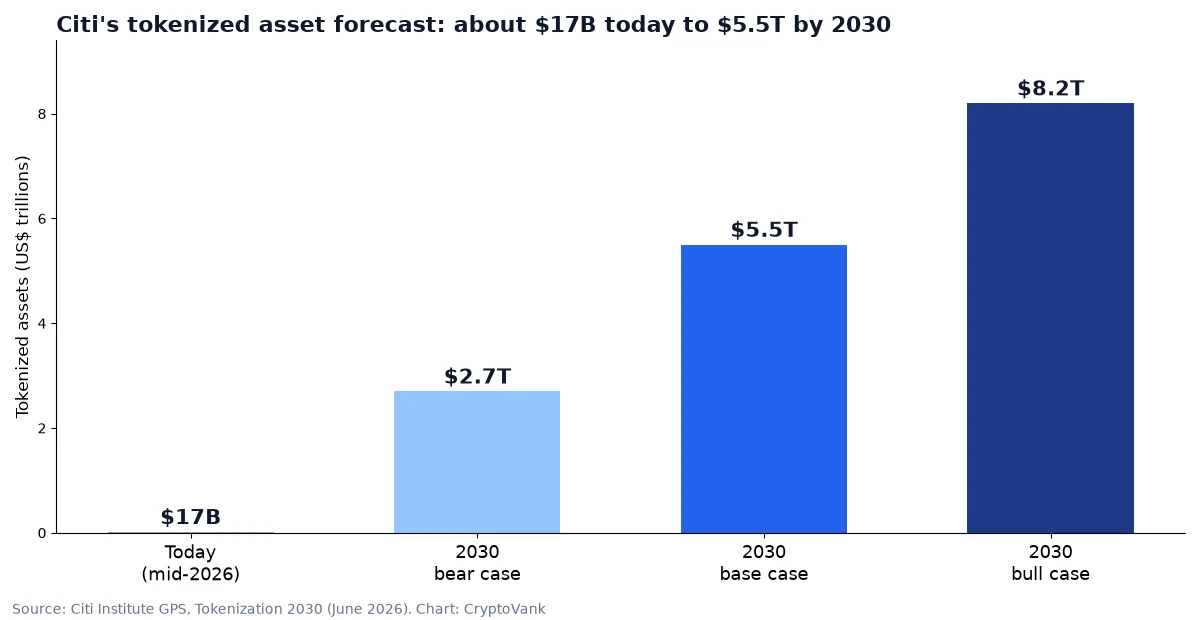
That same report says near-term adoption will likely focus on high-quality liquid assets, such as collateral and treasury management. It also notes DeFi total value locked peaked near $180 billion in 2021 and now sits close to $100 billion.
How does Aave already use tokenized stocks as collateral?
Aave is not starting from zero. On Sept. 25, 2026, Aave Labs launched an Equities Hub on Aave V4 on Base. Eligible users outside the U.S. can deposit seven Coinbase tokenized stocks, including Apple, Nvidia and Tesla, and borrow USDC against them.
The start was small. The Block reported an initial collateral cap of about $29 million and a $21 million USDC borrow cap, with collateral factors from 65% to 79%. We covered the volume side of this shift in our story on tokenized stocks on Base.
At protocol level, Aave holds about $17.9 billion in supplied assets and about $12.3 billion in active loans, per DefiLlama data on Oct. 20, 2026. Ethereum carries most of that, so the Ethereum price still drives a large share of Aave’s risk.
What does the Citi report mean for the AAVE price?
So far, very little. AAVE traded near $152.06 at about 03:50 UTC on Oct. 20, 2026, up 0.6% in 24 hours, per CoinGecko. Its market cap was about $2.35 billion.
That muted move makes sense. Research notes shape long-term stories, but they do not add deposits overnight. For traders, the more useful signals are whether the Equities Hub caps rise, whether more banks test Horizon, and how lending demand holds up. Our report on crypto lending vaults topping $10 billion shows regulators are watching this space too.
What are the risks?
Collateral-based lending can unwind fast. If collateral prices drop sharply, positions get liquidated, and tokenized stocks add new issues such as weekend price gaps and corporate actions. Regulation of tokenized securities also differs by country, which limits who can use these markets.
Citi Aave Report FAQ
What did Citi say about Aave?
Citi Research called Aave a “decentralized collateral mobility ecosystem” and one of the more important real-world cases in tokenized finance, per The Block on Oct. 20, 2026. Citi said collateral mobility may become one of tokenization’s most important use cases.
Is Citi investing in Aave or AAVE?
No. The report is research, not an investment or a partnership announcement. It describes Aave’s role in tokenized finance and does not recommend buying the AAVE token.
What is collateral mobility?
Collateral mobility means moving and reusing assets as security for loans quickly. On Aave, users can post tokens, including some tokenized stocks, as collateral and borrow stablecoins such as USDC around the clock.
Did the AAVE price jump after the Citi report?
No. AAVE traded near $152 on Oct. 20, 2026, up about 0.6% in 24 hours, per CoinGecko. The market treated the report as a long-term signal, not a short-term catalyst.
Not financial advice. Crypto assets are volatile, so always do your own research (DYOR) before trading.
Sources
- The Block on X: Citi Research report on Aave, Oct. 20, 2026
- Lookonchain: Citigroup report summary on Aave
- Citi Institute GPS: Tokenization 2030 (June 2026)
- Aave Labs: Coinbase Tokenized Stocks now live on Aave V4
- The Block: Aave V4 on Base adds Coinbase tokenized stocks
- DefiLlama: Aave
- CoinGecko: Aave (AAVE)