Quick answer: Papertrade, a HyperEVM exchange offering up to 1000x leverage on BTC and ETH, opened at 14:00 UTC on Oct. 10, 2026. It said volume passed $250 billion by 16:49 UTC, while DefiLlama tracked about $120.7 million locked. The volume is notional, and its house pool pays winners only from trader losses.
Papertrade, a new perpetual futures exchange on HyperEVM, opened with up to 1000x leverage and said it passed $250 billion in volume within three hours. That number is notional, though, and the cash behind it is far smaller.
What happened at the Papertrade launch
Trading opened at 10 a.m. ET (14:00 UTC) on Oct. 10, 2026, Crypto Briefing and crypto.news report. In under 10 minutes, the exchange logged $14.4 billion in notional volume. Bitcoin open interest reached $3 billion, and ether open interest hit $2.66 billion.
The pace did not slow. BlockBeats said volume topped $80 billion in the first hour. Then, at 16:49 UTC, Papertrade posted on X that it had reached “one quarter of a trillion dollars.”
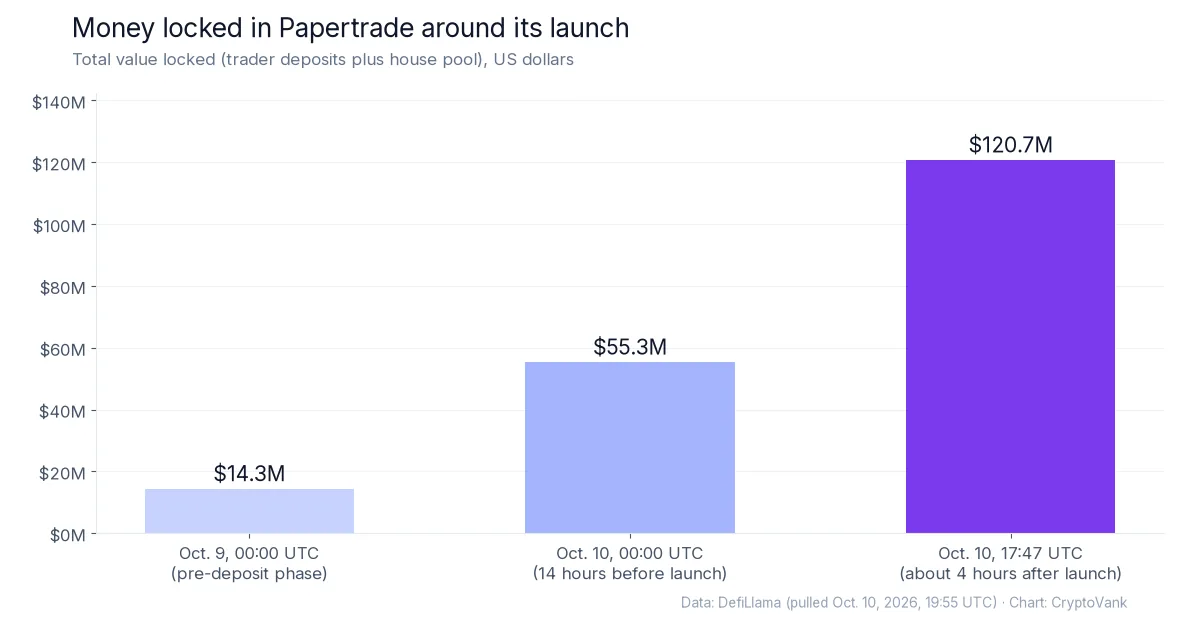
Meanwhile, the money actually deposited grew fast too. DefiLlama tracked $55.3 million locked at midnight UTC and $120.7 million by 17:47 UTC. That total includes trader balances and the house pool.
How Papertrade works
Papertrade has no order book. Instead, every trader bets against one shared USDC pool, which Bankless calls the Martingaler LP. Prices come from the midpoint of Hyperliquid’s best bid and offer. As a result, there is no slippage and no funding rate.
The pool started at $0. It fills only when traders lose money. If a winner closes and the pool is short, the trader gets their margin back, but the profit waits in a first-in, first-out queue.
Losers do get something back. The protocol mints PAPER tokens to them, at 100 PAPER per $1 lost while the pool holds less than $2 million. After that, the rate falls. PAPER cannot be transferred at launch, but holders can stake it. Stakers then earn 1% of realized profit and loss, plus pool gains above a $5 million cap.
Why it matters
The headline number needs context. At 1000x, a $10 margin controls $10,000 of bitcoin. With BTC at $83,008 at 19:55 UTC, per CoinGecko, a move of roughly $83, or 0.1%, wipes that position out.
So $250 billion of volume on about $120 million of deposits is not a sign of deep markets. By our math, it equals more than 2,000 times the cash locked, turned over in a few hours. In other words, small accounts cycled huge positions again and again.
The token design adds fuel. Because losses mint PAPER, some traders appear to be losing on purpose to farm tokens. BlockBeats counted $4.73 million in user losses within the first hour. Later, Crypto Briefing reported about $18.6 million in net realized losses and nearly $13.89 billion in liquidations.
For stakers, the early numbers look strong. Papertrade said $8.5 million had gone to PAPER stakers by 16:22 UTC. The Defiant later saw $10.3 million in rewards, with about $5 million in the pool and no queued payouts.
Our take: a casino with on-chain books
We think Papertrade is honest about what it is. The rules are public, the pool is visible, and the team kept no token allocation for itself. Still, the timing is striking. It launched exactly one year after the October 10 crash, when extreme leverage liquidated more than $19 billion in a day.
The main risk is not hidden. Winners are paid from losers, so a run of winning trades could fill the payout queue. In addition, Papertrade depends on Hyperliquid prices, so any glitch there flows straight into its contracts. Its operators can also pause new positions, freeze markets and change fees, according to crypto.news. Contract upgrades, by contrast, need a seven-day timelock.
If you are new to this, treat 1000x products as entertainment money only. Our guide to DeFi risks explains smart-contract and liquidity risks in plain terms.
What to watch next
- The payout queue. Any queued debt would show the pool cannot keep up with winners.
- The staker cap change. Papertrade said it will raise the staker reward cap from $5 million to $10 million shortly after 18:45 UTC on Oct. 17.
- Volume after the rush. Launch-day activity often fades. Watch whether daily volume and deposits hold up next week.
- Market mood. The Fear and Greed Index can show when traders get too greedy with leverage.
Papertrade FAQ
What is Papertrade?
Papertrade is a synthetic perpetual futures exchange on HyperEVM, the smart contract layer of Hyperliquid. Traders can open BTC and ETH positions with up to 1000x leverage against a shared house pool, using Hyperliquid’s mid price.
How does Papertrade pay winning traders?
Winners are paid from a pool that fills only from trader losses. If the pool runs short, the trader gets their margin back at once, while the unpaid profit waits in a first-in, first-out queue until later losses refill it.
Can you sell PAPER tokens?
Not at launch. PAPER is minted to traders who lose money and can only be staked or unstaked for now. Staked PAPER earns USDC rewards from the pool, per Papertrade’s documentation as reported by crypto.news and Bankless.
Sources
- Crypto Briefing: Papertrade draws $3B in Bitcoin open interest as on-chain perps exchange launches
- Crypto Briefing: Papertrade traders lose $18.6 million while stakers collect $12.57 million
- crypto.news: Papertrade plans 1000x leverage launch after $85.3m deposits
- Bankless: What to know about Papertrade’s launch
- The Defiant: Papertrade shows $10.3 million in staker rewards hours after launch
- BlockBeats: Papertrade notional volume exceeds $80 billion
- Papertrade on X
- DefiLlama: Papertrade
- CoinGecko: Bitcoin price data
This article is for information only and is not financial advice. Do your own research before you buy or sell any crypto asset.