
Quick answer: Binance net outflows reached about $3.64 billion between 06:00 and 15:30 UTC on Nov. 1, 2026, the first 9.5 hours after withdrawals reopened. Users withdrew $4.65 billion and deposited $1.01 billion. Binance says that equals 2.1% of its $171 billion in assets and that withdrawals are slowing.
Binance net outflows came to about $3.64 billion in the first 9.5 hours after the exchange reopened withdrawals on Nov. 1, 2026. That is a real exit, but it equals only about 2.1% of the assets Binance says it holds, so there is no sign of a full bank run yet.
What happened after Binance withdrawals reopened
First, Binance began restoring withdrawals in phases at 06:00 UTC on Sunday. Then, by 12:36 UTC, all 15 networks in the first phase were open again, the exchange said in an update on X, as reported by The Block and Bitcoin.com News.
Between 06:00 and 15:30 UTC, users withdrew $4.649 billion. In the same window, they deposited $1.01 billion. As a result, the gap is the $3.64 billion net figure. A Reuters report carried by Devdiscourse gave the same numbers.
Binance said withdrawal volumes “have declined and are stabilising as expected” after an early spike. According to Bitcoin.com, the busiest 30-minute window began at 08:00 UTC, with about $733 million withdrawn. Deposits peaked at $187 million at 08:30 UTC. Still, withdrawals beat deposits in every half-hour slot.
This follows our report on the first phase of the reopening, where we flagged net flows as the first thing traders would watch.
Why Binance net outflows matter
The hack drained about $6.3 billion from Binance hot wallets on Oct. 29. The FBI has since linked it to North Korea’s TraderTraitor group, as we covered in our report on the attribution. After a hack like this, the key question is simple. Do users trust the exchange enough to leave their coins there?
So far, the answer is mixed. On one hand, $3.64 billion is a large sum by any standard. On the other hand, Binance measured it against $171 billion in assets from its Oct. 28 proof-of-reserves data. A 2.1% outflow in the first hours is far smaller than the collapse seen at FTX in 2022, where the exchange could not meet withdrawals at all.
Still, the other side of the ledger also matters. Deposits of $1.01 billion in under ten hours show that many users kept trading. In addition, Binance says it has replaced about 95% of the stolen assets with its own funds, up from 90% in its Oct. 31 update.
What on-chain data shows about Binance net outflows
Independent trackers also point the same way, though their numbers are a little higher. DefiLlama showed $4.05 billion in net outflows from Binance over 24 hours as of about 16:37 UTC, The Block reported. That window includes hours before the reopening, so it is not directly comparable with Binance’s own figure.
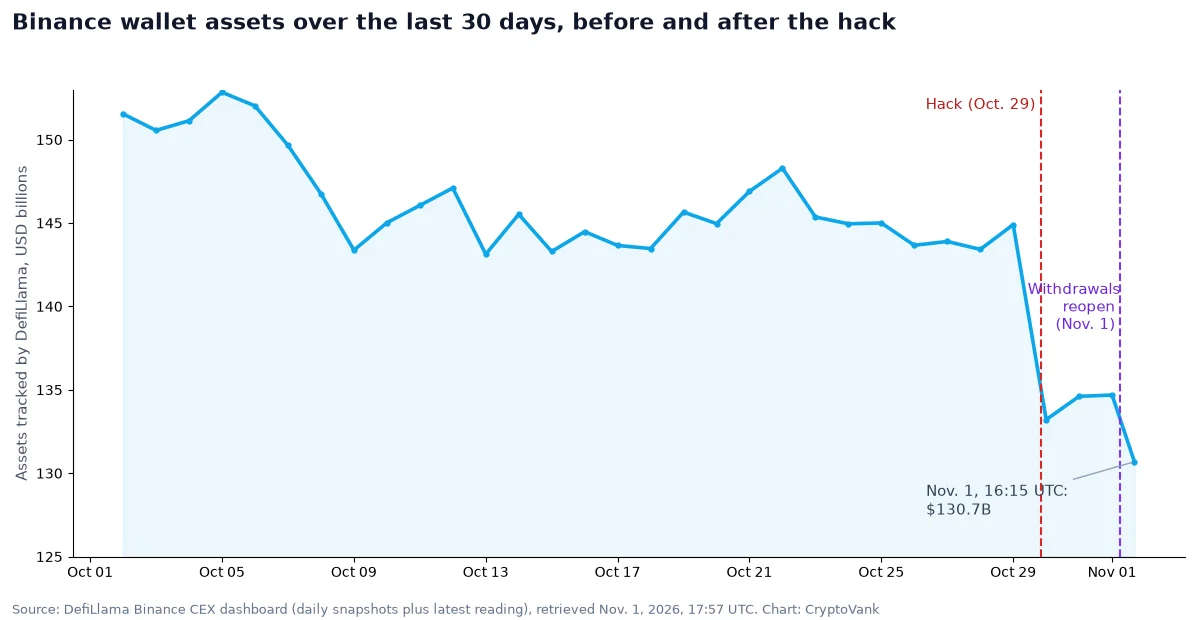
The chart above uses DefiLlama’s Binance dashboard. Tracked wallet assets stood at about $144.9 billion in the Oct. 29 daily snapshot, the last one before the attack. They fell to $133.2 billion on Oct. 30 and read $130.7 billion at 16:15 UTC on Nov. 1. However, part of that move comes from prices, not flows, since the dashboard values coins in dollars.
Where did the coins go? The next 10 exchanges DefiLlama tracks saw about $368 million in combined net inflows, led by OKX at $316.8 million. Similarly, bitcoin balances at Coinbase and Kraken rose by about 984 BTC and 1,422 BTC, citing CoinGlass, while Binance’s fell by about 19,289 BTC. In short, most of the money did not move to rival exchanges. It likely went to self-custody wallets, although on-chain data cannot prove that.
Market reaction
Meanwhile, prices barely moved. At 17:57 UTC on Nov. 1, CoinGecko showed BNB at $710.63, up 0.56% in 24 hours. Bitcoin traded at $77,991 (+0.43%) and Ether at $2,265.08 (+0.45%). In other words, for now the market is treating the outflows as an orderly exit rather than a crisis.
What to watch next for Binance net outflows
- The proof-of-reserves report. Binance took a new snapshot at 00:00 UTC on Oct. 31 and expects to publish it on Nov. 2. It will show whether reserves still cover user balances after the hack and the outflows.
- The slowdown. If daily outflows keep shrinking, the panic phase is likely over. A second spike would be a warning sign.
- The remaining coins. Binance’s status page showed withdrawals suspended for 531 of 552 listed coins as of about 16:22 UTC, with assets such as Cardano, Chainlink and Litecoin still in testing. Outflows could rise again as those open.
If you are moving funds off an exchange for the first time, read our guide to seed phrases before you set up a wallet. For spending crypto straight from a wallet, see our crypto card comparison.
Binance Net Outflows FAQ
How much money left Binance after withdrawals reopened?
Binance reported about $3.64 billion in net outflows between 06:00 and 15:30 UTC on Nov. 1, 2026. Users withdrew $4.649 billion and deposited $1.01 billion in that window.
Is Binance facing a bank run?
Not on current data. The outflow equals about 2.1% of the $171 billion in assets Binance reported, and the exchange says withdrawals are slowing. The Nov. 2 reserve report will give a clearer picture.
Can I withdraw all coins from Binance now?
No. Only 15 networks in the first phase are fully open. Many other coins remain suspended or only partly restored while Binance tests them.
Sources
- The Block: Binance sees $3.64 billion in net outflows after reopening withdrawals
- Bitcoin.com News: Binance processes $4.65B in withdrawals across 15 networks
- Devdiscourse (Reuters): Binance sees net outflows of $3.64 billion
- DefiLlama: Binance CEX dashboard
- CoinGecko: BNB price
This article is for information only and is not financial advice. Do your own research before making any investment decision.