Quick answer: The China crypto corruption crackdown became official on Nov. 1, 2026, when Xinhua published a Communist Party Central Committee decision, adopted Oct. 29, that orders a crackdown on graft via virtual currencies, blockchain and cross-border funds. It targets officials hiding bribes in crypto, not traders.
With a new crypto corruption crackdown, China’s ruling Communist Party has written crypto into its anti-corruption playbook. A decision released on Sunday, Nov. 1, 2026, tells party investigators to go after officials who use virtual currencies and blockchain to hide bribes.
However, the move does not change the rules for traders. Instead, it shows that Beijing now treats crypto as a standard tool for graft, and that its investigators are learning to trace it on-chain.
What did China decide in its crypto corruption crackdown?
State news agency Xinhua published the full text at 15:36 Beijing time (07:36 UTC) on Nov. 1. The Fifth Plenary Session of the 20th Central Committee adopted it on Oct. 29, 2026.
The key line sits in the chapter on fighting corruption. It calls for a resolute crackdown on corruption “carried out using the internet, virtual currencies, cross-border funds, blockchain” and similar means. It also tells investigators to dig into new and hidden schemes, such as:
- promised future returns paid after an official leaves office
- proxy shareholdings held by friends or relatives
- “white gloves,” meaning middlemen who receive money for an official
- the “revolving door” between government posts and business
Reuters, via The Straits Times, described the document as an updated framework for President Xi Jinping’s long-running anti-graft drive, with demands for loyalty, career-long oversight of cadres and closer checks on family assets. It lands about a year before a leadership reshuffle.
Is the China crypto corruption crackdown a new ban?
No. China already banned crypto trading and mining in 2021, when the People’s Bank of China declared all crypto business activity illegal. The new decision does not add a trading ban or new rules for exchanges.
Instead, the China crypto corruption crackdown aims at the people inside the system. The text pairs the crypto line with a plan to build a “digital discipline inspection” system and a big-data platform to monitor public power. In short, Beijing wants better tools to spot officials whose wealth does not match their salary.
In other words, this fits a pattern. China keeps blocking public crypto while building its own state-run ledger, as we covered in our report on the national blockchain network. It also fights hard over seized coins, like the 61,800 bitcoin held in the UK.
Which crypto bribery case shaped this policy?
The clearest example is Yao Qian, former head of the central bank’s Digital Currency Research Institute and later a senior official at the securities regulator. For example, a state TV documentary aired on Jan. 14, 2026, reported by China News Service, laid out the case.
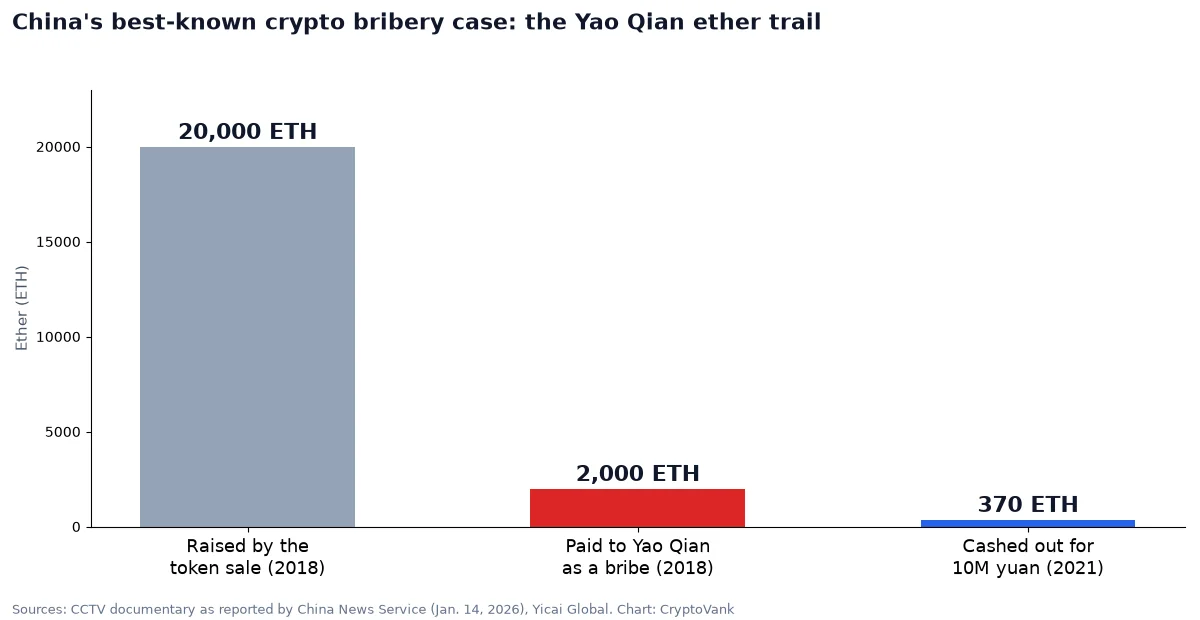
In 2018, a businessman asked Yao to help his token sale. Yao helped the project, the sale raised 20,000 ether, and the businessman then sent him 2,000 ETH as thanks. At its peak, that stake was worth more than 60 million yuan. Then, in 2021, Yao sold 370 ETH for 10 million yuan, and that money helped pay for a Beijing villa.
Later, investigators found hardware wallets in his office drawer and traced the transfers on the public Ethereum ledger. Yicai Global put the peak value at about $9.8 million. Yao was expelled from the party in November 2024. If you hold crypto yourself, our guide on how to store a seed phrase safely explains why those wallets mattered.
What does China’s crypto corruption crackdown mean for Bitcoin?
So far, markets have shrugged. At about 12:53 UTC on Nov. 1, CoinGecko showed Bitcoin at $77,804 (+0.45% in 24 hours) and Ether at $2,260 (+0.42%).
Previously, Chinese crackdowns in 2013, 2017 and 2021 caused sharp sell-offs, because they hit mining and trading. This one is different, because it targets party members. As a result, there is little direct impact on global demand. Even so, three things are worth watching:
- Over-the-counter (OTC) desks. Brokers who turn crypto into yuan could face more questions from investigators.
- Cross-border flows. The focus on cross-border funds and tracing may push regulators in Hong Kong and elsewhere to share more data with Beijing.
- On-chain tracing. China is clearly investing in blockchain analysis. That cuts against the idea that crypto is a safe place to hide money.
China Crypto Corruption Crackdown FAQ
What did China announce about crypto on Nov. 1, 2026?
Xinhua published a Communist Party Central Committee decision, adopted on Oct. 29, 2026. It orders a resolute crackdown on corruption carried out through virtual currencies, blockchain, the internet and cross-border funds.
Is China banning crypto again?
No. Crypto trading and mining have been banned in mainland China since 2021. The new decision targets officials who use crypto to take or hide bribes, not ordinary users.
Who is Yao Qian?
Yao Qian is a former head of the People’s Bank of China’s Digital Currency Research Institute. State TV said he took 2,000 ETH as a bribe in 2018. He was expelled from the party in November 2024.
Did Bitcoin fall on the China crypto news?
No. At about 12:53 UTC on Nov. 1, 2026, CoinGecko showed Bitcoin near $77,804, up about 0.45% in 24 hours.
Sources
- Xinhua: CPC Central Committee decision (Chinese, Nov. 1, 2026)
- The Straits Times (Reuters): China’s Communist Party demands loyalty, vows to tighten discipline
- PANews: CPC Central Committee to crack down on virtual currency corruption
- China News Service: Details of the Yao Qian ether bribery case (Chinese)
- Yicai Global: Former regulator took ether bribes worth $9.8 million
- CoinGecko: Bitcoin price data
Not financial advice. Crypto is volatile; always do your own research (DYOR) before trading.