Quick answer: A $1 billion Iran crypto seizure will probably happen this week, US Treasury Secretary Scott Bessent said on Oct. 8, 2026. He did not name the tokens, wallets or legal route, and Treasury had not confirmed a completed seizure as of Oct. 10, per The Block and Bitcoin Magazine.
The United States plans a $1 billion Iran crypto seizure this week, Treasury Secretary Scott Bessent said on Thursday. However, he named no tokens, wallets or legal process, so the real test is what Washington can actually freeze.
What Bessent said about the Iran crypto seizure
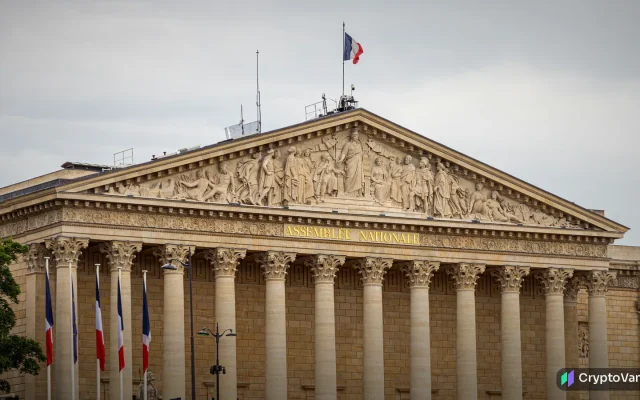
Bessent spoke with Greta Van Susteren at Newsmax’s NPolicy Summit in Washington on Oct. 8, 2026. “We’re probably gonna seize a billion dollars of crypto this week,” he said, according to The Block, citing the Newsmax report. “We know where it is and we are isolating them.”
Specifically, he framed the move as part of an “absolute isolation campaign” against Iran. That campaign also covers flights, land routes and access to the Strait of Hormuz. Bitcoin Magazine quoted him saying the earlier “maximum pressure” approach had given way to isolation, and that “it’s working.”
Still, several key details are missing. Bessent did not say which coins are involved. He also gave no wallet addresses and no legal route. As of Oct. 10, Treasury had not announced a completed seizure.
Is the Iran crypto seizure new money or a repeat?
That question matters most, because the numbers have shifted before. In May, Bessent said the US had already seized about $1 billion in Iranian crypto. Yet a Treasury release soon after cited an earlier figure of nearly $500 million, The Block reported. Coinscreamer also notes it is unclear whether the new target overlaps with the May claim.
Meanwhile, there is a paper trail of smaller actions, too. According to The Block, Treasury sanctions in July led to about $130 million being frozen. An onchain analyst tied that action to four Tron addresses holding roughly $131 million in USDT, which Tether blacklisted. In addition, Treasury has sanctioned several Iranian crypto exchanges since June, most recently BitBank in September.
Why stablecoins sit at the center of the Iran crypto seizure
Here is the key point for readers. Bitcoin held in a private wallet cannot be frozen by any government or company. Bitcoin Magazine makes the same point: seizing Iran’s bitcoin would be very hard unless it sits on a centralized exchange.
Stablecoins, by contrast, work differently. Tether’s USDT contract includes a blacklist function. It lets the issuer stop an address from moving its tokens. For that reason, an Iran crypto seizure of this size would most likely target dollar stablecoins on chains like Tron, plus any funds held at exchanges that cooperate with US authorities.
That power was on display this week, though not in an Iran case. On Oct. 9 at 12:09 UTC, Tether blacklisted 35 Tron addresses in one batch, according to contract records read by CryptoWatchDesk. Four of them were THORChain vaults holding about 1.45 million USDT. Tether lifted those four at about 15:30 UTC, Cointelegraph and The Defiant reported. Tether gave no public reason, and nothing public links that sweep to Iran.
Market data: little reaction so far
So far, markets have shrugged off the news. At 10:49 UTC on Oct. 10, Bitcoin traded at $82,747, up 0.3% in 24 hours, per CoinGecko. Ether sat at $2,493. USDT held its peg at $0.999 with a market value of about $184.1 billion.
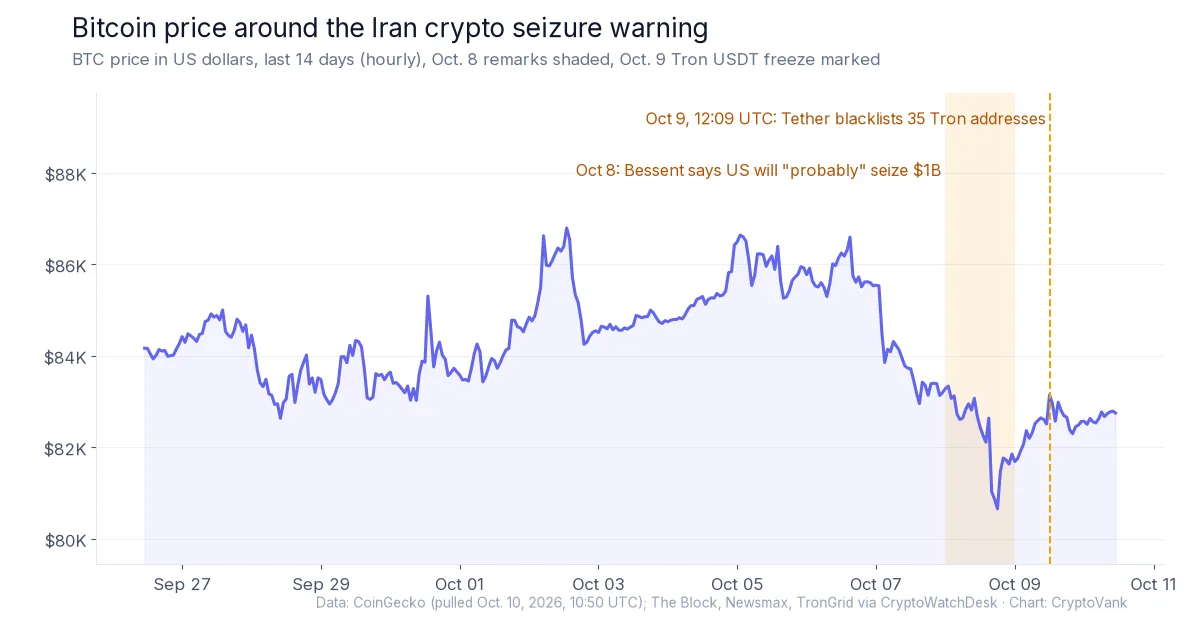
Bitcoin did touch about $80,650 on CoinGecko’s hourly data at 18:00 UTC on Oct. 8, the day of the remarks. But it had already been sliding for two days on oil and bond yield worries, as we covered in our Bitcoin price and ETF outflows report. So the dip is hard to pin on Bessent alone.
Our take: sanctions follow the issuer
In short, this story shows where crypto sanctions really bite. They rarely touch the blockchain itself. Instead, they hit the companies in the middle: stablecoin issuers, exchanges and custodians. If you hold USDT, your coins carry the issuer’s rules, including the right to freeze. Our stablecoins explained guide covers how that works.
On the other hand, the gap between Bessent’s numbers and Treasury’s own releases is worth noting. Big round figures make strong headlines. Even so, investors should wait for a court filing, an OFAC notice or onchain blacklist events before treating $1 billion as fact.
What to watch next
- Official paperwork. A civil forfeiture complaint or a Treasury release would show which assets were taken and from whom.
- Tether blacklist events. Large batches of frozen Tron or Ethereum addresses could signal the seizure in real time.
- Exchange exposure. Any platform found holding the funds could face pressure, as earlier sanctions on Iranian exchanges showed.
Iran crypto seizure FAQ
Has the Iran crypto seizure already happened?
Not publicly. Bessent said on Oct. 8, 2026 that the US will “probably” seize it this week, but Treasury had not announced a completed seizure as of Oct. 10.
Can the US freeze Bitcoin linked to Iran?
Only if it sits with a company that can be compelled, such as an exchange. Bitcoin held in self-custody cannot be frozen, which is why dollar stablecoins like USDT are the more likely target.
Does this affect ordinary USDT holders?
Not directly. Freezes target specific addresses, and USDT traded at $0.999 on Oct. 10 per CoinGecko. Still, holders should know the issuer can blacklist any address. Our self-custody wallet setup guide explains the trade-offs.
Sources
- The Block: US targets $1 billion Iran-linked crypto seizure, Bessent says ‘we know where it is’
- Newsmax: Bessent interview at the NPolicy Summit
- Bitcoin Magazine: Treasury Secretary threatens to freeze $1B of Iran’s crypto
- Coinscreamer: Bessent says US may seize $1 billion in Iran-linked crypto
- CryptoWatchDesk: Tether blacklists four THORChain Tron vaults, then reverses
- Cointelegraph: THORChain exec accuses Tether of temporarily freezing USDT vaults
- CoinGecko: Bitcoin price data
This article is for information only and is not financial advice. Do your own research before you buy or sell any crypto asset.