Quick answer: The NEAR issuance cut in proposal HSP-029 passed a House of Stake vote on Nov. 2, 2026. It lowers the network’s maximum annual issuance from 2.5% to 1.6% over 24 months, after a 90-day grace period. Validators still have to adopt a protocol upgrade before anything changes.
NEAR token holders have voted for a NEAR issuance cut that lowers the network’s maximum yearly inflation from 2.5% to 1.6%. The change rolls in slowly over two years, and validators still have to switch it on.
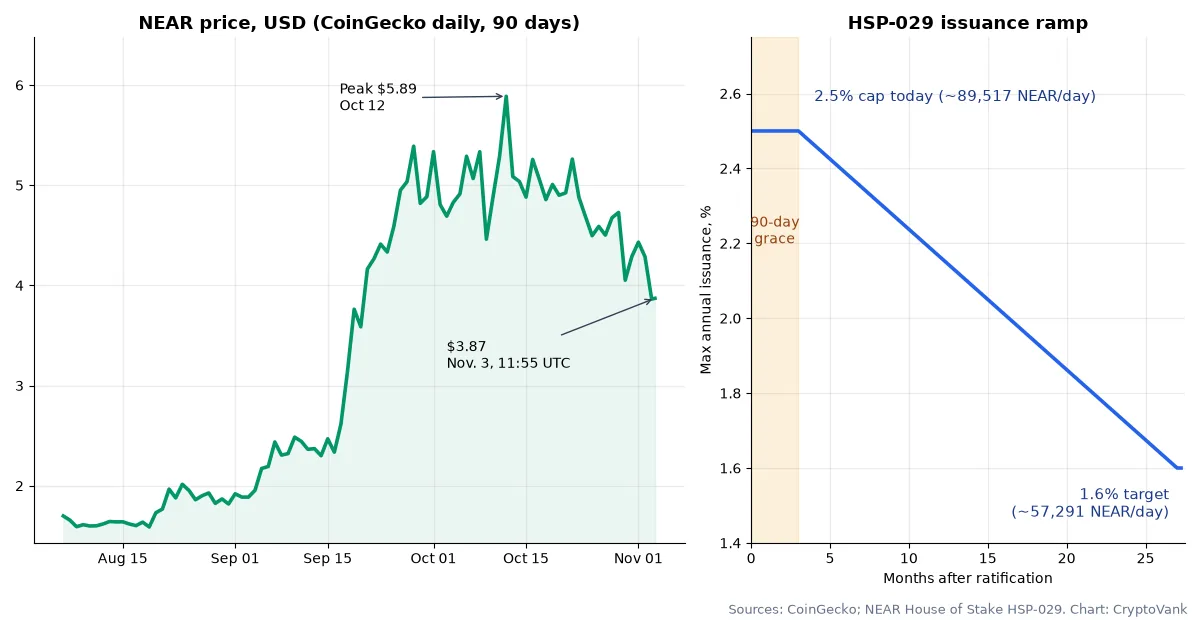
The vote landed on a rough day for the token. NEAR traded at $3.87 on Nov. 3, 2026, at 11:57 UTC, down 6.3% in 24 hours, according to CoinGecko. That is about 34% below its 90-day closing high of $5.89 on Oct. 12.
What the NEAR issuance cut changes
The plan is House of Stake proposal HSP-029. Sal Ternullo of the staking firm SVRN wrote it, and the forum page now lists its status as “Succeeded.” Crypto.news reported that the vote passed on Nov. 2, and The Block also reported the approval.
Only one setting changes. After ratification, a 90-day grace period gives wallets, exchanges and staking providers time to update their disclosures. Then the issuance cap falls by about 3.75 basis points a month, adjusted every epoch, until it reaches 1.6% after 24 months.
The split of new tokens stays the same. Stakers get 90%, and the treasury gets 10%. The proposal also leaves NEAR Intents fee buybacks untouched.
Why NEAR holders voted for it
The goal is less dilution. Under the proposal’s model, new supply drops from about 89,517 NEAR a day to about 57,291. That avoids roughly 11.8 million NEAR of issuance over two years and 66.1 million over six years.
The authors argue that most holders gain at once. About 57.3% of supply is not staked, so those holders simply get diluted less. Stakers pay a small price instead. A holder staking 1,000 NEAR would end year two with about 20 fewer tokens than under the old rate, the proposal says.
The idea also has a back story. In August, NEAR co-founder Illia Polosukhin withdrew a “Sovereign Fund” plan, saying a managed fund carried “risks the protocol should not internalize.” HSP-029 was written as the simpler option: a fixed schedule with no fund and no administrator.
Solana went down a similar path first. Its validators ratified SGP-0002 on Aug. 28, 2026, with 67.001% of stake, the NEAR proposal notes. However, NEAR’s version is gentler, because its target yield ends higher.
Data: what stakers and validators give up
Lower issuance means lower rewards. The proposal’s ramp table shows gross staking yield falling from about 5.27% to 3.37%, assuming the share of staked NEAR holds at 42.71%. Its summary uses a different baseline and shows 4.80% falling to 3.07%.
Smaller validators feel this most. The proposal estimates that 24 of 405 validator pools would no longer cover their costs at the 1.6% target. Even so, the authors argue that issuance was never keeping those pools alive.
Not everyone agrees. One forum critic said the plan “starts from the interests of the future buyer and works backwards,” instead of serving long-term stakers. Another member reported 370 active validators on Nov. 2, while noting that liquid staking providers are pulling delegations from some mid-sized nodes.
Price context for NEAR
The NEAR issuance cut did not lift the price. Crypto.news tied the drop to selling across AI-linked tokens, the Binance hack fallout and caution before the U.S. midterm vote. Bitcoin traded near $77,000 at the same time, down about 1% in 24 hours, per CoinGecko.
Analyst Michaël van de Poppe wrote on Nov. 2 that “NEAR couldn’t hold a crucial level of support” near $4.30. That is one analyst’s view, not a confirmed trend. Supply changes also work slowly, so the cut will matter more over months than days. For another example of how token schedules shape supply, see our look at Ritual’s tokenomics and unlocks.
What to watch next
First, watch the upgrade. Validators must adopt it through the normal protocol process, so the cut is not active yet. Second, watch the 90-day clock, which starts only after ratification. Third, watch validator count. If more small pools shut down, decentralization could become the next governance fight, a theme the SEC also touched in its decentralization FAQ.
NEAR issuance cut FAQ
When does the NEAR issuance cut start?
It does not start right away. Validators must first adopt a protocol upgrade, and a 90-day grace period follows ratification. After that, the cap falls a little every epoch for 24 months until it reaches 1.6%.
How much will NEAR staking rewards fall?
The proposal’s ramp table shows gross staking yield falling from about 5.27% to 3.37% over two years, if the staked share holds at 42.71%. Actual yields will shift with how much NEAR is staked.
Does the cut burn NEAR tokens?
No. It only slows how many new tokens are created. The 90% staker and 10% treasury split stays the same, and NEAR Intents buybacks are unchanged.
Sources
- HSP-029 proposal on the NEAR governance forum
- The Block: NEAR governance approves proposal to cut token issuance ceiling to 1.6%
- Crypto.news: Why is NEAR Protocol price down today?
- CoinGecko: NEAR Protocol price data
This article is for information only and is not financial advice. Do your own research before you buy, sell or stake any crypto asset.