Quick answer: Solana’s Alpenglow consensus upgrade went live on mainnet-beta at slot 459,653,000, around 14:00 UTC on Oct. 21, 2026, according to core developer Anza. It retires TowerBFT and cuts Solana finality to about 150 milliseconds from roughly 12.8 seconds. Users and wallets need no action.
Solana finality now takes about 150 milliseconds. The Alpenglow upgrade went live on Oct. 21, and the network kept running through the biggest consensus change in its history.
What happened on Solana today?
Solana validators switched to Alpenglow at slot 459,653,000, at roughly 14:00 UTC on Wednesday, Anza said in its announcement. Anza is the core engineering team behind the Agave validator client. The handoff retired TowerBFT, the consensus protocol Solana had used since its March 2020 launch.
The handoff happened on the live chain. Independent operators agreed on a shared switch point and carried the existing ledger forward, The Block reported. No restart from a new chain was needed.
“This is the largest, most ambitious blockchain upgrade since ‘The Merge,'” Anza CEO Brennan Watt said. Anza first published the design in May 2025, so the team went from paper to mainnet in under 18 months.
We previewed the timing and the validator checklist in our Alpenglow activation explainer on Monday. This report covers what actually changed once the switch was done.
Why faster Solana finality matters
Finality is the moment a transaction can no longer be reversed. An exchange waits for it before crediting a deposit. A merchant waits for it before handing over goods.
Under TowerBFT, Solana gave a fast but conditional confirmation, while full finality took about 12.8 seconds, per Anza. CoinDesk described the old lock-in time as about six seconds. Either way, the new target is about 40 to 80 times faster. For comparison, CoinDesk noted that Ethereum takes roughly 13 minutes to reach full finality.
Our view is that the biggest winners are payments and exchanges, not traders. A deposit that settles in a blink removes a real wait for users. That fits the push to bring stablecoins and cards into daily spending, which we track in our crypto cards guide.
Trading desks see it differently. “For desks, faster finality is nice, but it was never the bottleneck,” Raiku founder Robin Nordnes told CoinDesk. Being close to the block producer still matters more for them.
What changes for validators and on-chain data
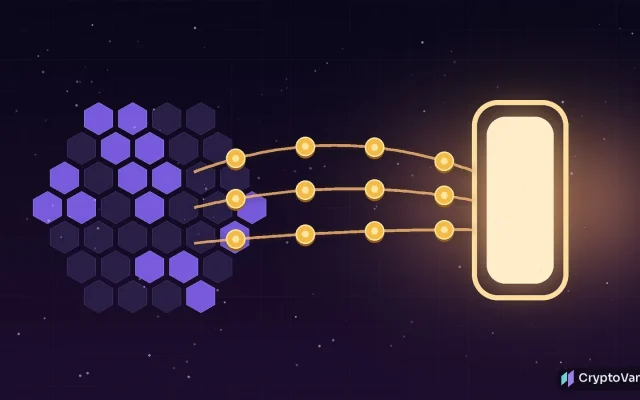
The mechanics behind the speed are simple to describe. Validators used to post every vote on-chain as a normal transaction. Alpenglow moves that voting off-chain and bundles votes into certificates, so a block can be locked in after one or two rounds.
This has a visible side effect. Solana’s transaction count will look much lower from this week, because votes made up a large share of it. Nordnes put it plainly: “The trading’s all still there.” Analysts who compare chains by raw transactions per second should adjust their numbers.
Validators also get a cheaper bill. They spent about 2 SOL a day on vote fees, CoinDesk reported. Alpenglow replaces those fees with a flat validator admission ticket of 0.8 SOL per epoch, which lasts about a day. That is roughly 60% cheaper.
The saving arrives at a useful time. Active validators fell to 659 at the end of September from 696 three months earlier, according to Bitwise data cited by CoinDesk. Meanwhile, the number of validators needed to control a third of staked SOL dropped to 18 from 20. Lower costs could help smaller operators stay online, although hardware and bandwidth bills remain.
What does the SOL market data show?
Price reaction has been calm so far. At 16:50 UTC on Oct. 21, SOL traded at $108.53, up 1.9% in 24 hours, with a market value of about $64.0 billion, per CoinGecko. Bitcoin rose 2.3% over the same window to $84,630, so SOL is roughly moving with the market.
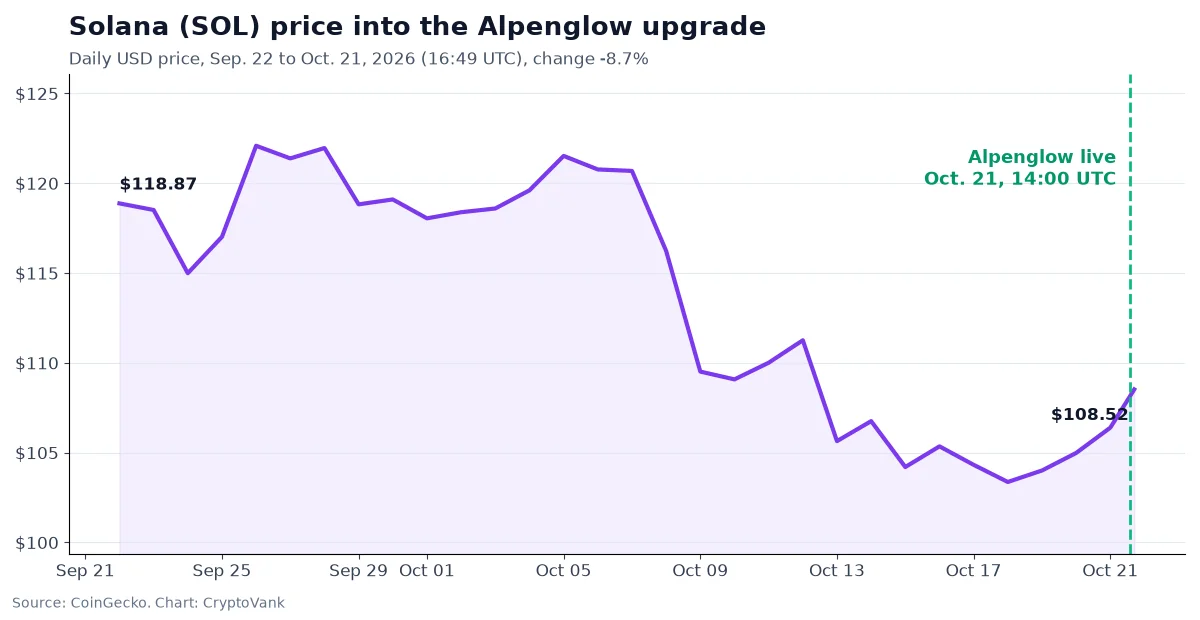
Over 30 days, SOL is still down 8.7%. Upgrades like this tend to show up in usage before price. In addition, Solana treasury firms have been selling, as our report on the SkyAI treasury exit showed this week.
What should Solana users watch next?
First, stability. The test network was wiped and restarted six times since early May, and one migration attempt failed and was rolled back, according to a Galaxy Digital post cited by CoinDesk. The coming days will show whether mainnet stays smooth under real load.
Second, measured finality. Anza’s 150-millisecond figure is a target. Watch for independent data from explorers and exchanges that shorten their deposit wait times.
Third, the follow-up upgrades. Anza listed Rotor, which changes how block data spreads, plus location-aware leader rotation. It also described Quantumglow, a research design that swaps in hash-based signatures for post-quantum security. None of these has a release date yet.
Finally, block capacity. Jump Crypto’s Firedancer team has proposed removing Solana’s 60 million compute-unit block limit after Alpenglow, The Block noted. That proposal, SIMD-0370, would let capacity grow with validator hardware.
Solana finality FAQ
Do SOL holders need to do anything after Alpenglow?
No. Alpenglow changes how validators reach agreement. Wallets, tokens and balances carry over as before, and users do not need to move or claim anything.
How fast is Solana finality now?
Anza says transactions become irreversible in about 150 milliseconds after the Oct. 21, 2026 upgrade, down from roughly 12.8 seconds under TowerBFT. Real-world figures will depend on network conditions.
Why will Solana’s transaction count drop?
Validator votes used to be recorded on-chain as regular transactions. Alpenglow moves voting off-chain into certificates, so reported transaction counts fall even if user activity stays the same.
Not financial advice. Crypto prices are volatile; always do your own research.
Sources
- Anza via PR Newswire: Alpenglow is live on Solana (Oct. 21, 2026)
- The Block: Anza’s Alpenglow goes live on Solana, cutting finality to 150 milliseconds
- CoinDesk: Solana’s Alpenglow, its biggest network overhaul since 2020, goes live Wednesday
- Anza: Alpenglow status page
- Solana: Alpenglow upgrade page
- CoinGecko: Solana (SOL) price