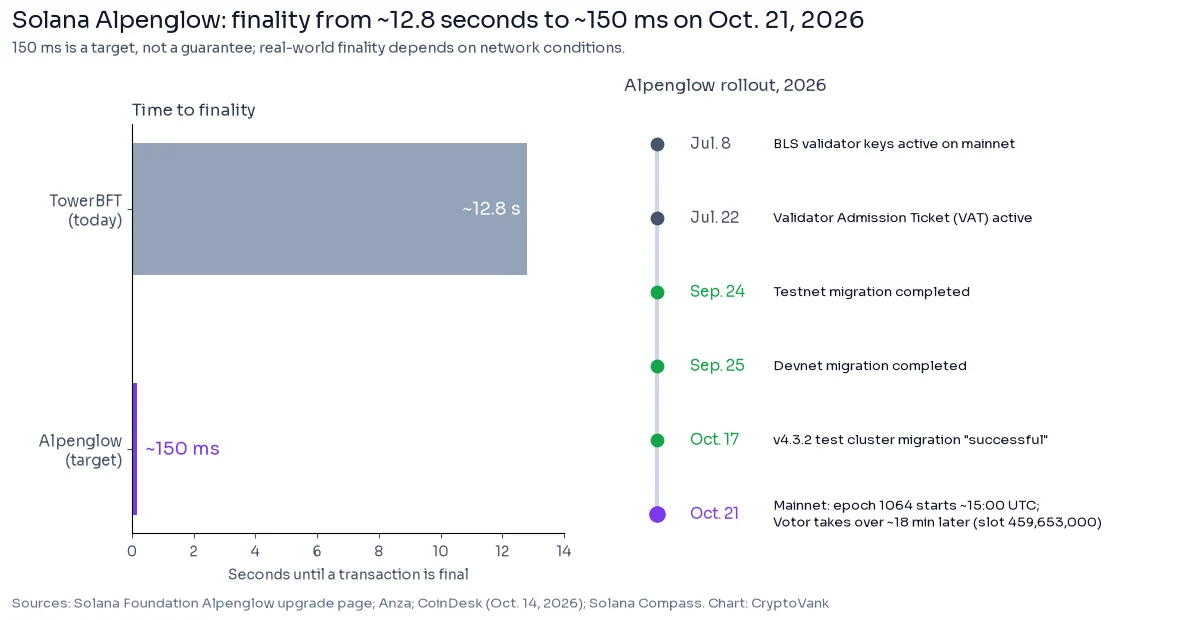
Quick answer: Solana Alpenglow activates on mainnet in epoch 1064, which starts Wednesday, Oct. 21, 2026, at about 15:00 UTC, per the Solana Foundation. It replaces TowerBFT and targets transaction finality of roughly 150 milliseconds, down from about 12.8 seconds. Wallet users don’t need to do anything.
Solana Alpenglow, the biggest change to the network’s core since its 2020 launch, is two days away. The upgrade activates on mainnet in epoch 1064, which starts on Wednesday, Oct. 21, 2026, at approximately 15:00 UTC, according to the Solana Foundation’s Alpenglow page. It retires TowerBFT and aims to make transactions irreversible in about 150 milliseconds instead of roughly 12.8 seconds.
The final rehearsal is done. Anza CEO Brennan Watt posted on Oct. 17 that the v4.3.2 test cluster migration was successful and “all systems go” for mainnet.
When exactly does Solana Alpenglow go live?
The feature gate flips at the start of epoch 1064, around 15:00 UTC on Oct. 21. However, the switch is not instant. The network keeps running TowerBFT for the first 5,000 slots, about 18 minutes, and Alpenglow consensus takes over at slot 459,653,000, per the Foundation.
Epoch start times drift with slot timing, so the Foundation tells operators to track the epoch, not the clock. Anza’s own post gave “~14:50 UTC”. Solana Compass estimates the handoff itself will land between roughly 15:10 and 15:30 UTC.
During the handoff, blocks briefly carry only validator votes. Anza expects the final step to take “hundreds of milliseconds”, so user transactions should only pause for a moment.
What does Alpenglow change on Solana?
Today, validators vote by sending transactions, and a block is final once enough votes stack up over 32 slots. Alpenglow’s voting protocol, Votor, has validators send votes directly to each other and bundle them into certificates. As a result, a block is final after one or two voting rounds.
Execution does not change. The Solana Virtual Machine, transaction formats, programs and fees stay the same, the Foundation says. Moreover, the design tolerates 20% of stake acting maliciously plus another 20% offline.
The second phase, Rotor, will replace Turbine, the system that spreads block data. It is not yet scheduled.
Do SOL holders need to do anything?
No. The Foundation says wallets and apps “keep working exactly as they do today.” Nothing about signing or sending a transaction changes. In practice, a merchant or a bridge waiting for a payment to be final could act much sooner, CoinDesk noted.
Validators face two hard rules before epoch 1064. First, they must run an Agave-based client (Agave, Jito-Solana or Harmonic Salsa) built on Agave 4.3.0. Firedancer and Frankendancer are not supported during the migration. Second, they must hold at least 0.8 SOL in their vote account for the Validator Admission Ticket. It replaces the roughly 1 SOL per epoch that validators pay in vote fees today.
Why will Solana’s transaction count suddenly drop?
Vote transactions leave blocks at activation. Votes averaged about 3,060 per second from Oct. 10 to 12, against about 1,780 user transactions per second, per Solana Compass. That makes votes about 63% of the total.
So dashboards that count every transaction will show a sharp fall on Oct. 21. That is an accounting change, not a drop in real usage. Watch user transactions and failed-transaction rates instead.
What could go wrong, and what does it mean for the SOL price?
The genesis certificate needs 82% of stake to sign. On Oct. 13, validators labelled as Firedancer-family clients held about 15.8% of stake among the top 500, Solana Compass found. If none of them took part, roughly 84% would remain, just above the bar. Many operators have likely switched since then, though. If the certificate doesn’t form at once, validators keep producing vote-only blocks until it does.
Meanwhile, the market is muted. SOL traded at $105.82 on Oct. 19, 2026, at 04:51 UTC, per CoinGecko, down about 13% from $121.52 on Oct. 5. Track it live on our Solana price page. Big upgrades don’t guarantee a rally, and traders often “sell the news”. The real test is whether finality holds near 150ms under load after Oct. 21.
For more Solana DeFi context, see our coverage of Jupiter’s 1,000x YOLO launch and Pump.fun perps on Hyperliquid.
Not financial advice. Crypto is volatile; do your own research (DYOR) before you trade.
Solana Alpenglow FAQ
What time does Solana Alpenglow go live?
Alpenglow activates at the start of Solana epoch 1064, around 15:00 UTC on Wednesday, Oct. 21, 2026, per the Solana Foundation. Consensus switches from TowerBFT to Alpenglow about 18 minutes later, at slot 459,653,000.
Is Alpenglow a hard fork for Solana users?
It is a breaking change for validators and data indexers, but not for users. The Solana Foundation says wallets, apps, signing and fees work as they do today, so SOL holders don’t need to move funds or update anything.
How fast is Solana finality after Alpenglow?
The target is about 150 milliseconds, down from roughly 12.8 seconds under TowerBFT. The Solana Foundation calls 150ms “an expectation, not a constant”, since real performance depends on network conditions and stake distribution.
Why can’t Firedancer validators run during the migration?
The Solana Foundation says Firedancer and Frankendancer are not supported during the switch, so operators must run an Agave 4.3-based client such as Agave, Jito-Solana or Harmonic Salsa for epoch 1064.